

More news on this day
Hundreds of travelers across Asia faced another day of turmoil as 1,666 flights were delayed and 188 cancelled at major hubs including Chengdu Tianfu, Jakarta Soekarno Hatta, Kunming Changshui, Bangkok Suvarnabhumi, and Kuala Lumpur, adding fresh strain to an already fragile global air travel network.
Get the latest news straight to your inbox!
Major Asian Hubs Grapple With Severe Schedule Disruptions
Publicly available aviation data for early April 2026 indicate that a cluster of large airports in mainland China and Southeast Asia has become the latest epicenter of global flight disruption. Chengdu Tianfu, Kunming Changshui, Bangkok Suvarnabhumi, Jakarta Soekarno Hatta, and Kuala Lumpur International have all reported elevated levels of delays and cancellations, contributing to a combined total of 1,666 delayed flights and 188 cancellations across the region.
These hubs serve as critical connectors between domestic Chinese routes, intra-ASEAN traffic, and long haul services to Europe, the Middle East, and North America. When operations falter at multiple nodes simultaneously, late arriving aircraft and displaced crews quickly cascade through airline schedules, leaving passengers stranded far from their final destinations.
Reports from regional outlets and aviation tracking platforms show irregular operations building on top of earlier disruptions recorded in other Asian markets over the past several weeks. The latest figures suggest that April is continuing a pattern seen in March, when Asia Pacific airports experienced repeated waves of mass delays and cancellations tied to weather, geopolitical tensions, and infrastructure constraints.
While the headline numbers for delays and cancellations vary by day, the volume reported across these key hubs places them among the most affected in the current disruption cycle, highlighting how vulnerable busy airports are when several stress factors emerge at once.
Weather, Congestion and Network Strain Drive the Chaos
The causes of the latest disruption stretch beyond a single incident. In Indonesia, Jakarta’s Soekarno Hatta has contended with episodes of heavy rain and wind shear strong enough to trigger temporary diversions and ground handling limitations, according to recent Indonesian news coverage. Short suspensions of arrivals and departures can rapidly create backlogs as aircraft stack up in holding patterns or divert to alternate fields.
In mainland China, Kunming Changshui and Chengdu Tianfu sit at the crossroads of dense domestic networks that have expanded rapidly as travel demand recovered. Aviation bulletins and capacity reports show these airports handling high volumes of traffic, which leaves little room to absorb operational shocks. When a storm cell, runway inspection, or air traffic flow restriction slows departures, subsequent rotations across multiple cities are pushed back, inflating delay statistics even if local weather has improved.
Bangkok Suvarnabhumi and Kuala Lumpur International face similar pressures as regional hubs that depend on tight turnarounds and complex banked schedules. Published analyses of recent Asia disruptions note that delays originating in North Asia or the Middle East often arrive in Southeast Asia several hours later in the form of late inbound aircraft, forcing airlines either to compress ground times or accept rolling delays and occasional cancellations.
Compounding these factors is the broader context of Asia’s air travel rebound. Industry data show that many airports in the region are operating near or above pre pandemic volumes, even as staffing, ground services, and maintenance capacity have not always scaled at the same pace. The result is a system where relatively routine problems in one location can spill across borders in a matter of hours.
Passengers Confront Long Queues, Missed Connections and Overnight Stays
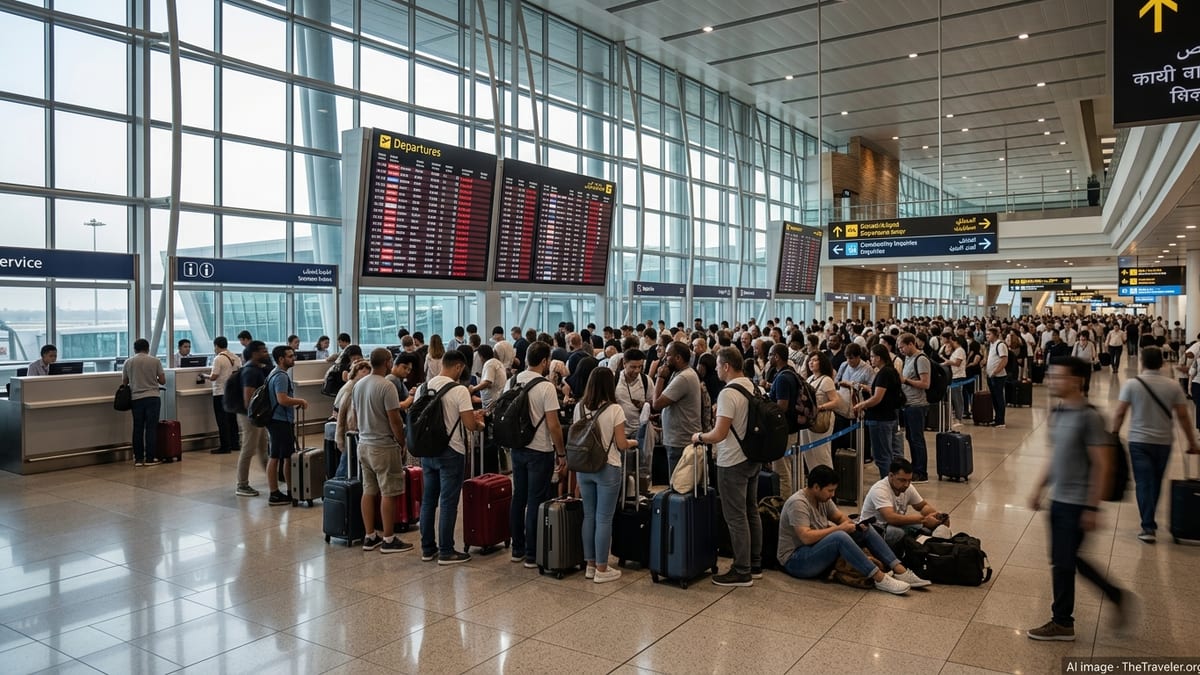
For travelers on the ground, the statistics translate into long waits at departure gates, protracted immigration queues, and hastily arranged overnight stays. Social media posts and local news photography from the affected airports in recent days show crowded check in halls and departure lounges, with families and business travelers seated on the floor as they wait for revised departure times.
At transfer oriented hubs such as Bangkok Suvarnabhumi and Kuala Lumpur International, missed connections have emerged as a particular pain point. When a flight arrives several hours behind schedule from Chengdu or Kunming, onward passengers to European or regional destinations may find that their connecting service has already departed, forcing rebooking onto later flights that are themselves heavily loaded at the start of a peak travel season.
In Jakarta and Chengdu, reports indicate that some passengers have been provided with hotel accommodation or rebooked on alternative carriers, while others have chosen to purchase new tickets to avoid further delays. For travelers on tight itineraries or those heading to time sensitive events, the disruption has meant abandoned trips or significantly curtailed stays.
Consumer groups and travel advisors observing the situation have reiterated long standing recommendations for longer connection windows in Asia and the importance of flexible bookings. With irregular operations now recurring across multiple weeks, the traditional assumption that a one or two hour layover is sufficient at busy regional hubs is coming under renewed scrutiny.
Ripple Effects Spread Beyond Asia
Although the latest wave of disruptions is concentrated in Asian airports, the effects are not confined to the region. Long haul services linking these hubs to Europe, the Middle East, Australia and North America rely on aircraft and crews that rotate through multiple time zones each week. When a narrowbody or widebody arrives late into Bangkok or Kuala Lumpur due to upstream delays in Chengdu or Jakarta, the subsequent outbound sector to another continent may depart significantly behind schedule or face operational cancellation.
Recent reporting on flight disruption patterns in Europe and the Middle East has already highlighted how airspace constraints and reroutings are lengthening block times and tightening schedules. The addition of fresh irregularities in Asia increases the risk that aircraft will not be in the right place at the right time, amplifying strain on carriers that were already operating with limited spare capacity.
Travel industry analyses suggest that global airlines are seeking to protect key long haul departures whenever possible, pushing more of the disruption onto short haul or regional sectors. This approach can help preserve connectivity on flagship routes but may worsen conditions for passengers using feeder flights to reach major intercontinental gateways.
For airports, sustained disruption carries commercial as well as operational consequences, including pressure on concession revenues when passengers avoid nonessential purchases during uncertain waits, and added costs associated with managing crowds, additional staffing, and irregular operations support.
What Travelers Can Expect in the Coming Days
With weather systems still active over parts of Southeast Asia and operational constraints unresolved at several hubs, aviation data providers and travel analysts expect continued irregularities in the short term. While the volume of delays and cancellations may fluctuate from day to day, the underlying issues of congestion, tight crew scheduling, and knock on effects from other regions remain in place.
Passengers booked to travel through Chengdu Tianfu, Kunming Changshui, Jakarta Soekarno Hatta, Bangkok Suvarnabhumi, Kuala Lumpur International, and other busy Asian airports are being advised in public guidance to monitor flight status closely and allow additional time for check in and security. Where possible, same day high risk connections are being reconsidered in favor of longer layovers or overnight stops.
Industry observers note that airlines and airports are gradually clearing backlogs as aircraft return to regular rotations, but warn that any new weather front, technical problem, or airspace restriction could trigger another spike in disruption. In that environment, flexible tickets, comprehensive travel insurance, and realistic expectations about journey times are likely to be as important as ever for those planning trips across Asia in the coming weeks.
For now, the figures of 1,666 delayed flights and 188 cancellations across some of the region’s busiest airports underscore how even a partial breakdown in schedule integrity can leave hundreds of passengers stranded and reverberate far beyond Asia’s borders.