

More news on this day
Passengers across Asia are facing widespread disruption as 65 flights were cancelled and 651 delayed at Shenzhen Bao’an, Jakarta–Soekarno-Hatta and Beijing Daxing International Airports, snarling schedules and stranding travelers at three of the region’s busiest hubs.
Get the latest news straight to your inbox!
Major Asian Hubs Buckle Under Operational Strain
Publicly available flight tracking data and regional aviation reports indicate that Shenzhen Bao’an in southern China, Jakarta–Soekarno-Hatta in Indonesia and Beijing Daxing in northern China have emerged as focal points of a fresh wave of disruption affecting Asian air travel. While other airports in China, Japan, South Korea and India are also reporting irregular operations, the combination of cancellations and extensive delays at these three hubs is having an outsized impact on regional connectivity.
At Shenzhen Bao’an, which serves as a key gateway to the Pearl River Delta manufacturing belt, dozens of flights have been pushed back well beyond scheduled departure times as congestion builds in already crowded airspace. Similar patterns are being reported at Beijing Daxing, China’s newest large-scale international airport, where domestic and regional services have been affected by a mixture of weather, traffic management restrictions and knock-on operational challenges.
Jakarta–Soekarno-Hatta, Indonesia’s primary international gateway, has also seen a spike in late departures and arrivals. The airport is a central transfer point for passengers traveling between Southeast Asia, Australia and the Middle East, meaning disruptions there can quickly ripple into other regions. Combined, the three airports have registered 65 cancellations and 651 delays over a short period, resulting in missed connections and extended waits for thousands of passengers.
Travel and aviation outlets tracking day-of-operations performance report that the disruptions are not isolated to any single carrier or route, but instead reflect systemic strain across networks that are operating close to capacity during a busy travel period.
Weather, Airspace Limits and Capacity Bottlenecks Converge
Meteorological conditions appear to be a key factor behind the latest wave of disruptions. Southern China has been affected by thunderstorms, fog and low visibility that hamper ground operations and limit the use of certain runway configurations, according to regional weather bulletins and airport status summaries. When conditions deteriorate around Shenzhen, air traffic control typically reduces the rate at which aircraft can take off and land, creating queues that quickly cascade into delays.
In northern China, Beijing Daxing has experienced its own combination of adverse weather and heavy traffic. Aviation industry coverage notes that the airport has been handling robust domestic demand while also acting as a growing hub for connecting traffic. When storms or low ceilings affect either Daxing or nearby Beijing Capital, controllers often need to redistribute airspace and runway usage, which can slow operations at both airports.
In Jakarta, Soekarno-Hatta’s longstanding capacity constraints continue to challenge reliability. Publicly available information highlights that the airport has been operating near or above its designed passenger capacity in recent years, even after infrastructure enhancements. Under such conditions, any disruption, including seasonal storms common across the Java Sea, can have a magnified effect on flight schedules.
Industry analysts cited in recent regional coverage point to the interaction of these factors with lingering staffing and fleet deployment imbalances at some airlines. After years of demand volatility, carriers and airports are still calibrating crew rosters, maintenance windows and aircraft rotations, leaving less margin to absorb sudden shocks to the system.
Knock-on Effects Across Asian and Long-haul Networks
The disruption at Shenzhen, Jakarta and Beijing Daxing is reverberating well beyond local departure boards. Because all three airports function as important transfer points, delays and cancellations are feeding into wider networks across Asia and on selected intercontinental routes.
Shenzhen Bao’an serves as a hub for several Chinese carriers operating dense domestic schedules that feed into regional connections. When flights depart late from Shenzhen, onward services to cities across China, Northeast Asia and Southeast Asia can be forced to wait for inbound passengers and aircraft, propagating delays throughout the day. Coverage from travel industry outlets has described Shenzhen as one of the most disrupted Chinese hubs in recent days, with hundreds of delayed movements recorded during previous disruption spikes.
Beijing Daxing, designed as a major international and domestic gateway, is similarly central to Chinese network planning. Published reports on recent operational performance at Daxing describe a pattern of significant delay pressure relative to total flight volumes, with a notable share of departures leaving behind schedule. This has implications not only for domestic travelers, but also for passengers connecting from Daxing onto flights bound for other Asian capitals.
At Jakarta–Soekarno-Hatta, delays can quickly complicate itineraries that involve onward connections to destinations in Australia, the Middle East and Europe. Travel news coverage has highlighted how even relatively modest numbers of cancellations at a busy transfer hub can lead to missed long-haul flights, overnight stays and rebookings as airlines seek to reposition aircraft and crews.
Travellers Confront Long Waits and Uncertain Timelines
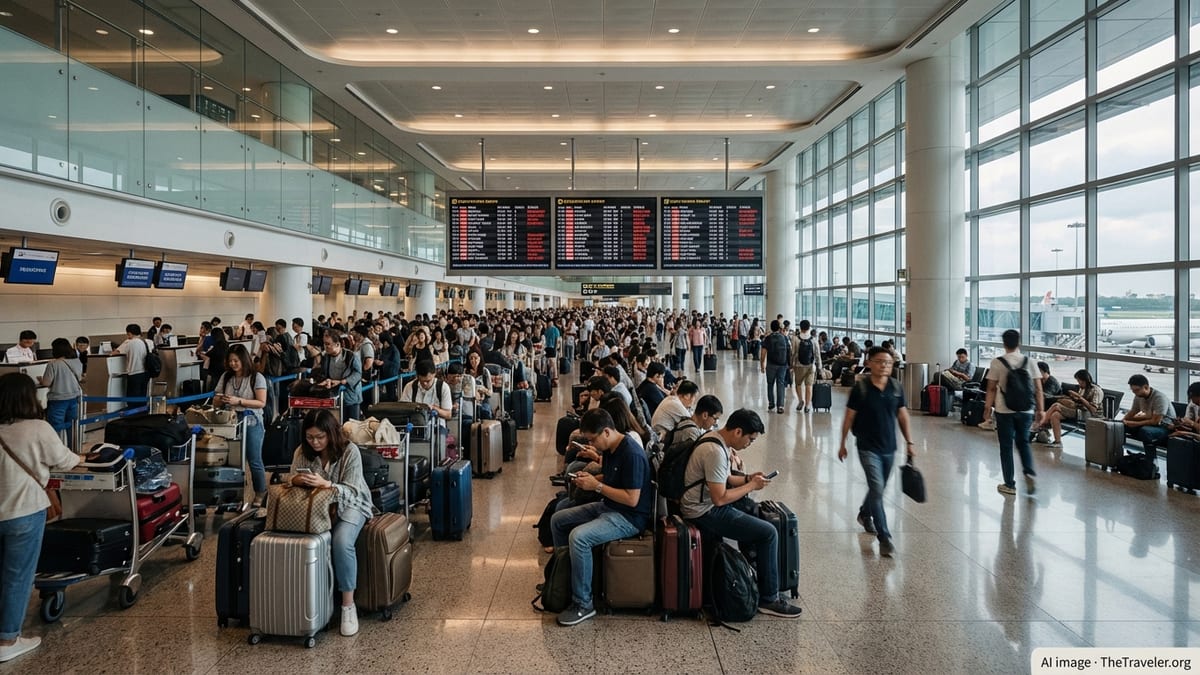
For passengers on the ground, the statistics translate into long waits in terminals, lengthening queues at customer service counters and ongoing uncertainty about when flights will depart. Social media posts and local media coverage from China and Indonesia show crowded check-in halls, passengers resting on terminal floors and departure boards dominated by red and yellow delay markers.
According to publicly available airline and airport guidance, travellers whose flights are cancelled may be offered rebooking on later services, refunds, or vouchers in line with individual carrier policies and applicable local regulations. However, limited spare capacity on popular routes can mean that affected passengers face multi-day waits for available seats during peak periods, especially when simultaneous weather events or airspace restrictions affect multiple hubs.
Travel advisories from industry publications suggest that passengers check their flight status frequently through official airline channels, arrive at the airport earlier than usual, and build additional buffer time into connections, particularly when transiting through affected hubs such as Shenzhen, Beijing or Jakarta. Travel insurance, where available, may offer partial compensation for additional accommodation or rebooking costs, depending on policy terms.
Consumer advocates quoted in regional reporting emphasize that travellers should keep documentation of delays or cancellations, including screenshots of updated departure times and any written notices from airlines, to support potential claims with insurers or credit card companies.
Outlook for Operations in the Coming Days
With weather patterns in parts of East and Southeast Asia remaining unsettled, and airports like Shenzhen Bao’an, Beijing Daxing and Soekarno-Hatta already operating near capacity, aviation analysts expect that operational volatility could persist in the short term. While airlines are working to restore schedules after each wave of disruption, recovery can take several days as aircraft and crews return to their planned rotations.
Travel and aviation news outlets report that some carriers are adjusting schedules, consolidating lightly booked flights or temporarily reducing frequencies on select routes in an effort to build resilience into operations. Such measures can help reduce last-minute cancellations but may also limit seat availability for travelers seeking to rebook.
Passengers planning to transit through the affected airports are being advised by travel industry sources to monitor conditions closely, consider booking longer layovers to protect connections, and remain flexible in case of last-minute changes. For many travellers, the latest round of cancellations and delays underscores how quickly local operational challenges at a handful of major hubs can scale into a region-wide disruption across Asia’s tightly interconnected air transport network.