

More news on this day
Thousands of passengers have been left stranded across Asia after more than 60 flights were cancelled in rapid succession, disrupting travel through key hubs in Indonesia, Malaysia, Laos and Hong Kong and rippling out to long-haul routes serving Singapore, Vancouver and other major international gateways.
Fresh Wave of Cancellations Hits Regional Hubs
The latest data from multiple Asian airports on February 27 and 28 indicates a sharp escalation in operational strain, with cancellations concentrated in Indonesia and Malaysia but felt across the wider network. Airlines including Malaysia Airlines, AirAsia and Batik Air have cut services on short-notice, while additional international carriers have trimmed or scrubbed departures on routes linking Asia to North America and other long-haul markets.
Jakarta Soekarno-Hatta and Kuala Lumpur International emerged as the primary flashpoints, recording the highest combination of cancellations and delays over the two-day period. Disruptions radiated out to routes connecting these hubs with Singapore, Hong Kong and secondary Southeast Asian cities, compounding earlier schedule instability reported this week across China, Japan and Thailand.
The cancellation tally across the region now exceeds 60 flights when combined with closely related disruptions logged since February 27. While many services operated with delays, the outright loss of dozens of departures has left aircraft, crew and passengers badly out of position, forcing airlines into rolling schedule adjustments.
Operational data and airport departure boards point to a mix of contributing factors, from severe weather and air-traffic flow restrictions in parts of China, Malaysia and Indonesia to wider capacity and crew-availability pressures across already stretched regional carriers.
Indonesia and Malaysia Bear the Brunt
Indonesia remains at the center of the current disruption, with Jakarta and other key airports such as Makassar and Bali reporting some of the highest cancellation counts. Domestic trunk routes linking Jakarta with Makassar, Lombok, Yogyakarta and Medan have seen repeated cancellations by Batik Air and other local operators, squeezing capacity on corridors that typically rely on high-frequency service.
At the same time, Malaysian airspace and airports have faced their own wave of disruption. Kuala Lumpur International has reported a surge in delays alongside a growing list of cancelled departures, many of them on AirAsia-operated regional routes to destinations such as Kota Kinabalu, Langkawi and nearby Southeast Asian cities. Malaysia Airlines has also been forced to rework its schedule, including adjustments on key international services, as it navigates both operational constraints and evolving airspace advisories on some long-haul routes.
These cuts have immediate knock-on effects for passengers with onward connections. Travellers heading from Indonesian and Malaysian secondary cities into major hubs before continuing to Singapore, Hong Kong or beyond are finding that a single cancellation early in the journey can unravel entire itineraries, with limited spare capacity available for same-day rebooking.
The strain is especially acute at peak periods, when leisure travellers, migrant workers and business passengers all compete for remaining seats. Airport terminals in Jakarta and Kuala Lumpur have reported long queues at airline counters as travellers seek rerouting options or refunds.
Laos and Hong Kong Link Regional Turbulence to Long-Haul Routes
Beyond the big Southeast Asian hubs, a smaller but strategically important cluster of cancellations has been recorded in Laos and Hong Kong, underlining how regional volatility can quickly spill into intercontinental traffic. Wattay International Airport in Vientiane has seen flights scrubbed on links to Changsha and domestic destinations, cutting already limited connectivity and leaving travelers with few immediate alternatives.
In Hong Kong, cancellations on widebody services to Vancouver and other long-haul points have raised particular concern among transpacific passengers. When paired with regional cuts at neighboring hubs, even a single lost departure on a long-range route can cascade into missed connections, overnight stays and rebookings days into the future.
Air Canada and other international carriers operating between Asia and North America have been monitoring shifting conditions closely, with some services delayed, consolidated or cancelled outright as airlines adjust aircraft rotations and crew schedules. For passengers, that has meant abrupt changes to itineraries that once relied on tightly timed connections through Hong Kong, Singapore or Southeast Asian secondary hubs.
Industry analysts note that long-haul disruptions are especially painful because spare widebody capacity remains constrained. When a flight to Vancouver or another transpacific gateway is cancelled, re-accommodating hundreds of passengers at short notice often requires complex interline cooperation or extended stopovers.
Weather, Airspace Concerns and Operational Strain Converge
Behind the headline cancellation numbers lies a convergence of pressures that have been building across Asia’s aviation system over several days. Severe weather, including bands of heavy rain, low cloud and unstable winds, has swept across parts of China, Malaysia and Indonesia, prompting air-traffic control to slow arrival and departure rates and forcing airlines to ground aircraft temporarily for safety checks.
At the same time, airlines are contending with route-specific airspace advisories and tactical diversions that complicate flight planning and crew rostering. Malaysia Airlines and other regional carriers have already adjusted some long-haul flight paths in response to evolving risk assessments, and further changes remain possible as authorities update guidance.
Operationally, the combined effect has been to stretch airline resources thin. Aircraft and crews are frequently ending up in the wrong place at the wrong time, leading to knock-on cancellations even on routes unaffected by the original weather or airspace constraints. Carriers such as AirAsia and Batik Air, which depend on tight turnaround times and high aircraft utilization, are particularly exposed when disruption persists across multiple days and airports.
Aviation planners warn that Asia’s dense network of short-haul and medium-haul routes can amplify even modest disruptions. A missed slot in Jakarta or Kuala Lumpur can reverberate through connecting flights to Singapore, Hong Kong and onward long-haul services, effectively exporting delays and cancellations across the region.
Passengers Face Long Queues, Uncertain Timelines
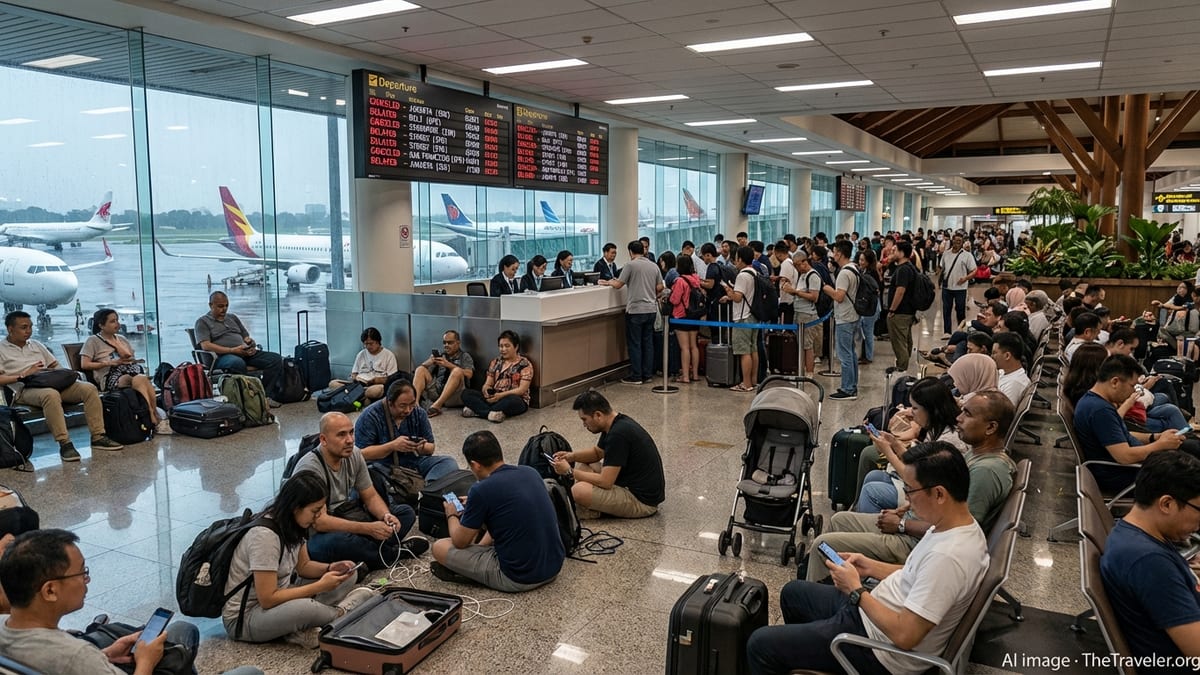
For travelers on the ground, the statistics translate into long waits, crowded terminals and uncertain timelines. Scenes from major airports show passengers camping out near departure gates and check-in halls, with departure boards dominated by red ink and rolling estimated departure times.
Many stranded passengers report difficulty reaching airline call centers or securing prompt rebooking options, particularly where cancellations affect the last daily service on a route or a heavily booked long-haul connection. Families returning from holidays and business travelers heading to time-sensitive meetings alike have been caught in the disruption, with some facing multiple reissued boarding passes in a single day.
Airlines are urging customers to monitor flight-status tools closely, update their contact details in booking profiles and allow additional time at the airport in case of last-minute gate or timing changes. Where possible, carriers are consolidating passengers onto remaining flights and relaxing change penalties, but limited spare capacity on popular routes means not all travelers can be accommodated immediately.
Airport authorities in Jakarta, Kuala Lumpur, Singapore and Hong Kong have deployed extra staff to manage queues and assist with wayfinding, while reminding passengers that safety-driven decisions to cancel or delay flights take precedence over schedule reliability in periods of severe operational stress.
What Travelers Should Expect Next
With weather systems still lingering over sections of East and Southeast Asia and airlines working through aircraft and crew backlogs, further short-notice cancellations and delays are possible in the coming days. Industry sources suggest that schedules may remain fragile through the weekend as carriers reset rotations and rebuild time buffers into busy routes.
Passengers booked on flights to or from Jakarta, Kuala Lumpur, Singapore, Hong Kong and other key Asian hubs are being advised to check their booking status repeatedly in the 24 hours before departure and to prepare for the possibility of overnight holds or rerouting via alternative gateways. Those with tight same-day connections, particularly onto long-haul services to North America and Europe, may wish to explore earlier feeder flights or more flexible itineraries.
Travel agents and corporate travel managers across the region report heavy demand for real-time updates and alternative routings, as businesses attempt to keep essential travel moving despite the disruption. Leisure travelers, meanwhile, are weighing whether to push ahead with existing plans or delay trips until operations stabilize.
While airlines insist that safety remains paramount and that crews are working to restore normal operations as quickly as possible, the latest wave of more than 60 cancellations underlines how vulnerable Asia’s tightly interconnected air network remains to weather shocks, airspace constraints and operational bottlenecks that can emerge with little warning.