

More news on this day
Thousands of passengers were left stranded today across Asia and the Middle East as airports in Japan, Singapore, the United Arab Emirates, Iran, China, India, Indonesia and the Philippines reported 2,588 delayed flights and 65 cancellations, disrupting operations for carriers including Emirates, Batik Air, Singapore Airlines, Japan Airlines, Air China, Air India and several regional airlines.
Major Hubs Buckle Under Mounting Operational Strain
Fresh data compiled from airport boards and aviation analytics platforms on February 19, 2026, point to an exceptionally disruptive day for air travel across some of Asia’s busiest hubs. While the region has seen several recent spikes in delays, today’s tally of 2,588 delayed flights and 65 outright cancellations across multiple countries stands out for its geographic breadth and the number of major international carriers affected.
Jakarta, Tokyo, Dubai and Beijing were among the most disrupted airports, with congestion quickly cascading into secondary hubs across India, Indonesia and the Philippines. At several locations, on-time performance fell sharply during the morning peak and never fully recovered, as ground handling teams, air traffic controllers and airline operations centers struggled to absorb rolling knock-on effects from earlier delays.
The disruption follows a pattern that has emerged over recent weeks in Asia’s aviation network, where even single-day surges in delays have exposed how finely balanced airline schedules have become amid surging post-pandemic demand. Industry analysts note that previous spikes this winter, some involving more than 3,000 delays in a single day across Asia and the Middle East, have already tested infrastructure and staffing at major hubs, leaving little margin to recover when fresh bottlenecks appear.
For passengers, the abstract statistics translated into hours spent in crowded terminals, missed connections and hastily rearranged itineraries. Long queues formed at transfer counters in Dubai, Tokyo and Singapore in particular, with many long-haul travelers forced into overnight stays after missing onward connections to Europe, North America and Australasia.
Jakarta, Tokyo and Beijing See Wave of Prolonged Delays
In Southeast Asia, Jakarta’s Soekarno Hatta International Airport once again emerged as one of the day’s key pressure points. The Indonesian capital, already known for its congested airspace and stretched runway capacity, saw a wave of morning delays ripple into afternoon and evening banks of flights, with Batik Air, Lion Air and several regional partners experiencing turnaround times far beyond their scheduled windows.
Tokyo’s twin airports, Haneda and Narita, also reported high concentrations of delayed services, affecting Japan Airlines as well as other Asia-Pacific and European carriers that rely on Japan as a crucial connecting point. While outright cancellations remained limited in Tokyo, extended departure holds contributed to tight connection windows collapsing for transit passengers bound for North America and Southeast Asia, forcing widespread rebooking.
Further north, Beijing’s main international gateways experienced yet another day of severe schedule strain. Recent weeks have already seen Chinese hubs record large numbers of delays as winter weather, traffic congestion and capacity constraints converged. Today’s figures fit that pattern, with Air China and other domestic carriers forced to manage rolling gate changes and late arrivals while trying to keep key trunk routes operating.
Aviation observers note that Beijing and other major Chinese airports have endured several disruption spikes this month, many linked to a combination of adverse weather and traffic saturation. Today’s disturbances underscored how quickly conditions at those hubs can deteriorate when flight volumes surge and there is limited slack in ground handling and air traffic control resources.
Dubai, Singapore and Gulf–Asia Connectors Feel the Squeeze
In the Gulf, Dubai International Airport once again found itself at the center of a complex web of disruptions stretching across Asia and Europe. Emirates, one of the day’s most affected carriers, had to contend with both late inbound flights from Asia and knock-on effects for its tightly choreographed connection banks serving Africa, Europe and the Americas. Even modest schedule slips at Asian origin airports quickly translated into missed connection windows in Dubai for long-haul travelers.
Industry data from earlier this month has already shown how quickly Middle Eastern hubs can accumulate more than a thousand delays in a single day when security tensions, airspace restrictions or weather issues arise in neighboring regions. Today’s figures, while slightly lower than the worst recent spikes, again highlighted the vulnerability of long-haul networks that depend on synchronized arrivals from multiple Asian origins in narrow time windows.
Singapore’s Changi Airport also faced serious operational headwinds. As a premier Southeast Asian super-hub, Changi handles enormous volumes of connecting traffic, and delays affecting Singapore Airlines, its low-cost subsidiary Scoot and partner airlines spread swiftly across regional and long-haul routes. Airport data indicated a heavy concentration of delays on intra-Asian services, particularly those linking Singapore to Indonesia and the Philippines, with onward disruption for passengers traveling to Australia and Europe.
For travelers passing through Gulf and Southeast Asian hubs, the day reinforced a reality that has become more evident through the winter peak: schedules remain brittle, and a disturbance at one end of the network often surfaces hours later in a completely different region as connection banks unravel and aircraft rotations fall out of sync.
India, Indonesia and the Philippines Grapple With Domestic Knock-On Effects
While much of the attention focused on large international hubs, domestic networks in India, Indonesia and the Philippines also absorbed significant stress. In India, major gateways including Delhi, Mumbai and Bengaluru reported clusters of delays affecting both national carriers such as Air India and a range of private airlines. Some of the day’s disruptions were linked to inbound delays from the Gulf and East Asia, which then cascaded into domestic rotations.
India’s aviation system has been operating near capacity through much of the winter season, following earlier turbulence that exposed vulnerabilities in crew scheduling and airport infrastructure. Even when the total number of cancellations remains modest, high volumes of late arrivals can create rolling congestion on taxiways and at parking stands, compounding delays for subsequent departures and forcing airlines to reshuffle aircraft assignments.
In Indonesia, a mix of weather-related slowdowns, air traffic congestion and operational bottlenecks around Jakarta and Bali spilled into the broader domestic network. Islanders dependent on flights to reach provincial capitals and medical hubs saw services pushed back by several hours. Batik Air, Garuda Indonesia and other local carriers worked to re-time and consolidate services to maintain essential connectivity, but large numbers of passengers still faced missed connections onward to international flights in Jakarta and Denpasar.
The Philippines experienced similar knock-on effects. Manila’s Ninoy Aquino International Airport and Cebu’s Mactan-Cebu International Airport, both chronically constrained, reported extended departure queues and late arrivals throughout the day. Local carriers struggled to maintain punctuality as aircraft returning late from regional destinations caused delays to the next departure wave, leaving stranded travelers squeezed into already crowded terminals.
Weather, Airspace Restrictions and Crew Limits Combine
A combination of familiar culprits lay behind the day’s disruptions. Periodic winter weather across northern Asia continued to trigger de-icing operations, low-visibility procedures and temporary runway capacity reductions at several airports, particularly in parts of Japan and China. While not extreme by seasonal standards, these measures were enough to slow operations at already busy hubs.
Airspace restrictions in parts of the Middle East and West Asia also contributed to flight reroutings and longer-than-usual track times for services linking Europe and the Gulf to South and East Asia. Even relatively minor rerouting can push aircraft and crew schedules toward regulatory limits on duty hours, forcing airlines to adjust rotations, delay flights or cancel individual sectors to remain compliant.
At the same time, airlines across Asia are still navigating tight crew availability after years of pandemic-related attrition and a rapid rebound in demand. New rules on crew duty times in several jurisdictions have added further complexity to rostering. When weather or airspace issues force extended holding or diversions, crews can quickly “time out,” leaving aircraft on the ground even when airspace and runway conditions have improved.
Collectively, these factors form what aviation experts describe as a fragile equilibrium in which small operational shocks can multiply rapidly. Today’s figures on delays and cancellations underscore that the region’s recovery in passenger numbers has, in many cases, outpaced investment in resilient infrastructure and staffing buffers.
Stranded Passengers Face Crowded Terminals and Limited Options
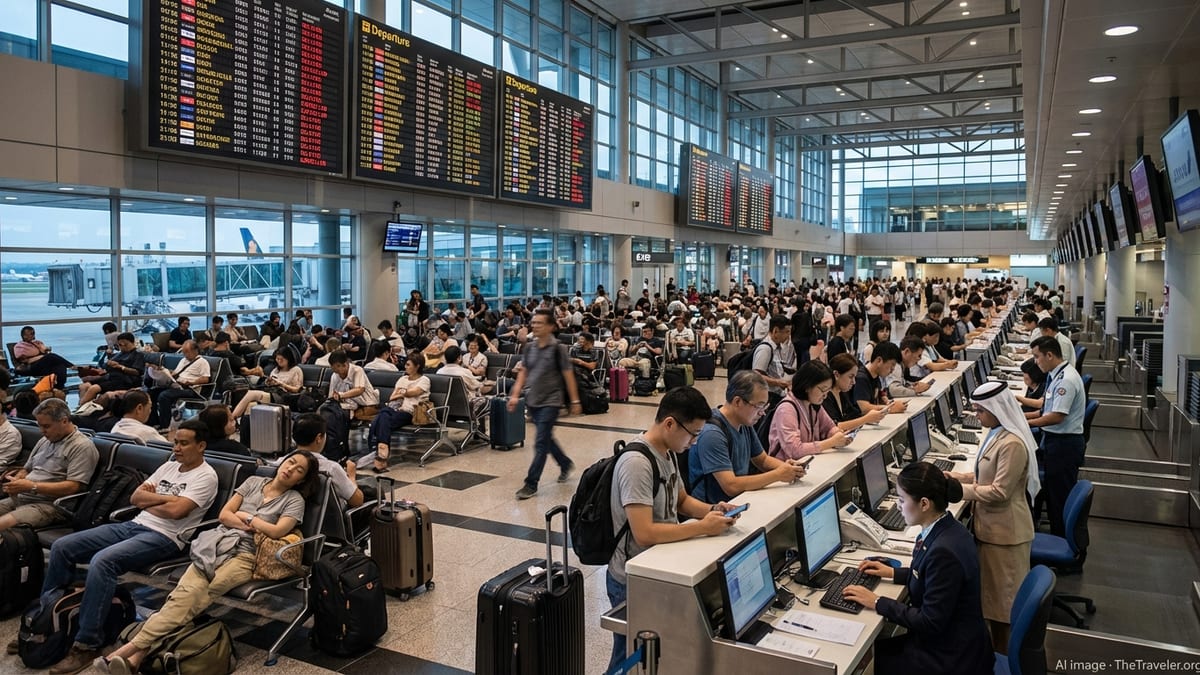
For travelers, the human impact of 2,588 delayed flights and 65 cancellations was most visible in the departure halls and transit zones of major hubs. In Dubai, long lines formed at airline service desks as passengers arriving late from Jakarta, Manila and Delhi tried to rebook missed connections to Europe and North America. Hotel desks at several airports reported brisk business as airlines distributed meal vouchers and overnight accommodation for those unable to travel onward the same day.
In Tokyo and Beijing, large digital boards lit up with rows of delayed departures and arrivals, while airport staff attempted to keep passengers informed via repeated announcements. Families with young children and elderly travelers were among those most acutely affected by long waits, particularly at airports where rest areas and seating were already under strain from high passenger volumes.
Social media feeds filled with images of packed terminals from Jakarta, Singapore and Manila, with some passengers reporting waits of several hours just to speak to an agent. Others described confusion around rebooking options when connecting carriers were not part of the same alliance or ticket, leaving them to negotiate changes with multiple airlines or seek last-minute alternatives at their own expense.
Despite the frustration, there were few reports of serious incidents or confrontations, reflecting both the professionalism of airport staff and a growing public awareness that air travel in the region remains vulnerable to sudden disruption. Still, for travelers with time-sensitive commitments such as business meetings, medical appointments or onward cruises, today’s delays carried significant personal and financial costs.
What Today’s Chaos Signals for Asia’s Peak Travel Months
Analysts warn that the latest wave of disruption is part of a broader pattern that has been building across Asia since late 2025. January has already seen multiple days where more than 6,000 flights were delayed across the region, and early February brought additional spikes as Chinese New Year and other holidays drove up passenger numbers.
Today’s cross-regional disruption, spanning Japan, Southeast Asia, the Gulf and parts of South Asia, suggests that the underlying structural pressures have not yet been resolved. Many major airports are operating at or near pre-pandemic capacity with infrastructure that has not significantly expanded, while airlines are pushing aircraft and crew schedules to maximize revenue during a period of strong demand.
For travelers planning trips through spring and into the northern summer, industry experts recommend building in additional buffers for connections, particularly when itineraries involve multiple carriers or tight transfer windows at congested hubs. While airlines are gradually adding capacity and hiring more staff, the timeline for meaningful improvements in resilience remains uncertain.
Regulators in several countries have signaled that they are reviewing air traffic control staffing levels, airport slot allocations and consumer protection rules in light of repeated disruption events this winter. However, any large-scale infrastructure upgrades at key hubs in Japan, China, India and Southeast Asia will take years to deliver, leaving passengers to navigate a complex and occasionally fragile network in the meantime.