

More news on this day
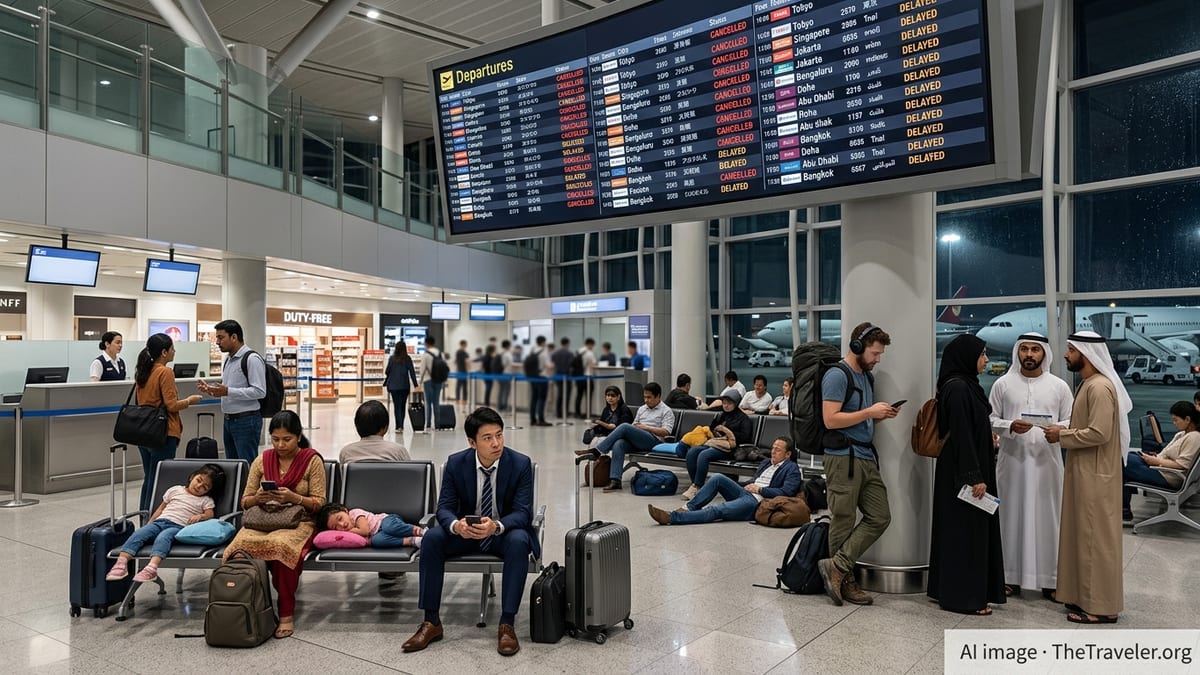
Tens of thousands of travellers have been left stranded or severely delayed across Asia after a fresh wave of disruption led to 2,699 flight delays and 186 cancellations in and out of Thailand, Hong Kong, Singapore, Malaysia, Indonesia and mainland China, heavily impacting services from Cathay Pacific, AirAsia, Singapore Airlines, Air China and other regional carriers.
Get the latest news straight to your inbox!
Chain Reaction Across Asia’s Busiest Gateways
Published data from aviation tracking platforms on 12 April 2026 shows Asia’s major hubs absorbing an intense operational shock, with flight movements slowed or halted at intervals through the day. Airports in Bangkok, Hong Kong, Singapore, Kuala Lumpur, Jakarta, Beijing and other mainland Chinese cities recorded some of the highest disruption levels, with delayed departures and rolling cancellations pushing congestion deep into the evening schedules.
The imbalance between departures and arrivals translated quickly into terminal crowding and bottlenecks at immigration, security and baggage belts. Reports from regional outlets describe long queues snaking through departure halls and passengers camping out near check-in islands as airlines worked through backlogs. With many aircraft and crews out of position, even routes not directly affected by the initial triggers saw delays as carriers attempted to reset their networks.
The disruption has been particularly visible at long-haul gateways in Hong Kong, Singapore and Beijing, where flights feed extensive connection banks. Missed onward connections compounded the strain as travellers from Europe, North America and the Middle East arrived late into Asian hubs only to find their regional links to Thailand, Malaysia or Indonesia already closed or rescheduled.
Operational data shared by industry analysts in recent days indicates that the wave of delays is interacting with already tight schedules across Asia Pacific. After several years of rapid capacity restoration, many airlines are operating near pre‑pandemic frequencies with limited spare aircraft and crews, leaving little margin when multiple hubs are affected on the same day.
Weather Systems and Airspace Constraints Drive Disruption
Recent regional coverage links the latest spike in delays to a combination of adverse weather over Southeast Asia and evolving airspace restrictions further west. Thunderstorms, heavy rain and low cloud over parts of southern Thailand, Peninsular Malaysia and western Indonesia have repeatedly slowed runway operations and reduced visibility, forcing temporary halts to take‑offs and landings and triggering go‑arounds that lengthen airborne holding times.
At the same time, airlines across Asia have spent the early weeks of April reshaping flight paths to avoid sensitive airspace along some long‑haul corridors. Publicly available route tracking shows selected flights between Asia and Europe or the Gulf operating on longer routings than usual, adding flying time and tightening connection windows at hubs such as Hong Kong, Singapore and Kuala Lumpur. When those extended sectors meet congested arrival banks, even minor slowdowns on the ground can cascade into multi‑hour delays.
Industry commentary suggests that shifting jet streams and seasonal storm patterns are also playing a role. April often marks a transitional weather period for much of tropical and subtropical Asia, and this year’s onset has coincided with unusually active convection zones around the Bay of Bengal and the South China Sea. These systems can generate sudden turbulence and lightning risk along key airways, prompting pilots to request wider detours and air traffic controllers to impose stricter spacing between aircraft.
In northern China, cooler air masses and intermittent fog episodes have added another layer of complexity. Beijing’s main airports, already among the world’s busiest, have seen intermittent flow restrictions this month as visibility dipped or crosswinds strengthened, squeezing capacity at peak times and adding to the overall tally of delayed flights counted across the region.
Flag Carriers and Low‑Cost Giants Hit Simultaneously
The latest disruption has cut across airline business models, affecting both full‑service flag carriers and low‑cost operators. Data compiled from flight information boards and tracking services highlights Cathay Pacific, AirAsia and Singapore Airlines among those with notable numbers of delayed or cancelled services on the day in question, alongside Air China, China Eastern, China Southern, Thai AirAsia, Malaysia Airlines, Garuda Indonesia and others.
For Cathay Pacific and Singapore Airlines, the impact is particularly acute because of their hub‑and‑spoke structures. When weather or airspace constraints slow the arrival of long‑haul flights into Hong Kong or Singapore, departure waves to secondary cities in Thailand, Indonesia, China and Malaysia are disrupted, often forcing aircraft to hold for late‑connecting passengers or leave behind portions of their transfer traffic. Once a bank of connections is missed, it can take several rotation cycles to restore the original timetable.
Low‑cost carriers such as AirAsia, Thai AirAsia and Indonesia AirAsia rely heavily on tight aircraft utilisation to keep fares competitive. Reports from previous disruption events show that when one or two rotations are delayed early in the day, later sectors can slip further behind schedule because there are fewer spare aircraft available to absorb shocks. On days when multiple weather or routing issues converge, that lack of slack can lead to late‑night cancellations or significant schedule reshuffles for flights touching Kuala Lumpur or Jakarta.
Regional aviation coverage in recent weeks has also noted selective capacity adjustments by several airlines for the coming months, including modest frequency cuts at some carriers to cope with higher fuel costs and continued airspace detours. While these planned changes are separate from the sudden disruption of 2,699 delays and 186 cancellations, they underline how finely balanced many Asia‑Pacific networks have become as traffic rebounds.
Beijing, Kuala Lumpur and Other Key Hubs Under Pressure
Among the airports most visibly affected are Beijing’s primary international gateways and Kuala Lumpur International Airport, both of which serve as critical connection points between intra‑Asian routes and intercontinental services. Real‑time boards at Beijing have recently shown clusters of delayed departures on domestic and regional flights, especially during early evening peaks when weather or visibility issues tighten runway capacity.
In Kuala Lumpur, the combination of AirAsia’s large low‑cost operation and Malaysia Airlines’ full‑service network means even small perturbations can ripple quickly. When storms sweep across the Klang Valley, departures to Indonesia, Thailand and East Malaysia can be held on the ground, creating backlogs of aircraft waiting for departure slots and arrivals diverted to holding patterns. Public reports from previous weather‑related disruptions show that passengers connecting between short‑haul and long‑haul flights at Kuala Lumpur often face missed onward services if delays stretch beyond one or two hours.
Bangkok, Hong Kong and Singapore remain equally exposed. These hubs rely on finely tuned connection windows, and their terminals are laid out to funnel large volumes of transit traffic through security screening and transfer desks in narrow timeframes. On days when flights from Europe or the Middle East reach Asia behind schedule, transfer zones can quickly fill with travellers attempting to rebook after missing connections to secondary cities in China, Malaysia, Indonesia or Thailand.
Airport operations teams across the region have spent much of this month juggling gate availability, towing aircraft to remote stands and adjusting stand allocations at short notice. While these measures help to keep movements flowing, they also mean more passengers are bused to and from aircraft, increasing journey times and complicating efforts to recover from an already disrupted schedule.
What Travellers Can Expect in the Coming Days
Travel industry analysis published this week suggests that Asia‑Pacific’s air network may face further pockets of instability through mid‑April as unsettled weather persists and airlines continue to fine‑tune routings around restricted airspace. While the specific spike of 2,699 delays and 186 cancellations reflects a single day’s tally, recent patterns indicate that similar operational pressures could reappear with little warning.
Passengers flying with Cathay Pacific, AirAsia, Singapore Airlines, Air China and other carriers across the region are being advised by consumer advocates and travel publications to monitor flight status closely, build longer connection times into itineraries and keep accommodation plans flexible when traveling through major hubs such as Bangkok, Hong Kong, Singapore, Kuala Lumpur, Jakarta and Beijing.
Publicly available guidance from airlines and booking platforms stresses the importance of ensuring contact details are up to date so that schedule changes can be communicated quickly. Some carriers have also expanded options for voluntary rebooking or travel credits during periods of elevated disruption, although policies vary and may change as conditions evolve.
With the busy northern summer season approaching, aviation analysts writing in regional trade media warn that the recent events offer an early test of how resilient Asia‑Pacific’s rebuilt networks really are. If weather volatility and airspace constraints persist into peak travel months, airlines and airports may need to further adjust timetables, add operational buffers or selectively trim capacity to prevent repeated episodes of mass delays and stranded travellers across the region.