

More news on this day
Passengers across Asia are facing mounting disruption after dozens of flights were cancelled at major hubs in Indonesia, Malaysia, Taiwan and Hong Kong, with services on carriers including AirAsia, Malaysia Airlines, Batik Air and Qatar Airways scrapped and onward travel to Doha, Melbourne, Chennai, Manila, Osaka and other destinations severely curtailed.
Get the latest news straight to your inbox!
Over 40 Flights Pulled Across Key Asian Hubs
Published reports from regional outlets and aviation data providers indicate that more than 40 flights have been cancelled in recent days across Jakarta, Bali, Kuala Lumpur, Taipei and Hong Kong. The wave of disruption has affected a mix of short and long haul routes, severing some of the busiest links between Southeast Asia, North Asia, the Gulf and Australia.
In Indonesia, cancellations at Jakarta’s Soekarno Hatta International Airport and Bali’s Ngurah Rai International Airport have involved services on Indonesia-based units of AirAsia and Batik-branded operations, as well as international carriers adjusting their schedules. Local coverage from Bali notes that dozens of international flights alone were withdrawn in a single day, affecting thousands of passengers who were unable to depart the resort island.
Kuala Lumpur International Airport has reported a cluster of cancellations as Malaysia Airlines, AirAsia and Batik Air reshuffled operations to and from regional cities and long haul destinations. Publicly available schedules show reduced frequencies or pulled services to several major connection points, including Gulf and East Asian hubs, compressing options for travelers attempting to rebook.
In North Asia, Taoyuan International Airport in Taipei and Hong Kong International Airport have also seen services scrubbed on short notice. Data from global flight trackers and airline schedule summaries point to a pattern of cancellations on routes that typically support heavy transit flows between Asia, the Middle East and Australia, adding further strain as stranded passengers try to secure alternatives.
Knock On Effects for Doha, Melbourne and Other Long Haul Routes
The cancellations have had an outsized impact on long haul itineraries that rely on Asian hubs as critical waypoints. Publicly available information on airline schedules shows that connections from Jakarta, Bali, Kuala Lumpur, Taipei and Hong Kong into Doha, Melbourne, Chennai, Manila, Osaka and other cities have been among the hardest hit, leaving many travelers partway through multi segment journeys.
Travelers bound for Doha on Qatar Airways and partner airlines have reported disrupted transit plans after departures from Southeast and North Asia were cancelled or heavily delayed. Online forums tracking the carrier’s revised interim schedules describe a patchwork of remaining services and a gradual reintroduction of selected routes, which has left some passengers in Asia waiting days for viable alternatives.
Links to Melbourne have also been affected as carriers recalibrate operations between Australia and Asia. Public schedule updates for Gulf and Asian airlines serving Melbourne indicate that several services connecting via Bali, Kuala Lumpur, Taipei and Hong Kong have been thinned out or cancelled on specific days, narrowing options for those attempting to connect between Europe, the Middle East and Australia.
Routes into Chennai, Manila and Osaka show similar pressure. Published coverage of emergency and repatriation style flights in early March highlights how constrained capacity has become on some Asia Middle East corridors, with special services to cities such as Manila, Kuala Lumpur, Jakarta, Taipei, Hong Kong, Melbourne and Osaka positioned as temporary relief for stranded travelers whose original tickets were cancelled.
Multiple Airlines Under Strain as Schedules Are Redrawn
The disruption spans a wide range of airlines that typically overlap at Asian hubs. AirAsia branded carriers, Malaysia Airlines, Batik Air and Qatar Airways feature prominently in public reports, alongside other Gulf and regional operators that have restructured services in response to the broader squeeze on Middle East airspace and shifting demand patterns.
According to aviation industry analyses and regulatory filings, carriers had already been operating with tight utilization on certain fleets, especially widebody aircraft used to link Asia with the Gulf and Australia. The sudden need to reroute or temporarily suspend services around conflict affected airspace in the Middle East has left some aircraft and crews out of position, amplifying the likelihood of cancellations at far flung points such as Jakarta, Bali, Kuala Lumpur, Taipei and Hong Kong.
Malaysia based airlines are juggling both domestic and international commitments as they rework their timetables. Publicly available data shows that Malaysia Airlines and Batik Air, together with AirAsia, have adjusted frequencies on popular routes that feed long haul partners, sometimes reducing daily services to a few weekly rotations or consolidating flights at short notice.
For Qatar Airways, which relies heavily on feeder traffic from across Asia into its Doha hub, interim schedules shared through public channels reveal a phased approach to restoring connectivity. Reports indicate that some Asia Doha routes have resumed with limited frequencies, while others remain suspended or subject to last minute changes, prolonging uncertainty for passengers holding tickets through the end of March.
Stranded Passengers Scramble for Alternatives
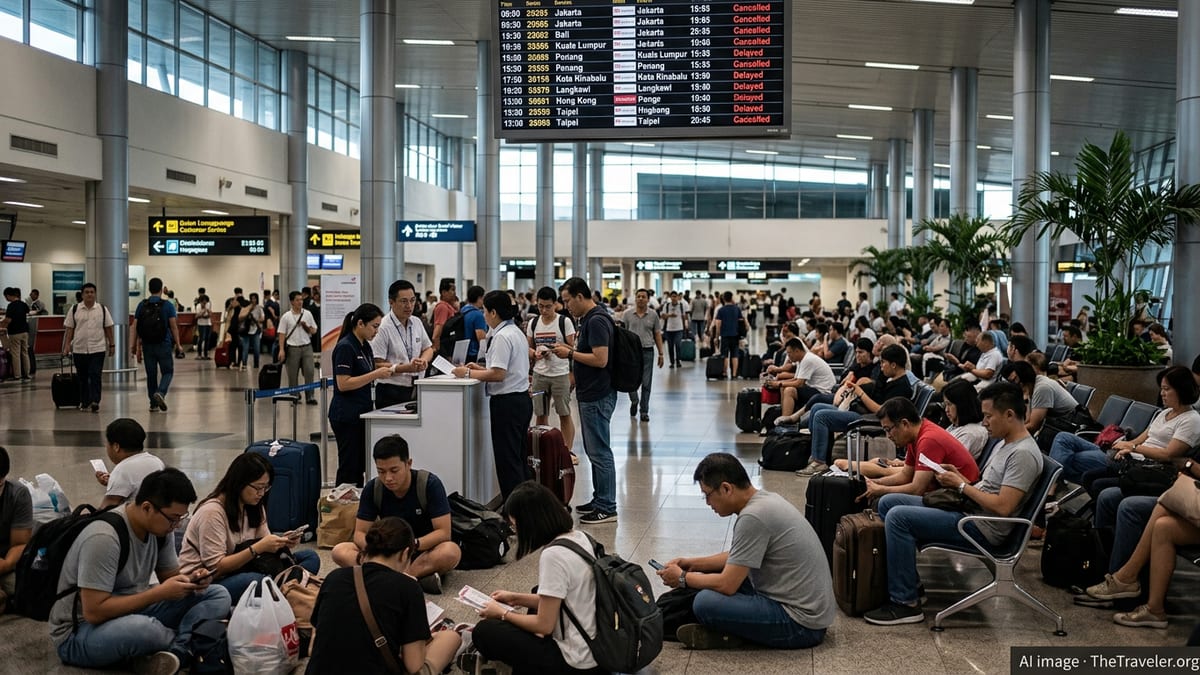
The immediate consequence of these cancellations has been a growing number of stranded passengers at airports across the region. Images and descriptions shared in regional media and on travel forums depict crowded departure halls in Bali, Kuala Lumpur, Taipei and Hong Kong as travelers wait for rebooking options, often with limited real time information on when replacement flights will operate.
In Bali, local coverage cites airport officials and airline statements indicating that several thousand passengers were unable to depart on a single day when more than thirty international flights were cancelled, many of them serving Gulf hubs such as Doha and other key connection points. Similar scenes have been described at Kuala Lumpur International Airport, where travelers connecting to Europe, the Middle East and Australia through a combination of regional and long haul airlines have found their itineraries abruptly broken.
Some passengers have turned to repatriation style flights and special schedules announced by Gulf carriers to secure seats out of Asia. Public posts summarizing such operations list ad hoc services from Dubai and Abu Dhabi to destinations including Hong Kong, Taipei, Manila, Kuala Lumpur, Jakarta, Melbourne and Osaka, with priority often given to travelers whose original flights were canceled due to the regional disruption.
Others are attempting to bypass the most affected corridors entirely by routing through alternative hubs such as Singapore or Bangkok. Travel community discussions indicate that while some of these routes remain busy, they currently offer more consistent operations than itineraries dependent on Gulf Middle East overflights, providing a potential way out for those able to purchase new tickets or secure re protection from airlines.
What Travelers Should Watch in the Coming Days
Aviation analysts and travel industry observers suggest that the situation remains fluid, with schedules subject to frequent revision as airlines respond to operational constraints and evolving airspace restrictions. Publicly available timetables are being updated day by day, and flights that appear as confirmed can still be retimed or cancelled at short notice.
Travelers with upcoming itineraries involving Jakarta, Bali, Kuala Lumpur, Taipei or Hong Kong, particularly those connecting onward to Doha, Melbourne, Chennai, Manila, Osaka or other long haul destinations, are being advised in public guidance to monitor their bookings closely and check for schedule changes repeatedly in the 24 hours before departure.
Consumer advocacy groups and travel commentators note that passengers whose flights are cancelled may be entitled to refunds, rebooking or care provisions depending on the airline, ticket type and governing regulations. However, they also point out that high call volumes and limited alternative capacity can make it challenging to exercise these options quickly, especially during peak disruption.
For now, the patchwork of cancellations and partial resumptions has left Asia’s normally seamless network of hubs operating below full strength. Until carriers can reliably restore frequencies between Jakarta, Bali, Kuala Lumpur, Taipei, Hong Kong and long haul destinations such as Doha, Melbourne, Chennai, Manila and Osaka, travelers across the region are likely to face longer journeys, fewer choices and an elevated risk of last minute disruption.