

More news on this day
Thousands of air passengers across Asia are facing severe disruption as airports in Thailand, Japan, Indonesia, Vietnam, the Philippines and Hong Kong report 2,427 delayed flights and 83 cancellations, snarling operations at some of the region’s busiest hubs and leaving terminals packed with stranded travelers.
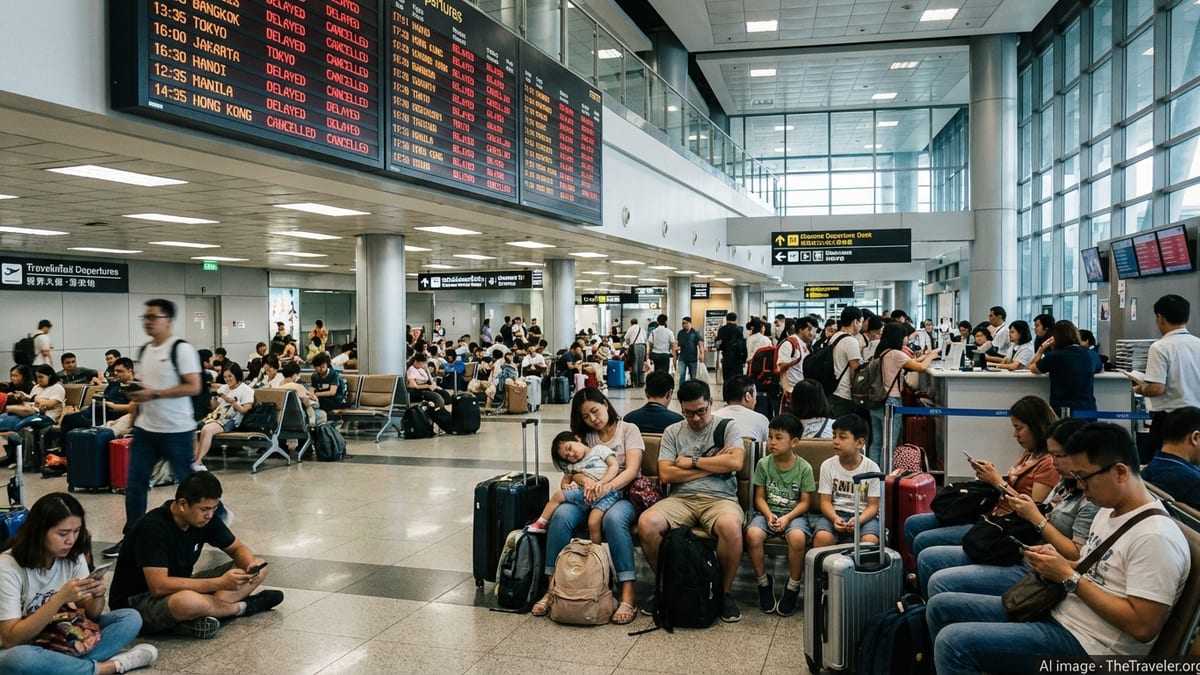
Major Asian Hubs Buckle Under Operational Strain
The latest flight data from airports and aviation tracking platforms shows an unusually high concentration of disruption across 12 major Asian gateways, with a clear tilt toward delays rather than outright cancellations. While the total of 83 cancellations has grounded aircraft and crews, it is the 2,427 delayed departures and arrivals that are causing the greatest misery for passengers, many of whom are trapped in hours-long queues at check in, security, and rebooking counters.
Airports in Bangkok, Tokyo, Jakarta, Hanoi, Manila, Ho Chi Minh City, Hong Kong and several regional Japanese and Indonesian cities have all reported extensive knock-on effects. With aircraft and crews out of position, even minor schedule gaps have cascaded into broader network disruptions, complicating recovery for both full-service and low-cost carriers.
Although no single weather event or technical failure has been publicly cited as the sole trigger, aviation analysts point to a familiar combination of congested airspace, tight aircraft utilization, crew rostering constraints and lingering weather-related backlogs in parts of East and Southeast Asia. The result is a patchwork of localized operational problems that collectively add up to a regionwide travel crunch.
For travelers on multi-leg itineraries that depend on tightly timed connections through Asian hubs, the disruption has been particularly painful. Missed onward flights, lost hotel nights and forced overnight stays in transit cities have been widely reported, with social media feeds from Bangkok, Tokyo and Manila showing images of packed departure halls and long lines snaking past service desks.
Vietnamese Airports Lead Delay Totals
Vietnam has emerged as one of the epicenters of the disruption, with Ho Chi Minh City’s Tan Son Nhat International Airport recording the single highest number of delays among the affected hubs. More than 500 flights operating through the airport have departed or arrived late, reflecting the intense pressure on Vietnam’s domestic and regional network.
Hanoi’s Noi Bai International Airport has also reported heavy disruption, with over 200 delayed flights straining gate capacity, ground handling crews and air traffic management. Much of the congestion has been linked to high-frequency shuttle services between the two cities and onward links to regional destinations in Thailand, Singapore, Malaysia and South Korea.
Two of Vietnam’s largest carriers, VietJet Air and Vietnam Airlines, account for a substantial share of the delay burden. Between them, they have racked up well over 500 delayed departures and arrivals across their networks, most of them clustered around Ho Chi Minh City and Hanoi. Industry observers note that Vietnam’s rapid growth in air traffic over the past few years has left airlines operating at the edge of their capacity, making them especially vulnerable to rolling schedule disruptions.
Passengers on Vietnam’s domestic trunk routes describe scenes of crowded departure lounges and repeated gate changes as airlines juggle aircraft rotation and crew rest requirements. While most flights are eventually departing, the extended delays are pushing back arrival times late into the night, straining airport operations and passenger patience in equal measure.
Thailand, Indonesia and the Philippines Grapple With Ripple Effects
In Thailand, Bangkok’s Suvarnabhumi Airport has reported hundreds of delayed flights as regional congestion ripples through Southeast Asia. Although the number of outright cancellations remains limited, the cumulative impact of late inbound aircraft has created rolling knock-on delays throughout the day, particularly on popular regional routes linking Bangkok with Ho Chi Minh City, Hanoi, Jakarta and Hong Kong.
Further south, Indonesia’s sprawling archipelagic network has come under pressure, with Jakarta’s Soekarno Hatta International Airport and Sultan Hasanuddin International Airport among the hardest-hit. Together they have reported more than 400 delays and dozens of cancellations, many tied to tight turnarounds on domestic routes operated by Batik Air and Lion Air.
In the Philippines, Manila’s Ninoy Aquino International Airport has struggled with a mix of delays and a smaller number of cancellations that nonetheless have outsized effects in a tightly scheduled airport environment. Philippine carriers and regional partners have been forced to consolidate flights, reassign aircraft and reroute some services to manage the disruption, leading to last-minute schedule changes for passengers.
Regional aviation experts say that Southeast Asia’s reliance on short-haul, high-frequency flights makes its air travel ecosystem particularly sensitive to any deterioration in on-time performance. With many airlines scheduling aircraft for multiple legs per day across Indonesia, Thailand and the Philippines, an early-morning delay at one airport can easily translate into late-night disruption at another.
Japanese and Hong Kong Airports See High Cancellations
While Southeast Asian hubs are experiencing the largest volume of delays, it is airports in Japan and Hong Kong that are registering some of the most concentrated pockets of outright cancellations. In Japan, New Chitose Airport serving Sapporo has recorded the highest single-airport cancellation count in the current disruption, with around 30 flights scrubbed from the schedule alongside nearly 100 delays.
Tokyo’s two primary gateways, Haneda and Narita, are reporting a combined total of more than 270 delays and several cancellations. These disruptions affect not only domestic routes but also selected transpacific and regional links, as long-haul carriers adjust departure times or consolidate services in response to tight crew limits and air traffic constraints.
Hong Kong International Airport, one of Asia’s premier long-haul and regional hubs, has reported close to 200 delays amid its own wave of operational challenges. While the number of outright cancellations from Hong Kong remains comparatively modest, late-arriving aircraft and congested departure slots are forcing airlines to re-time flights and, in some cases, downgrade or upgauge aircraft to balance capacity and demand.
Strategically, the disruption in Japan and Hong Kong matters beyond the raw numbers, as both markets serve as key connecting points between North America, Europe and the rest of Asia. Missed connections in Tokyo or Hong Kong can strand travelers bound for secondary destinations across the region, amplifying the effect of each delayed or cancelled flight.
Airlines Most Affected: From ANA Wings to Batik Air
Across the 12 disrupted airports, a wide range of carriers are affected, but several airlines stand out for their high number of delays and cancellations. Japanese regional operator ANA Wings has become one of the most cancellation-heavy carriers in the current episode, scrubbing nearly 20 flights and delaying more than a dozen others, primarily on routes linking Sapporo, Tokyo and other domestic destinations.
Batik Air, a key player in Indonesia’s domestic network, has also faced a difficult operating day. The airline has reportedly cancelled more than 30 flights and delayed close to 80, particularly on routes linking Jakarta and Makassar with other Indonesian cities. Combined with disruption at Lion Air, which has logged over 130 delays, Indonesia’s domestic market has been one of the most turbulent in the region.
Among full-service flag carriers, Japan Airlines has recorded multiple cancellations and well over 100 delays, affecting services across Tokyo and regional Japanese airports. Jetstar Japan, a low-cost competitor, has also been forced to cancel several flights and delay more than a dozen others, primarily on leisure-heavy routes from Tokyo and Sapporo.
In the Hong Kong market, Cathay Pacific has seen around 65 flights delayed, most of them departing or arriving at its home hub. While cancellations for the airline remain limited in this particular disruption, the volume of late-running operations underscores how thin the margin for error has become as airlines push toward pre-pandemic capacity levels.
Ground-Level Impact: Stranded Passengers and Packed Terminals
For passengers caught in the middle of the disruption, the statistics translate into very real and immediate problems. At Bangkok’s Suvarnabhumi, terminals have filled with travelers camped out on the floor or lining up at service counters as they wait for rebooking options or updated departure times. Similar scenes have been reported in Jakarta and Manila, where overnight travelers are sleeping on benches and makeshift bedding while they await scarce open seats.
Families traveling with children and elderly passengers have been particularly hard hit, with some reporting waits of six to ten hours for confirmed alternative flights. Language barriers and varying local regulations around compensation and duty of care have added to the confusion, especially for those flying on multi-airline itineraries involving codeshare tickets.
Airport staff across the region are feeling the strain as well. Check-in and gate agents, ground handling crews, and call-center employees are scrambling to process rebookings, handle baggage issues and manage crowd control. In many terminals, extra staff have been deployed to help with queue management and to provide basic information, but passengers still report long waits and limited clarity around when normal operations will resume.
Travel insurance providers and credit card issuers with trip-interruption coverage are also seeing a spike in claims inquiries, as passengers look to recover costs tied to missed tours, hotel nights and nonrefundable bookings. However, reimbursement eligibility varies widely depending on the underlying cause of the disruption and the specific policy wording.
What Travelers Can Do Right Now
With disruption spread across multiple countries and carriers, aviation experts advise affected passengers to take a proactive approach to managing their journeys. The first step, they say, is to monitor flight status directly through airline apps or official channels, rather than relying solely on third-party booking platforms or airport displays that may update more slowly during busy periods.
Travelers who suspect their flight may be disrupted are encouraged to contact their airline or travel agent as early as possible to explore rebooking options. In cases where a cancellation or long delay is confirmed, airlines may offer free changes, refunds or rerouting, but seat availability can be limited on alternative services, particularly on popular routes in and out of Bangkok, Tokyo, Hong Kong and Jakarta.
Experts also recommend building extra buffer time into connections when planning upcoming travel to or within Asia, at least while the current wave of disruption persists. For critical journeys such as cruise departures, major events or long-haul connections, opting for a longer layover or an earlier arrival date can reduce the risk of a missed departure further down the line.
Finally, travelers are urged to keep receipts for additional expenses such as meals, hotels and ground transport incurred as a direct result of delays or cancellations. Depending on local aviation regulations, airline policies and insurance coverage, these documents may be essential when seeking reimbursement or filing a claim in the aftermath of the disruption.
Outlook for Recovery Across the Region
Industry observers say that while the headline numbers of 2,427 delays and 83 cancellations appear stark, they likely represent a peak in a broader pattern of intermittent strain as Asia’s aviation network continues to scale back up toward full capacity. Once aircraft and crews are repositioned and backlogs at the most affected airports are cleared, operations could normalize within a matter of days, provided no further shocks hit the system.
However, the disruption has also highlighted deeper structural challenges facing carriers and airports in the region. Rapid traffic growth in markets such as Vietnam and Indonesia has outpaced infrastructure upgrades at some airports, while tight scheduling practices leave little room to absorb unexpected delays. At the same time, extreme weather episodes and crowded regional air corridors are adding unpredictable variables that operators must manage daily.
Airlines are expected to review their near-term schedules, particularly on heavily affected routes, to build in more conservative turnaround times or to deploy larger aircraft on select services in order to move more passengers once slots and crews are available. Airports, meanwhile, may adjust staffing plans and ramp operations to better handle surges in delayed traffic, especially during evening and late-night peaks.
For now, travelers heading to or within Asia over the coming days are being urged to remain flexible, stay informed and prepare for the possibility of last-minute changes. While most flights are still operating, the current wave of delays and cancellations is a reminder that the region’s busy skies remain vulnerable to sudden bouts of turbulence on the ground.