

More news on this day
Thousands of travelers across Asia faced extensive disruption on April 12, 2026, as airports in Thailand, Singapore, Japan, the United Arab Emirates, India, Indonesia, and China saw 4,319 flights delayed and 189 cancelled, snarling operations for Etihad, Japan Airlines, Air China, Thai Airways, and other carriers at key hubs including Beijing, Tokyo, and Dubai.
Get the latest news straight to your inbox!
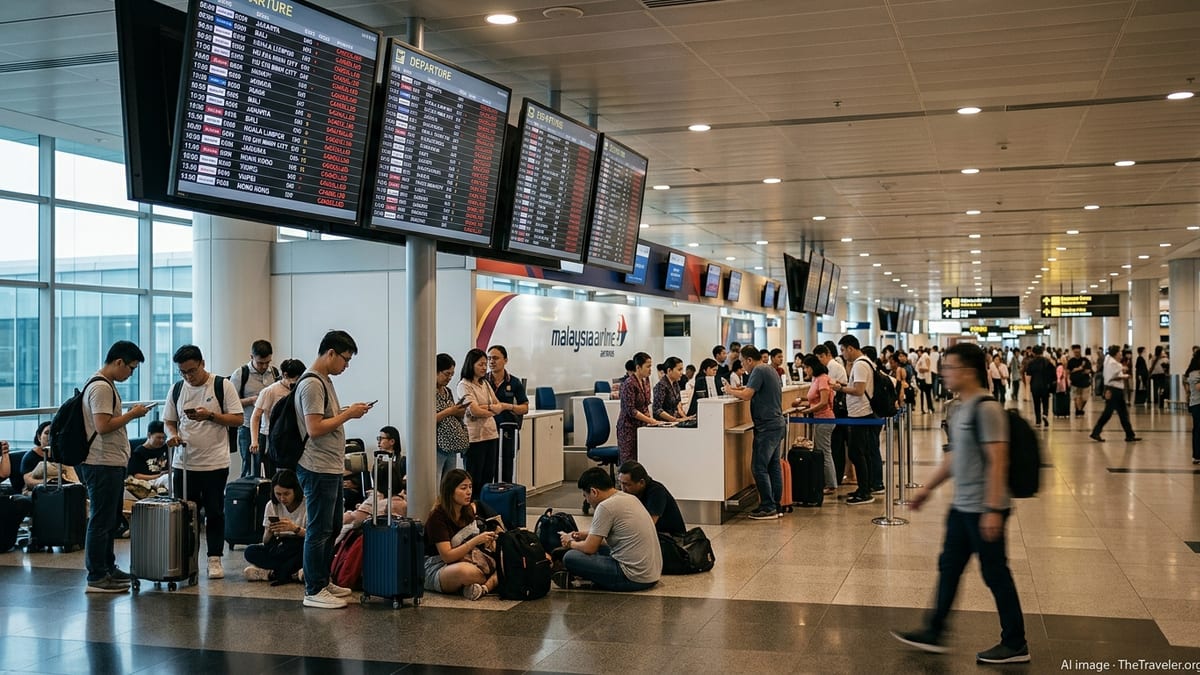
Widespread Disruption Across Asia’s Busiest Hubs
Publicly available operational data compiled from flight-tracking platforms and regional aviation coverage indicates that April 12 developed into one of the most severely disrupted travel days of the spring in Asia. The concentration of 4,319 delays and 189 cancellations across major hubs created rolling knock-on effects, with departure boards in multiple countries showing extended postponements and a shrinking number of on-time departures.
The disruptions were most visible at large multi-runway airports handling dense networks of short and medium haul routes. Beijing Capital and Daxing, Tokyo’s Haneda and Narita, Bangkok Suvarnabhumi, Singapore Changi, Delhi and Mumbai, Jakarta Soekarno Hatta, Dubai International, Abu Dhabi and Guangzhou Baiyun all registered elevated levels of delay compared with typical April patterns, according to aggregated monitoring data and contemporary travel-industry reporting.
While some airports reported relatively few outright cancellations, long queues at check in, security, and transfer desks added to the strain on passengers. Accounts compiled from consumer platforms described travelers waiting through repeated rolling delay estimates, struggling to rebook missed connections, and facing uncertainty about luggage transfers as aircraft and crews rotated late through the network.
Regional analysts note that the clustering of disruptions on a single day added extra pressure to an already tight aviation system in the middle of a busy spring season, when capacity is heavily utilized and spare seats for last minute rebooking are limited across the region’s major airlines.
Etihad, Japan Airlines, Air China and Thai Airways Among Affected Carriers
The disruption cut across a wide range of airlines operating in and through Asia’s largest hubs. According to published operational tallies, global network carriers such as Etihad Airways, Japan Airlines, Air China and Thai Airways were among those facing significant schedule challenges, particularly at their key gateways and high frequency city pairs.
Flights linking Tokyo with Chinese and Southeast Asian destinations, as well as services between Gulf hubs and major South and Southeast Asian cities, were reported to be especially vulnerable to delay as congestion built up across multiple airports. Monitoring services showed aircraft arriving late from one disrupted airport only to encounter fresh restrictions or bottlenecks at the next, magnifying small timing issues into multi hour hold ups.
Etihad’s operations through Abu Dhabi were affected as delays at Asian origin airports fed into departure banks bound for Europe, North America, and Africa. Similarly, Japan Airlines and other Japanese carriers experienced waves of late running departures at Tokyo Haneda and Narita, while Air China and fellow mainland Chinese airlines saw extended delays at Beijing, Guangzhou, Chengdu, Shenzhen, and other large domestic and international hubs.
Thai Airways, which relies heavily on Bangkok Suvarnabhumi as a connecting gateway between Europe, the Gulf, and Asia Pacific, also featured among the carriers facing schedule disruption. Publicly available information indicates that even where Thai Airways and other airlines managed to avoid large numbers of outright cancellations, late aircraft arrivals forced retimed departures and complicated crew scheduling.
Beijing, Tokyo, Dubai and Regional Gateways Under Pressure
Operational data circulating on April 12 highlighted how a handful of large airports carried a disproportionate share of the delays and cancellations. In China, Beijing Capital, Beijing Daxing, Guangzhou Baiyun, Shenzhen Bao’an, Chengdu Tianfu, Nanjing Lukou, Chongqing Jiangbei, Guiyang Longdongbao and others reported figures far above normal daily disruption levels, reflecting the country’s dense domestic network layered on top of international traffic.
In Japan, Tokyo Haneda in particular emerged as a flashpoint, with several hundred delayed departures and arrivals recorded by tracking platforms. Narita and Osaka area airports, including Kansai and Itami, showed lower absolute numbers but still experienced a marked increase in late operations. Passengers on regional flights connecting through these hubs reported long waits as airlines tried to preserve as many onward connections as possible within crew duty limits and curfew constraints.
Across the broader region, Singapore Changi and Bangkok Suvarnabhumi saw their own spike in delayed departures, affecting both regional routes and long haul services. Delhi’s Indira Gandhi International and Mumbai’s Chhatrapati Shivaji Maharaj International in India, as well as Jakarta Soekarno Hatta and Abu Dhabi International, were also listed among airports with unusually high numbers of delayed or cancelled flights.
Dubai International, one of the world’s busiest long haul connectors, experienced dozens of delays and a smaller number of cancellations across multiple airlines. These schedule disruptions at a key global hub threatened to propagate into Europe, Africa, and the Americas, as late arriving aircraft and connecting passengers forced airlines to adjust departure times and, in some cases, substitute equipment.
Passengers Face Missed Connections, Long Queues and Uncertain Rebookings
The operational statistics translated into a difficult travel experience for many passengers. Reports gathered from consumer forums, social media posts, and local media coverage described travelers stuck in terminals for extended periods as they waited for updated departure times and rebooking options, particularly at hubs where onward connections are common.
Many long haul passengers connecting between Europe or North America and destinations in Asia or Oceania found that relatively short initial delays were enough to cause missed connections, especially on routes with only one daily service. In such cases, travelers often faced overnight stays, extended layovers, or rerouting via alternative hubs, sometimes adding an extra day to their journey.
Check in, security, and transfer desks at major airports reportedly came under heavy strain. Passengers arriving just a few hours before departure discovered that earlier disruptions had already created long backlogs, with some missing their flights simply because they were stuck in queues. Where flights were cancelled, travelers described challenges securing timely assistance at customer service counters during peak disruption periods.
Travel industry commentators noted that the day’s events underlined the importance of flexible ticket options and comprehensive travel insurance. Public information from airlines and regulators indicates that compensation and care obligations vary depending on the jurisdiction and the cause of delay or cancellation, leaving some passengers reliant on their own arrangements for accommodation or alternative transport.
Knock On Effects Expected To Continue Through the Week
Aviation analysts expect the April 12 disruption to have lingering effects beyond the day itself. Aircraft and crew displaced from their scheduled rotations can take several days to return to normal patterns, particularly on long haul routes where each leg occupies many hours and operates only a few times per week.
Publicly available flight schedule data suggests that some early morning departures on April 13 were already showing minor retimings in systems as airlines attempted to recover their networks. As operations stabilize, carriers are likely to prioritize restoring key trunk routes and high demand flights, while less frequent services may see ongoing timing adjustments.
Industry observers point out that the episode arrives at a time when many airlines in Asia and the Gulf are still fine tuning capacity after recent shocks to global aviation. Tight margins in aircraft availability and crew rosters can leave networks more vulnerable to sudden spikes in disruption, especially during busy travel periods such as spring holidays and major regional events.
For travelers planning upcoming trips through affected hubs such as Beijing, Tokyo, Bangkok, Singapore, Dubai, Abu Dhabi, Delhi, Mumbai, Jakarta, and Guangzhou, publicly accessible guidance from airports and airlines emphasizes the value of checking flight status frequently, allowing extra time at the airport, and being prepared for potential changes to routings or departure times over the coming days.