

More news on this day
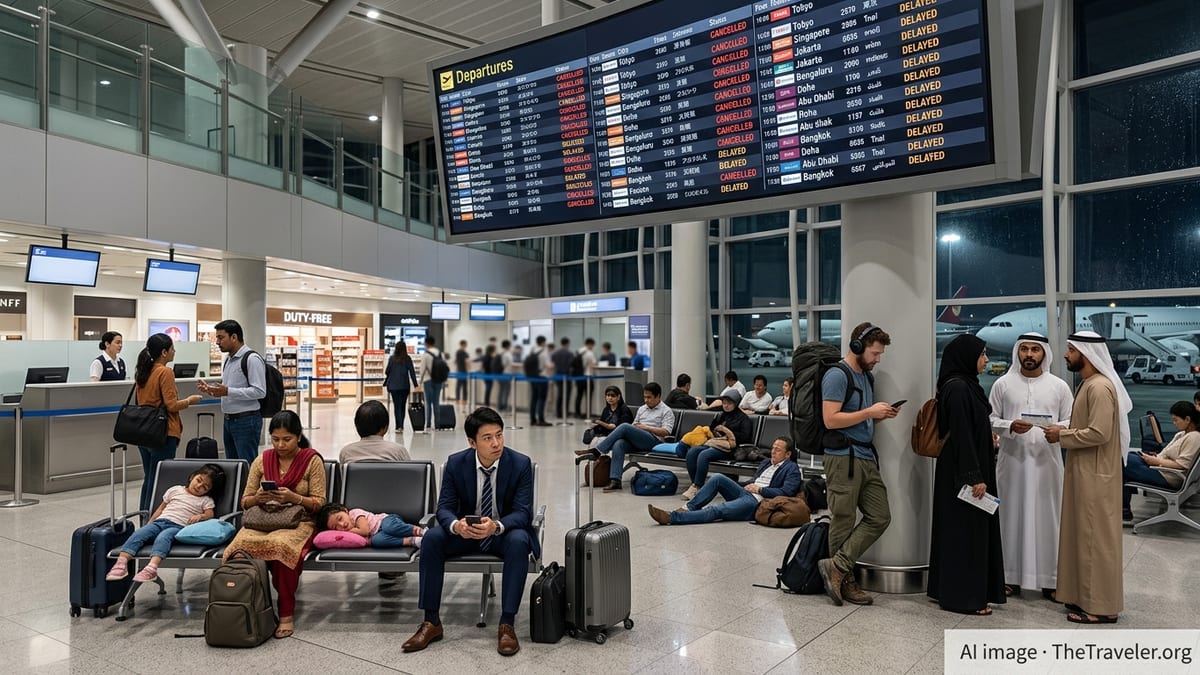
Air travel across Asia and key Gulf hubs is facing renewed turmoil as nearly 200 flights are canceled and more than 2,600 delayed in a single day, stranding thousands of passengers from Tokyo and Bengaluru to Jakarta, Abu Dhabi and beyond.
Get the latest news straight to your inbox!
Flight Disruptions Ripple Across Asia and the Gulf
Tracking data and operational updates indicate that airlines serving Thailand, Singapore, Japan, Indonesia, Qatar and other regional markets have collectively canceled around 195 flights and delayed roughly 2,660 more within a 24 hour window. The pattern reflects a fresh spike in operational stress layered on top of weeks of reroutings and schedule changes triggered by airspace restrictions linked to conflict in West Asia.
Major hubs including Tokyo, Singapore, Jakarta, Bengaluru and Doha are experiencing knock-on effects as aircraft and crews are left out of position. Even when individual airports remain technically open, rolling delays on long-haul and regional rotations are creating gaps that cascade through daily timetables, particularly on routes connecting Asia with Europe and the Middle East.
Publicly available flight status boards show wide variations from one airport to another. Some terminals report only isolated cancellations, while others are seeing clusters of scrapped services in peak evening and overnight waves. The mixture of full cancellations and multi-hour delays is leaving passengers unsure whether to wait it out or seek alternative routings entirely outside affected corridors.
Operational data also suggests that the effect is highly dynamic, with some long-haul departures gaining clearance at the last minute while others are pulled from schedules with little notice. This volatility is making it difficult for travelers and airlines alike to predict which connections will actually operate as planned.
All Nippon, China Eastern, Gulf Air, Saudia and Others Affected
The disruptions are impacting a wide spectrum of carriers. Japan focused operators such as All Nippon Airways have already been juggling schedule adjustments on flights connecting Tokyo with Southeast Asia and the Middle East as airspace routings change and block times increase. Longer flight paths, crew duty limitations and aircraft rotation challenges are combining to push some departures outside their planned slots.
China Eastern, with a network that links East Asia to Europe via both direct and Gulf connected routings, is among the carriers facing variability in on time performance. Reports from passengers and aviation data platforms highlight long delays on some services into and out of major Asian hubs, including Japan and Southeast Asia, as crews wait for confirmed routings that avoid closed or congested airspace.
Gulf based carriers such as Gulf Air and Saudia are seeing particular pressure on services that intersect with restricted West Asian airspace or rely on hubs that have been operating reduced schedules at various points in recent weeks. While many flights are still departing, the combined effect of earlier cancellations, rerouted aircraft and constrained slots is feeding into the broader total of nearly 200 cancellations and thousands of delays recorded across the region.
Other regional and long haul brands, from low cost operators in Southeast Asia to full service Asian and European airlines, are also visible in the disruption statistics. Their Asia bound flights are often forced to adjust departure times or cruise profiles to accommodate longer routings, increasing the risk of missed connections for passengers who had planned tight transfers through Tokyo, Singapore, Doha or Abu Dhabi.
Tokyo, Bengaluru, Jakarta and Other Hubs Struggle With Knock On Effects
Tokyo’s major airports, which function as key gateways between North Asia, Southeast Asia and North America, are experiencing a complicated mix of delays and selective cancellations. According to publicly available timetables, several services that once routed via Middle Eastern hubs have been retimed or restructured, sometimes shifting traffic onto alternative Asian connection points, intensifying pressure on already busy intra Asia banks.
In India, Bengaluru’s Kempegowda International Airport is one of several large gateways dealing with changing connectivity to the Gulf and beyond. Flight information displays and airline bulletins show repeated adjustments to departures linking the city with Abu Dhabi, Doha and other West Asian nodes, as carriers recalibrate operations to fit within evolving airspace and safety constraints.
Jakarta and other Indonesian gateways are also recording a sequence of delays and cancellations, particularly on long haul or one stop itineraries that cross West Asian corridors on their way to Europe or Africa. Publicly available flight route data indicates that some of these services are now being rerouted via alternative paths through Central Asia or farther north, extending flight times and tightening turnaround margins at both ends.
Smaller but strategically placed hubs in Thailand and Singapore, which serve as essential connectors for regional traffic, are feeling the secondary waves of disruption. Even when flights operate, later arrivals from affected regions reduce the buffer between inbound and outbound legs, contributing to late evening and overnight delays that can stretch into the following day.
Passengers Face Long Queues, Missed Connections and Limited Alternatives
For travelers, the numerical totals of 195 cancellations and more than 2,600 delays translate into long queues at transfer desks, congested call centers and uncertainty about how journeys will be completed. Posts on social media, travel forums and airline feedback channels describe passengers sleeping in terminals, rebooking onto indirect routings through alternative Asian hubs, and in some cases abandoning travel plans altogether.
In cities such as Abu Dhabi and Doha, where hub and spoke models depend on tightly coordinated banks of arrivals and departures, even partial schedule restorations have not fully normalized operations. Public dashboards and user reports show that some flights are now running with significantly extended connection times built in, while others are being held on the ground to wait for late inbound aircraft or updated route clearances.
Business travelers and long haul leisure passengers are particularly exposed, as itineraries often include multiple sectors across several carriers. A delay on an Asia to Gulf leg can force involuntary stopovers or require same day switches to entirely different routings via Tokyo, Singapore or other Asian gateways that still have available capacity.
Travel advisers and frequent flyer communities are urging passengers to monitor their reservations closely, check real time departure boards rather than relying solely on automated notifications, and be prepared to accept alternative routings that avoid the most heavily affected airspace. Flexibility in dates, routings and even destination airports is emerging as one of the few ways to navigate a system that continues to shift day by day.
Airlines Rework Networks as Airspace Restrictions Persist
The latest wave of cancellations and delays underscores how vulnerable Asia and Gulf aviation networks remain to continuing airspace and security constraints in parts of West Asia. Industry summaries released over recent weeks show that hundreds of flights per day have been removed from schedules or rerouted around restricted zones, with Middle Eastern hubs absorbing a large share of the disruption.
Carriers are responding through a mixture of temporary suspensions, reduced frequencies and permanent timetable changes that prioritize routes less dependent on the most volatile corridors. Some airlines are increasing nonstop capacity between Asian and European cities to bypass intermediate stops, while others are consolidating frequencies to fewer hubs where they can maintain more reliable operations.
These adjustments are happening alongside ongoing efforts to repatriate stranded travelers from affected regions and to clear backlogs of passengers whose earlier flights were canceled. Extra sections, ad hoc charter style services and aircraft swaps have become recurring features of daily operations, although they have not yet eliminated the accumulation of delays that continue to show up in regional statistics.
With no clear timeline for a full reopening of key airspace or a return to pre crisis traffic patterns, industry observers indicate that travelers should expect periods of acute disruption to persist. The current tally of 195 cancellations and 2,660 delays across Thailand, Singapore, Japan, Indonesia, Qatar and neighboring markets may represent only one snapshot in a series of volatile days for Asia connected air travel.