

More news on this day
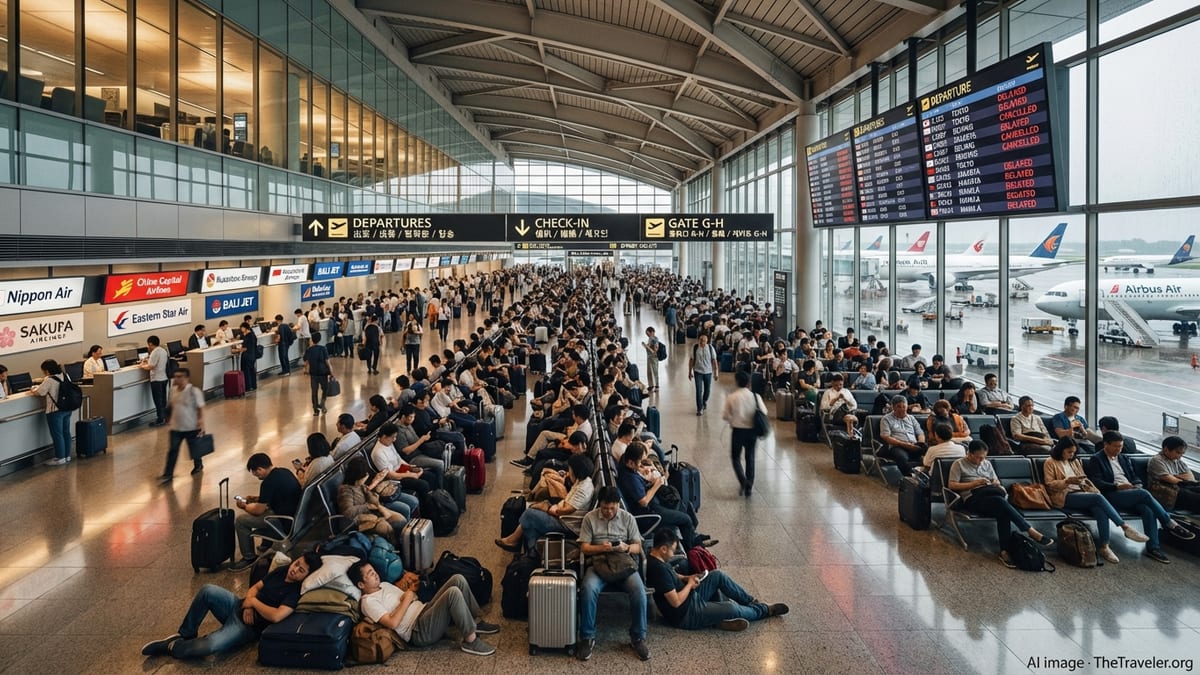
Thousands of passengers across Asia and the Middle East are facing long queues, missed connections and overnight airport stays as widespread disruption hits aviation networks from Beijing and Tokyo to Delhi and Dubai, with hundreds of flights cancelled and several thousand more delayed in a single day.
Get the latest news straight to your inbox!
Airports From Beijing to Dubai Buckle Under Strain
Publicly available flight-tracking data and specialist aviation analyses indicate that on some of the region’s busiest travel days, up to 283 flights have been cancelled and close to 4,000 delayed across hubs in China, Japan, Indonesia, South Korea, the United Arab Emirates and neighboring markets. The disruption is centered on major gateways including Beijing Capital, Tokyo’s Haneda and Narita airports, Jakarta Soekarno-Hatta, Seoul Incheon, Delhi and Dubai International, where rolling delays have stretched into many hours for some travelers.
Reports from aviation data services show that the pattern is not confined to one country or a single cause. Severe weather systems in eastern China, a tight aircraft and crew balance at several Asian carriers, and ongoing airspace restrictions affecting routes through West Asia have all contributed to the pressure. On peak days, Asia-Pacific and Middle East networks together have recorded well over 5,000 delayed movements, amplifying the immediate effect of several hundred outright cancellations.
The result for passengers is a patchwork of disruption that can begin with a short domestic hop and cascade across entire long-haul itineraries. In China, storms around Shanghai and Beijing have led to dozens of cancellations and hundreds of delays at key airports, severing domestic connections that usually feed long-haul services to Southeast Asia and the Gulf. Similar knock-on impacts are being observed at Tokyo and Seoul, where late-arriving aircraft from regional routes have forced last-minute schedule changes.
Observers note that the wave of cancellations and delays is particularly acute because it overlaps with a period of strong travel demand. Airlines had packed schedules heading into the spring holiday and business travel window, leaving little slack to absorb weather shocks, airspace restrictions or operational hiccups without visible effects for travelers.
Flag Carriers and Low-Cost Airlines Equally Affected
According to recent operational tallies and published coverage, both full-service and low-cost airlines have been heavily impacted. Korean Air and its regional competitors have seen delayed departures and disrupted connections at Seoul Incheon, while Japan’s ANA Wings and other Japanese operators have faced schedule challenges at Tokyo’s dual-airport system as congestion and knock-on delays spread through their networks.
In South and Southeast Asia, India’s IndiGo, which already entered 2026 under scrutiny for a separate wave of cancellations and schedule cuts, has again appeared prominently in disruption data. Earlier regulatory filings and media reports documented thousands of passengers affected by Indo domestic cancellations in late 2025, and the latest regional turbulence has added another layer of complexity for the carrier as it juggles aircraft and crew across a vast network anchored in Delhi and other Indian metros.
Gulf-based and transit-focused carriers are also under strain. Qatar Airways, Emirates and other regional airlines have reduced or reshaped schedules in response to airspace closures and rerouting requirements in parts of West Asia, reducing capacity on some key Asia–Europe and Asia–Africa links. Analysis from aviation consultancies shows that these cuts can translate into journey times extended by two to four hours or force passengers onto alternative routings through hubs such as Istanbul, Singapore or European gateways.
In Indonesia and across Southeast Asia, local and regional carriers are experiencing similar turbulence. Jakarta and other Indonesian airports have reported elevated cancellation and delay counts on days when regional weather edges into busy air corridors or when downstream Gulf and European connections become uncertain. This has affected travelers booked on both point-to-point services and through itineraries connecting via the Middle East.
Weather, Airspace Closures and Capacity Cuts Create a Perfect Storm
Published analyses of recent operations in Asia highlight the interplay of several overlapping stressors. In China, severe storms around March travel dates brought over 100 cancellations and hundreds of delays at Shanghai Pudong, Beijing Capital and other major airports, affecting carriers such as China Eastern, Air China and China Southern. When those flights are cancelled or significantly delayed, the aircraft and crews that would normally continue on to international services can no longer operate as planned, triggering a chain of missed connections.
At the same time, airline capacity decisions and diplomatic or regulatory developments have reshaped route networks. Chinese carriers have been scaling back flights to Japan through early 2026, with some estimates pointing to cuts of around 60 percent on certain country-pair capacities. That has squeezed available seats between the two markets, pushing rebooked passengers toward other Asian or Gulf carriers and tightening capacity further on already busy routes.
On a wider scale, airspace closures and security-related restrictions in parts of West Asia have removed a significant share of weekly seats across the broader Middle East region. Industry trackers estimate that around 1.7 million weekly seats have been lost on some Asia–Europe and Asia–Africa patterns as airlines suspend or reroute services. Reduced schedules at Gulf hubs, combined with weather or operational issues in Asia, have produced a highly volatile environment in which a local delay at one airport can ripple across multiple continents within hours.
Aviation analysts suggest that this convergence of factors explains the steep one-day tallies now being recorded, including well over 280 cancellations and nearly 4,000 delays across selected Asian and Middle Eastern markets on the worst-affected dates. With demand remaining high and replacement service options limited, even moderate disruptions have an outsized effect on travelers.
Impact on Passengers in Beijing, Tokyo, Delhi, Dubai and Beyond
For passengers on the ground, the statistics translate into very tangible difficulties. Travelers at Beijing Capital and Shanghai Pudong have faced waits of six to twelve hours in some cases as they queue for rebooking, hotel vouchers or updated departure information. International passengers bound for Bangkok, Dubai and Singapore have been among those most exposed when domestic links are severed by weather-related cancellations inside China.
In Tokyo, reports indicate that Narita and Haneda have experienced crowded terminals and extended security and check-in lines on peak disruption days, especially where delayed arrivals from China, Southeast Asia or the Korean Peninsula feed into onward long-haul departures. Similar scenes have been reported at Seoul Incheon as Korean Air and other carriers attempt to retime flights and consolidate loads to keep long-haul operations viable with limited aircraft availability.
Delhi and other major Indian airports have recorded sustained disruption stretching back to late 2025, when IndiGo’s earlier scheduling crisis left tens of thousands of travelers dealing with cancelled departures and last-minute changes. While that event had distinct causes, the latest wave of Asia-wide disruption is again testing the resilience of Indian and foreign carriers that rely on Delhi and Mumbai as key spokes feeding Gulf and East Asian hubs.
Dubai International, one of the world’s busiest transit hubs, has been a focal point for the current turmoil. With Gulf carriers trimming schedules because of airspace issues and aircraft redeployments, published coverage shows that passengers connecting between Asia and Europe or Africa via Dubai, Doha and Abu Dhabi have been particularly likely to experience cancellations, lengthy re-routes or improvised overnight stays, adding cost and complexity to their journeys.
How the Disruption Could Evolve in the Weeks Ahead
Industry observers caution that while daily totals of cancellations and delays fluctuate, the structural factors behind the current wave of disruption may persist for weeks. Weather patterns across East Asia can continue to affect operations into the spring travel season, while any prolonged airspace restrictions in West Asia will keep pressure on hub-and-spoke networks that rely on predictable overflight permissions.
Airlines are attempting to stabilize schedules by trimming peak-day frequencies, reallocating widebody aircraft to the most in-demand routes and adjusting crew rosters. Some carriers have already reduced their published timetables by several percentage points to build added resilience into daily operations. However, such steps also reduce the pool of spare seats available when irregular operations strike, which can lengthen the time passengers wait for rebooking after a cancellation.
Travel experts following the situation recommend that passengers with upcoming itineraries involving Beijing, Tokyo, Seoul, Delhi, Jakarta, Dubai and other affected hubs monitor their flight status frequently and build longer connection times into multi-leg journeys. Public guidance from consumer bodies and aviation regulators in several countries underscores that travelers may be entitled to refunds or re-routing when flights are cancelled, though compensation rules vary by jurisdiction and ticket type.
With Asia’s peak spring and early summer travel period approaching, any easing of airspace constraints or stabilization in weather patterns could gradually reduce the scale of daily disruption. Until that happens, the combination of several hundred cancellations and thousands of delays across key Asian and Gulf hubs is likely to remain a defining feature of regional air travel.