

More news on this day
Thousands of air travelers across Asia faced severe disruption today as publicly available flight-tracking data showed 2,880 delays and 139 cancellations affecting major airports in Thailand, Japan, Singapore, Malaysia, China, and Indonesia, snarling operations for carriers including AirAsia, Batik Air, All Nippon Airways, Japan Airlines, and China Eastern.
Get the latest news straight to your inbox!
Major Hubs From Bangkok to Tokyo Buckle Under Disruption
The latest data indicate that the impact is concentrated at some of Asia’s busiest international gateways, where heavy schedules and tight turnaround times left little room to absorb cascading delays. Airports in Bangkok, Kuala Lumpur, Tokyo, Singapore, Guangzhou, Shanghai, Shenzhen, Jakarta, and others all reported sizeable backlogs of late departures and arrivals through the day.
Figures compiled from airport departure boards and flight-tracking platforms show particularly high disruption levels at Tokyo Haneda, Kuala Lumpur International, Jakarta Soekarno–Hatta, Singapore Changi, Bangkok Suvarnabhumi, Guangzhou Baiyun, Shenzhen Bao’an, Shanghai Pudong, Don Mueang, and Narita. Collectively, these hubs accounted for the 2,880 delayed services and 139 outright cancellations recorded over the most recent 24-hour period.
Operationally, the imbalance between delays and cancellations points to airlines attempting to maintain network connectivity by operating late rather than scrapping large numbers of flights. However, as rotations slip further behind schedule, even minor incidents such as weather cells or ground-handling issues can trigger extended knock-on effects throughout the region.
Travel-industry coverage notes that this latest wave of disruption follows a series of similarly strained days across Asia and the Gulf, underscoring how little slack remains in many carriers’ schedules during the busy early April travel period.
AirAsia, Batik Air, ANA, JAL and China Eastern Among Hardest Hit
The disruption has been felt most acutely by airlines with dense short- and medium-haul schedules across East and Southeast Asia. Low-cost and hybrid carriers such as AirAsia and Batik Air, which rely on rapid aircraft turnarounds and high daily utilization, feature prominently in delay tallies at Kuala Lumpur, Jakarta, Bangkok, and other regional gateways.
Japan’s two largest full-service airlines, All Nippon Airways and Japan Airlines, are also heavily exposed because of their extensive operations at Tokyo Haneda and Narita, where today’s data show hundreds of delayed flights alongside isolated cancellations. Even if long-haul sectors manage to depart, late arrivals of feeder services can leave passengers misconnecting or facing extended waits for onward flights.
China Eastern is another major player affected, with its operations through Shanghai and other Chinese hubs intersecting with regional flows into Southeast Asia and Japan. When delays mount at Guangzhou, Shenzhen, or Shanghai, aircraft and crew can be left out of position for subsequent services into Thailand, Malaysia, and Indonesia, amplifying the chain reaction.
Reports indicate that other regional and international carriers have also been swept into the disruption as shared runways, taxiways, and airspace slots become saturated. With many flights operating behind schedule, ground services such as fueling, baggage handling, and catering face surges of demand stacked into compressed time windows.
Weather, Congested Airspace and Structural Strains Converge
While no single cause has been identified for today’s widespread disruption, aviation and travel-industry reporting across recent days points to a combination of factors repeatedly straining Asia’s air transport system. Episodes of adverse weather in and around major hubs, lingering air traffic control bottlenecks, and reroutings linked to conflict-related airspace restrictions have all contributed to longer sector times and tighter margins.
Publicly available analyses of regional operations in early April highlight how storms and unstable weather patterns have already led to thousands of delays and several hundred cancellations across Japan, China, South Korea, India, Singapore, and other markets. When similar disturbances intersect with already busy schedules in Southeast Asia, the effects can quickly ripple through Bangkok, Kuala Lumpur, Jakarta, and Singapore.
Structural pressures are also evident. Capacity reductions and altered routings on some long-haul corridors have pushed additional connecting traffic onto East and Southeast Asian hubs, lifting load factors and leaving airlines less able to recover from disruptions. At the same time, continued growth in domestic and regional travel within China and across ASEAN states has filled more seats on short-haul services that depend on precise timing.
Industry data on on-time performance show that while many Asian carriers historically rank well for punctuality, even efficient operations can falter when multiple constraints arise simultaneously. Today’s figures, with thousands of delays but under 200 cancellations, suggest that airlines are largely attempting to operate through the turmoil rather than reduce schedules outright.
Passengers Face Long Queues, Rebookings and Overnight Stays
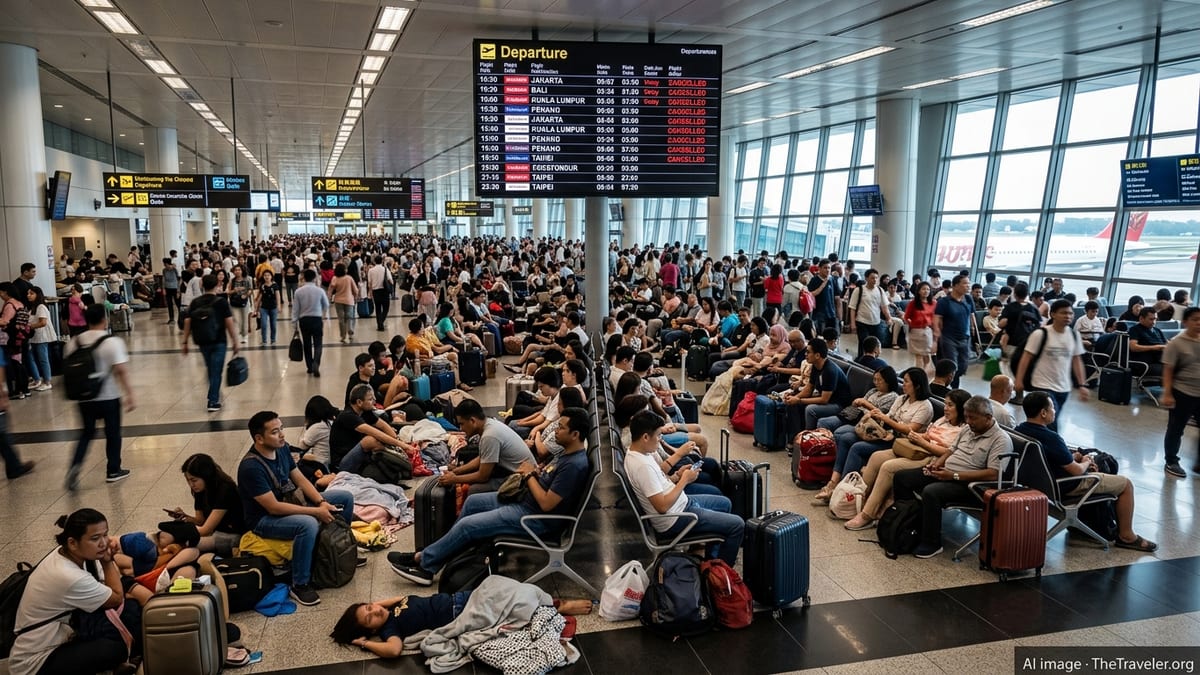
The immediate impact for travelers across the affected airports has been a familiar mix of long queues at check-in and transfer desks, crowded gate areas, and uncertainty over revised departure times. With some flights experiencing multi-hour delays, passengers are being forced into last-minute rebookings, missed connections, and in some cases overnight stays near airports.
Travel advisories and consumer-rights guidance consistently urge passengers to monitor their flight status through airline channels and airport information boards before heading to the terminal, and to keep boarding passes and receipts in case they later seek compensation or reimbursement. In several Asian jurisdictions, compensation frameworks vary by airline and route, meaning that entitlements may depend on whether the service is domestic, international, or operated by a foreign carrier.
Travel-focused publications note that passengers on low-cost carriers are especially vulnerable to extended waits, since these airlines often operate point-to-point networks with fewer interline options. When aircraft are delayed on earlier legs, subsequent sectors may depart late or be consolidated, leaving limited alternatives for travelers who need to reach smaller secondary cities.
Airport operators meanwhile are contending with congested terminals as passengers from delayed flights remain in lounges and gate areas longer than planned. This can stretch amenities, heighten demand for food and beverage outlets, and place additional strain on customer-service teams already facing a high volume of inquiries.
What Today’s Disruptions Signal for Asia’s Peak Travel Season
The scale of today’s delays and cancellations provides another warning sign ahead of the northern summer and late-spring holiday peaks, when traffic through Asian hubs typically accelerates. With many carriers already operating near pre-crisis capacity levels on core routes, the margin for error in day-to-day operations is narrowing.
Recent tallies from early April indicate that multi-thousand delay counts in Asia are no longer isolated events, but part of a recurring pattern in which clusters of airports across Japan, China, South Korea, India, Southeast Asia, and the Gulf experience systemic strain over short windows of time. For airlines, that raises questions about schedule resilience, crew and aircraft allocation, and the ability to protect key long-haul connections.
For passengers planning trips in the coming weeks, publicly available guidance from travel and aviation analysts suggests building in longer connection times at major hubs, considering earlier departures where possible, and remaining flexible about routing. Travelers who can adjust dates or connect via less congested airports may be better placed to avoid the worst bottlenecks when conditions deteriorate.
Today’s figures from Thailand, Japan, Singapore, Malaysia, China, and Indonesia underscore how tightly interconnected Asia’s air routes have become. A weather system, technical outage, or geopolitical flashpoint in one corner of the region can reverberate quickly through multiple hubs, affecting not only local flyers but also long-haul passengers connecting between continents.