

More news on this day
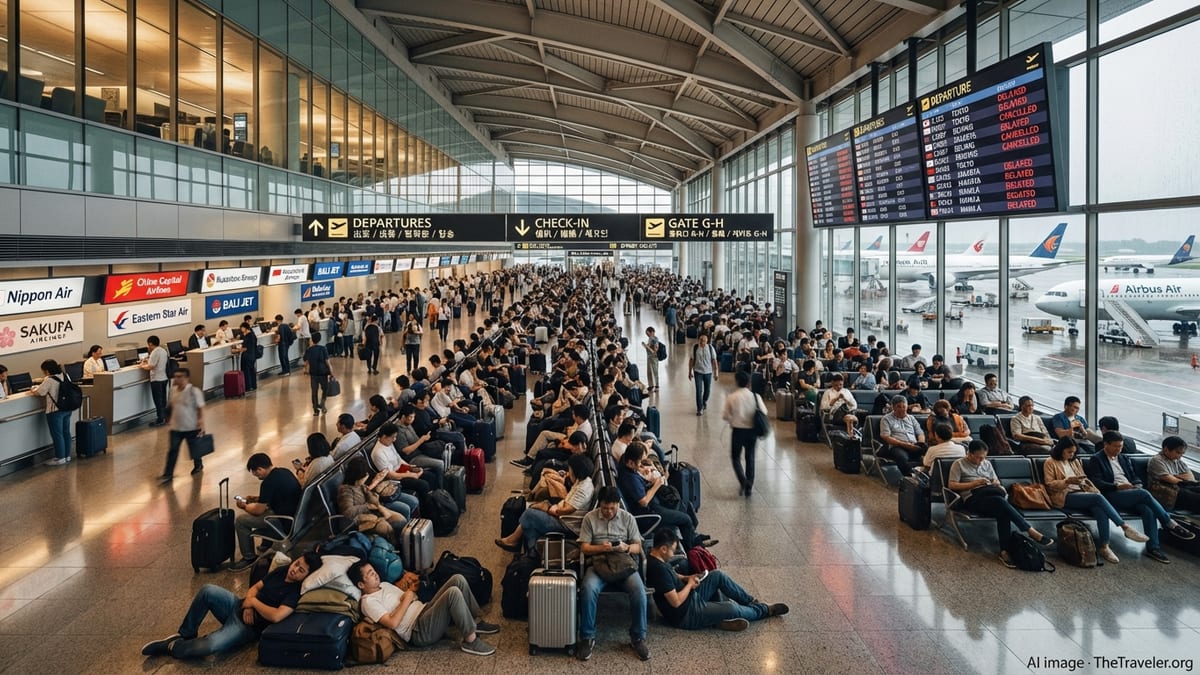
A fresh burst of flight delays across Asian hubs in early April 2026 is underscoring how fragile airline finances remain, as higher fuel costs, congested airports and rerouted long-haul traffic collide with razor-thin profit margins across the region.
Get the latest news straight to your inbox!
Wave of Disruptions Rolls From March Into April
Operational data and industry tracking for late March and the first week of April show that Asia’s latest bout of irregular operations did not arrive as an isolated event, but as the continuation of a stress pattern that has been building for weeks. Publicly available figures for March 31 pointed to nearly 400 cancellations and more than 5,000 delays across key hubs from Beijing and Shanghai to Jakarta, Tokyo, Dubai and Doha, with those residual disruptions still visible in April departure boards.
Coverage from aviation-focused outlets describes how that end-of-March spike left aircraft and crews out of position as April schedules began, particularly for carriers with dense intra-Asian networks. Low-cost and hybrid operators using fast turnarounds in Bangkok, Kuala Lumpur and Jakarta entered the new month with minimal slack, so minor weather or air traffic control restrictions quickly cascaded into missed slots and rolling delays.
Early April snapshots compiled from flight-status platforms indicate that the pressure remains elevated. Reports highlight hundreds of delayed services on April 5 through 7 across Southeast Asia and North Asia, with Bangkok, Kuala Lumpur and several major Chinese airports repeatedly flagged as hotspots. These irregularities are occurring just as airlines attempt to rebuild capacity for the northern summer, tightening the gap between planned schedules and what the system can reliably deliver.
The timing is particularly sensitive because regional traffic is climbing back toward, and in some markets above, pre-pandemic levels at the same moment that airlines are facing structurally higher operating costs. The resulting squeeze is making every disruption more expensive to absorb, exposing how little margin for error many carriers actually have.
Jet Fuel Shock Pushes Costs Higher
Overlaying the operational turmoil is a sharp jump in jet fuel prices that is rippling through the Asia-Pacific airline sector. Industry and trade publications report that the cost of refined jet fuel in recent weeks has surged several times over, forcing carriers to introduce emergency fuel surcharges, raise base fares or pare back frequencies on marginal routes.
Airlines with extensive fuel hedging programs appear somewhat shielded, but not immune. Publicly available commentary on the region’s larger network carriers suggests that hedges are easing the immediate blow, yet exposure to short-notice swings in refining spreads and supply bottlenecks remains. Smaller and low-cost airlines, which often have less comprehensive hedging in place, are more directly exposed to spot prices and are moving quickly to pass costs to passengers or trim unprofitable flying.
This fuel shock is landing at a moment when the industry’s overall profitability is still thin. Global projections released late last year anticipated airlines would achieve an average net margin of about 4 percent in 2026. For many Asian operators facing higher fuel bills, congested hubs and lingering supply chain constraints, actual margins now look tighter. When a 40-minute delay on an early-morning rotation forces extra fuel burn on the ground and disrupts aircraft utilization for the rest of the day, the unplanned cost can quickly erode what little profit was expected from that aircraft’s schedule.
The result is a network where every delayed departure is not only an inconvenience for passengers, but also a direct threat to already slender earnings. Carriers that lack balance sheet strength or pricing power to offset these shocks may find themselves under mounting financial pressure as the northern summer peak approaches.
Hub Congestion and Rerouted Traffic Stretch Operations
Operational reports and travel advisories point to a common theme across recent disruptions: structurally congested hubs operating close to their physical and staffing limits. Major Chinese airports have been singled out in multiple accounts for persistent air traffic control bottlenecks, while fast-growing Southeast Asian gateways are juggling rising passenger volumes with infrastructure and runway constraints.
The situation is being complicated by evolving airspace patterns beyond Asia. Partial shutdowns or restrictions across parts of the Middle East in recent months have prompted carriers to reroute some Europe–Asia services via Southeast Asian hubs. Travel rights organizations and passenger support platforms note that this has added more widebody arrivals and departures into already busy schedules at airports such as Bangkok and Singapore, narrowing the window to recover from delays.
Meanwhile, infrastructure projects intended to expand capacity are only just getting underway. In Thailand, for example, work tied to an expansion of U-Tapao airport and a wider aviation development corridor has recently been reported as moving ahead, but any meaningful relief for the regional network lies years in the future. For now, airlines must operate high-density schedules through legacy infrastructure, knowing that a single equipment issue or weather cell can trigger knock-on effects across several countries.
The convergence of rerouted long-haul traffic, limited runway capacity and saturated terminal operations means that April’s delays are less a transient weather story and more a reflection of systemic strain. For carriers, that translates into higher crew costs, missed connection obligations and increased compensation exposure at a time when balance sheets remain fragile.
Low-Cost Business Models Face Particular Strain
The current disruption cycle is also testing the resilience of low-cost carrier models that dominate short-haul travel in much of Asia. Industry analyses of late March operations describe how budget airlines in Thailand, Malaysia and Indonesia schedule 20 to 30 minute turnarounds to maximize aircraft utilization. Such tight rotations leave almost no buffer when storms, air traffic control restrictions or minor technical findings intervene.
When one early sector pushes back half an hour late, that delay tends to propagate through the rest of the day, touching passengers on later flights with no apparent link to the original problem. Financial coverage of the March disruptions has drawn attention to how this compounding process can turn a single technical or weather event into dozens of late arrivals by evening. Each misaligned aircraft or crew pairing adds incremental expense through overtime, hotel arrangements and missed onward connections.
At the same time, these carriers are grappling with the same elevated fuel costs as their full-service rivals, while often having less flexibility to raise fares without dampening demand. Some are trimming thinner routes or frequencies, but aggressive schedule cuts risk ceding market share just as demand recovers. The resulting trade-off between short-term cost control and long-term network presence is playing out in real time on departure boards across the region.
For investors and analysts watching the sector, the pattern of repeated delays and sporadic cancellations in early April is reinforcing the view that low-cost operators in particular must either build more resilience into their schedules or accept greater volatility in financial results. In markets where regulators have recently lifted fare caps or eased pandemic-era controls, airlines may gain some revenue flexibility, but that will not fully offset the financial hit from continued operational instability.
Margins in the Spotlight Ahead of Summer Peak
All of these dynamics are converging just weeks before Asia’s peak summer travel season, when leisure demand from Europe and North America intensifies and regional holiday flows surge. Publicly available financial forecasts still point to global airline profits improving in 2026, yet the experience of recent weeks across Asian hubs suggests that those averages mask considerable vulnerability beneath the surface.
For many carriers, the early-April pattern shows that a few days of weather issues, airspace rerouting and fuel price spikes can undo months of careful planning. Schedules optimized for maximum utilization offer attractive unit costs when everything runs smoothly, but leave little room to maneuver when airports or air traffic systems falter. Each additional delay erodes confidence among high-yield travelers, adds to customer service burdens and raises the likelihood of compensation payouts under various national and regional regimes.
Analysts tracking the region argue that April’s disruptions are likely to accelerate efforts by airlines and airports to invest in more resilient operations, whether through additional spare aircraft, longer ground buffers or improved digital coordination tools. However, these measures require capital at a time when many balance sheets are still repairing post-pandemic losses. The immediate reality is that Asia’s aviation network is entering the key summer period with margins that remain thin and shock absorbers that look increasingly worn.
For travelers planning itineraries through Asian hubs in the coming months, the latest disruptions function as an early warning that buffers, both in airline schedules and personal travel plans, may be essential. For airlines and their investors, they are a stark reminder that in a region of expanding demand, profitability can still hinge on a few minutes of delay at a single overloaded airport.