

More news on this day
Days of rolling flight delays and cancellations across Asia are revealing how little financial and operational slack remains in the region’s airline industry, as soaring fuel prices and tight capacity collide with resurgent travel demand.
Get the latest news straight to your inbox!
Wave of Delays Highlights Growing Operational Strain
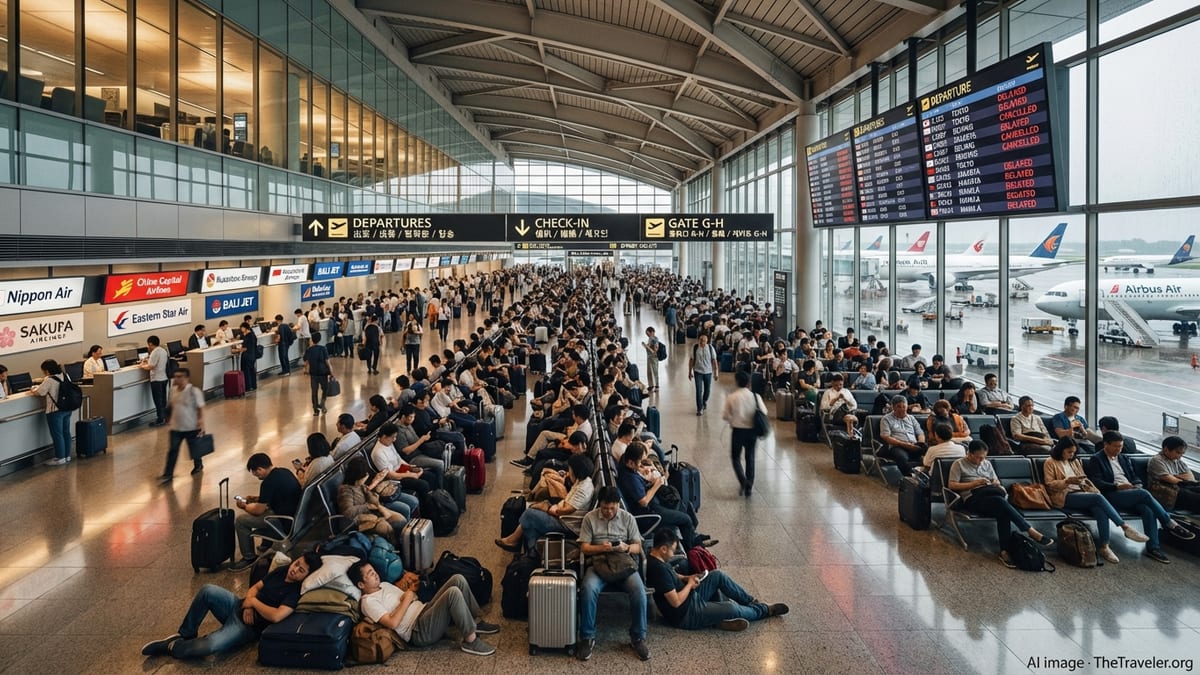
Major airports across Asia Pacific have recorded thousands of delays and hundreds of cancellations in recent days, leaving travelers stranded from Tokyo and Seoul to Singapore and Guangzhou. Published coverage indicates that on several peak days in early April, more than 3,000 flights were delayed and hundreds canceled across key hubs, including Tokyo Haneda, Hong Kong, Incheon, Manila and Singapore Changi. The numbers follow a series of earlier disruption spikes in March that rippled through domestic and international networks.
Reports from aviation tracking services describe a pattern of cascading knock-on effects. Weather disruptions in one subregion, congestion at a handful of busy hubs and local staff shortages have combined to push already stretched airline schedules beyond their limits. With aircraft and crews tightly rostered, any shock has translated quickly into long queues at check-in, missed connections and aircraft out of position for subsequent flights.
Recent analysis of a major March disruption event across Asia Pacific noted that airlines were often forced to cancel rather than merely delay flights because crew duty-time limits and slot rules left little room to recover operations later in the day. Observers see this as evidence that, despite strong demand, the region’s aviation system is operating with minimal redundancy.
Industry data also suggests that load factors in Asia Pacific are now at or near record highs, with seat capacity still catching up to post-pandemic demand. Publicly available figures from global airline associations show regional carriers posting some of the strongest year-on-year traffic growth worldwide, yet with capacity rising at a slightly slower pace. That imbalance has helped support yields but reduced the ability to absorb operational shocks.
Fuel Shock Turns Delays Into a Margin Crisis
The latest disruption wave is unfolding against a sharp spike in jet fuel costs tied to conflict and shipping constraints around the Middle East. Trade press and financial media report that jet fuel prices have roughly doubled from pre-crisis levels since early March, with some estimates placing spot prices near or above 190 to 200 dollars a barrel. The closure or restriction of key maritime chokepoints has tightened supply into Asia, which relies heavily on imported oil and refined products.
Analysts note that airlines globally were already operating on slender profitability, with forecasts for 2026 pointing to low single-digit net margins. Asia Pacific carriers have been among the biggest contributors to global traffic growth but have also faced higher structural costs related to labor, fleet renewal and airport infrastructure. The sudden fuel shock is now eating into what one recent industry outlook described as a narrow cushion of profitability built up over 2024 and 2025.
Regional reports indicate that airlines across Asia have begun trimming schedules by as much as 5 to 10 percent in response to tightening fuel supplies, particularly at more vulnerable import-dependent markets in Southeast and South Asia. Some carriers are operating selected long-haul flights with extra fuel uplift from alternative hubs, which further reduces payload and revenue potential on those routes.
Low-cost and leisure-focused airlines appear especially exposed. Public information on recent capacity and pricing decisions shows several budget operators in Asia cutting routes and lifting fares significantly, in some cases by around 30 to 40 percent on selected sectors, to offset fuel costs. Because these carriers traditionally compete on volume and operate with thinner margins and less fuel hedging, their ability to absorb prolonged fuel price spikes is limited.
Demand Recovery Meets Limited Buffers
The current crunch comes at a time when air travel demand in Asia has largely recovered to, and in some markets surpassed, pre-pandemic levels. International traffic to and from major tourism and business destinations in Southeast and Northeast Asia has strengthened, supported by the easing of visa rules and the gradual return of Chinese outbound travelers. Industry statistics released in recent weeks show Asia Pacific leading global growth in passenger traffic on a percentage basis.
Yet the rebuild in capacity has been more cautious. Airlines and lessors are contending with aircraft delivery delays, engine maintenance bottlenecks and financing constraints that slow the return of grounded or stored jets. Several industry reports have highlighted a structural shortage of pilots, technicians and ground staff in parts of the region, the legacy of deep cuts made during the pandemic. That means many carriers are running tight schedules with limited spare aircraft and crews.
These dynamics leave little headroom when weather, airspace closures or fuel rationing intervene. Analysts point to recent disruption episodes in India and China, where aggressive scheduling around peak travel periods has magnified the impact of storms, new crew-duty rules or air traffic control constraints. When flights are tightly banked to maximize aircraft utilization and connectivity, a single early-morning delay can cascade into missed slots and further cancellations across the day.
Travel advisors and passenger advocacy groups are warning that such conditions could make irregular operations more common through the northern summer if fuel markets remain volatile and airspace restrictions persist. The same high load factors that underpin airline revenues also reduce the availability of spare seats for reaccommodating disrupted travelers, lengthening recovery times for both networks and passengers.
Rising Fares and Shifting Networks for Travelers
For travelers, the immediate effects of the Asia disruption are longer journeys, higher fares and more complex routings. As carriers reroute services to avoid conflict zones and fuel pinch points, some popular long-haul flights between Asia and Europe are adding hours of flying time. Reports from South Asian and Gulf markets describe significant increases in fuel burn on rerouted services, at a moment when the underlying cost of fuel is already surging.
Short-haul leisure routes are being adjusted as well. Several Asia-based airlines have publicly announced selective capacity cuts on fuel-intensive or lower-yielding services, especially to secondary holiday destinations. Others are shifting capacity toward markets where fuel hedges, strong premium demand or higher ancillary revenues provide better protection for margins. This is altering the competitive balance on certain city pairs, particularly where foreign carriers step in to fill gaps left by regional operators.
At the same time, the combination of tight capacity and elevated operating costs has led many airlines to increase ticket prices. Regional business coverage notes that some Asia Pacific carriers have already begun lifting base fares and surcharges, while also warning of possible further increases if fuel prices remain elevated. For price-sensitive segments, including group tours and migrant worker traffic, these adjustments are prompting cancellations or switches to alternative destinations perceived as more affordable.
Travel planners advise that passengers build in extra time for connections at major Asian hubs and monitor bookings closely for schedule changes. With many flights departing close to full, rebooking options during disruption windows can be limited, particularly on peak travel days.
Policy Debate Over Support and Resilience
The disruptions and mounting cost pressures are feeding into a wider policy debate over how to support Asia’s aviation sector while improving its resilience. The Association of Asia Pacific Airlines has recently called for measures to ease the burden of surging fuel and insurance costs, according to regional trade coverage. Proposals in public discussion include temporary tax relief on jet fuel, targeted credit support and faster approvals for new routes that could improve network flexibility.
Industry experts argue that the current turbulence exposes longer-running structural issues, from high airport charges and fragmented airspace management to underinvestment in air traffic control and weather-resilience infrastructure. Several international analyses published over the past year have emphasized that Asia Pacific airlines, while growing rapidly in traffic terms, continue to operate on thinner margins than carriers in some other regions, leaving them more exposed to cost and demand shocks.
There is also renewed attention on diversification of fuel supply. Commentaries in energy and aviation circles suggest that some governments may look to broaden sourcing of refined products and accelerate investment in fuel storage and alternative supply routes after the latest crisis. However, these are medium-term responses that will not alleviate the immediate pressures facing airlines and travelers through the current travel seasons.
For now, the succession of delay-filled days at Asia’s biggest hubs underlines how closely airline operations are tied to fragile financial assumptions. As fuel prices, airspace availability and demand patterns continue to shift, carriers across the region appear likely to face a prolonged test of how much disruption their business models and balance sheets can absorb.