

More news on this day
Air travel across Asia faced another day of severe disruption on April 10, as publicly available data showed at least 104 flights cancelled and 1,367 delayed at major hubs including Guangzhou, Shenzhen, Chongqing, Shanghai and Jakarta, leaving thousands of passengers stranded or facing missed connections.
Get the latest news straight to your inbox!
Major Asian Hubs Grapple With Wave of Disruptions
The latest figures, compiled from flight-tracking dashboards and regional travel industry coverage, point to concentrated disruption at some of East and Southeast Asia’s busiest gateways. Guangzhou Baiyun, Shanghai Pudong, Shenzhen Bao’an and Chongqing Jiangbei in China, along with Jakarta’s Soekarno Hatta International Airport, accounted for the bulk of cancellations and delays, while knock-on effects were reported at secondary airports across the region.
Recent reporting on aviation performance in China highlights how quickly operational strain can build. Coverage of China’s network in early April described hundreds of cancellations and several thousand delays in a single day, with Guangzhou and Shanghai repeatedly among the worst affected, reflecting their role as core transfer points for both domestic and international routes.
Jakarta’s main hub has also entered the spotlight this week. Regional travel news outlets noted that Indonesia’s capital has been battling weather-related disruption, and that recent infrastructure issues at Soekarno Hatta’s Terminal 3 added further complexity to airport operations just as passenger volumes continue to climb.
Although the numbers vary from day to day, the combined tally of 104 cancellations and 1,367 delays across these hubs on April 10 illustrates a broader pattern of strain across Asia’s aviation system, rather than a problem confined to any single airport or airline.
Weather, Infrastructure Strain and Airspace Limits Combine
Published coverage across Asian markets indicates that the causes of the current disruption are multi layered. In several parts of China, unsettled spring weather has affected visibility and wind conditions, triggering spacing requirements and temporary flow restrictions that slow departures and arrivals. Even modest schedule degradation during peak hours can cascade into late running banks of flights through the afternoon and evening.
In Indonesia, recent storms around Jakarta have already been linked in regional reports to episodes of flooding and water damage at Soekarno Hatta. A widely cited account this week described a ceiling collapse near a gate in Terminal 3 after heavy rainfall, prompting the closure of part of the boarding area and forcing airlines to shuffle aircraft and passengers between gates, lengthening boarding times and increasing the risk of missed slots.
Aviation commentators are also drawing attention to temporary airspace constraints further north. Notices to air missions issued over waters off the Chinese coast have prompted questions from travelers about potential diversions or reroutes for flights to and from Shanghai. Even when services are not cancelled outright, longer routings and holding patterns can push crew duty times to their legal limits, reducing operational flexibility for airlines and heightening the risk that later rotations will be delayed or cancelled.
Against this backdrop, airline operations teams are balancing aircraft availability, crew duty limits and airport capacity, a combination that leaves little margin when adverse weather or infrastructure failures occur at more than one hub on the same day.
China’s Mega Hubs Bear the Brunt
Chinese airports remain at the center of the current disruption. Recent tallies released by travel industry outlets showed single day totals of over 3,000 delays and more than 200 cancellations across mainland China, with Guangzhou Baiyun and Shanghai Pudong consistently ranking among the most heavily impacted. Reports indicate that hundreds of departures at these hubs have been pushed back by more than an hour, while dozens of services were scrubbed entirely on peak disruption days.
Guangzhou serves as a vital connection point linking southern China with Southeast Asia, the Middle East and Europe. When its operation slows, domestic feeder flights struggle to connect with long haul departures, and returning intercontinental services face delays on their onward domestic legs. Shanghai’s dual airports, particularly Pudong for international traffic, play a similar hub role for eastern China, making any loss of capacity there immediately visible in delay statistics.
Shenzhen and Chongqing add another layer of complexity. Both airports have expanded rapidly in recent years, and publicly available data this month shows that even modest cancellation numbers can translate into significant passenger disruption because of tight connection times and busy evening departure waves. When services at all four Chinese hubs are disturbed at once, airlines have limited options to reroute travelers within the domestic network without triggering capacity issues elsewhere.
Regional analysts note that these pressures come at a time when Chinese carriers have been rebuilding international schedules, adding long haul and regional flights that rely on smooth hub operations in Guangzhou, Shanghai and other major cities to remain viable.
Jakarta and Southeast Asia Feel the Ripple Effects
In Southeast Asia, Jakarta’s Soekarno Hatta stands out as both a contributor to and a victim of the wider disruption. Travel and tourism industry coverage this week has detailed how weather systems over Java and the Jakarta metropolitan area have already led to several waves of delays. The recent damage to part of Terminal 3’s ceiling intensified scrutiny of the airport’s infrastructure and raised concerns about congestion during peak international departure periods.
With Jakarta handling hundreds of daily flights for Indonesian and foreign carriers, any operational slowdown quickly feeds into regional schedules. Short haul routes linking Jakarta with Singapore, Kuala Lumpur, Bangkok and various secondary Indonesian cities are particularly susceptible, as aircraft turnarounds on these sectors are often planned with limited ground time. Delays at Soekarno Hatta can therefore propagate across multiple countries in a single day.
Neighboring hubs such as Singapore Changi, Kuala Lumpur International and Bangkok Suvarnabhumi are also contending with higher than usual levels of disruption, according to recent regional briefings. While these airports may not be experiencing the same concentration of cancellations as some Chinese hubs, additional holding patterns, weather diversions and late arriving aircraft have increased pressure on gate and crew resources.
Taken together, these conditions mean that travelers flying through Southeast Asia, even on routes that do not touch China, may still encounter delays that trace back to issues at major Chinese and Indonesian airports earlier in the day.
Travelers Face Missed Connections and Overnight Stays
For passengers, the practical impact of 104 cancellations and more than 1,300 delays in a single day is measured in missed connections, rebooked itineraries and unexpected overnight stays. At large transfer hubs such as Guangzhou and Shanghai, publicly available dispatch data shows that many of the delayed flights sit within complex connection banks, magnifying the disruption whenever even a portion of the schedule slips.
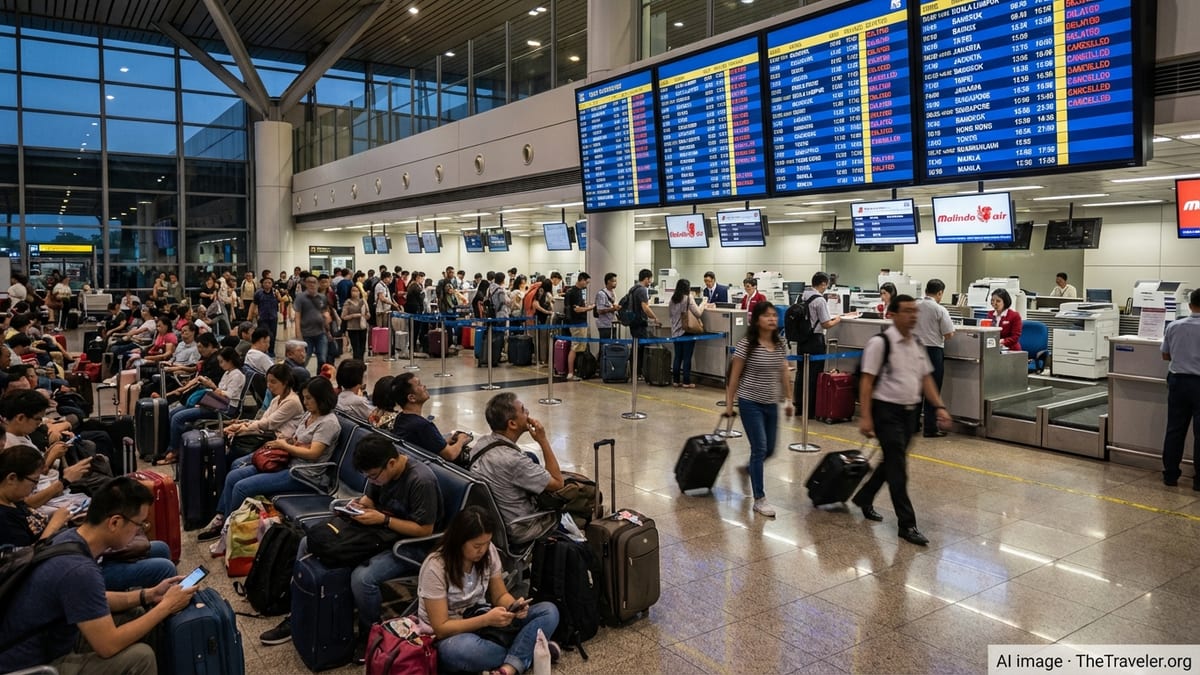
Regional consumer travel sites have reported images and accounts of crowded transfer areas, long queues at airline service counters and departure boards heavily populated with delayed statuses at multiple Asian hubs in recent weeks. As aircraft arrive late, onward sectors depart behind schedule, and crew rest requirements can force airlines to cancel later legs when duty limits are reached.
Travel industry guidance in light of the current disruption generally emphasizes preparation and flexibility. Passengers are being encouraged by airlines and airports, via public advisories and social media channels, to monitor flight status frequently on the day of travel, allow extra time for connections, and be ready for potential rerouting through alternative hubs such as Singapore, Kuala Lumpur or Hong Kong when space is available.
With April traditionally marking the start of a busier travel season on many Asian routes, industry observers note that the capacity of airports and airlines to manage cascading disruption at multiple hubs will be closely watched in the weeks ahead, particularly if unsettled weather and regional airspace constraints persist.