

More news on this day
Aviation networks across Asia are experiencing significant disruption this week, with major hubs from Tokyo to Jakarta reporting waves of flight delays and cancellations driven by a mix of extreme weather, constrained airspace and mounting operational pressures.
Get the latest news straight to your inbox!
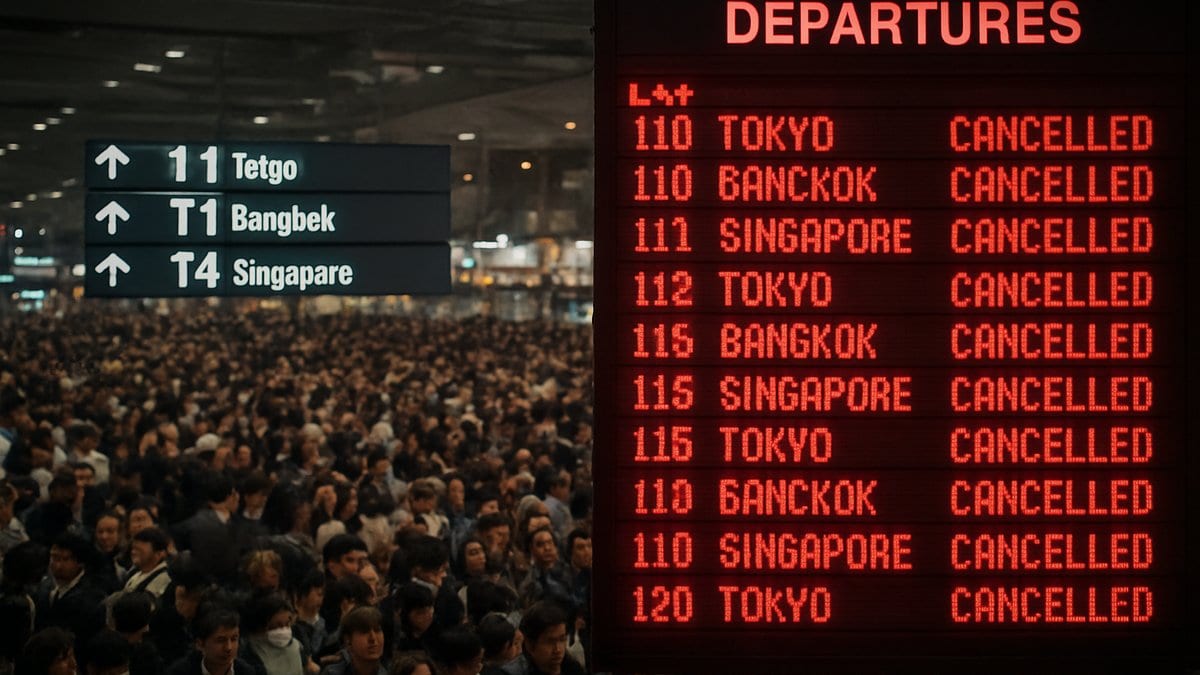
Ripple Effects From Tokyo to Southeast Asia
Recent disruption data and regional coverage point to a sharp escalation in delays across Asia’s busiest corridors, with Tokyo featuring prominently as a pressure point. Reports indicate that congested schedules at Tokyo-area airports, combined with equipment-related capacity constraints on select carriers, have turned minor timetable slippages into network-wide knock-on delays affecting onward connections throughout the region.
Publicly available disruption tallies compiled in late March show more than 2,000 flights delayed and over 100 cancellations across key Asian hubs in just a short window, including services touching Japan, Thailand, India, Malaysia and the United Arab Emirates. These figures highlight how quickly an already stretched system can seize up when a handful of busy hubs encounter simultaneous strain.
Travel-focused outlets tracking Asia-wide operations describe a pattern in which delayed departures from Tokyo ripple south and west through the day, complicating schedules for airlines linking the Japanese capital to Jakarta, Singapore, Kuala Lumpur and Gulf connection points. Even when aircraft ultimately depart, the late running often destroys carefully planned transfer windows at transit hubs across Southeast Asia.
For passengers, this has translated into missed connections, rebooked itineraries and unplanned overnight stays in cities that were never meant to be more than a brief layover. Social media posts and passenger reports from Tokyo’s major airports describe long lines at transfer desks, limited rebooking options and uncertainty over when backlogged flights will be able to depart on time again.
Jakarta and Regional Hubs Struggle With Cascading Delays
Jakarta’s Soekarno Hatta International Airport has emerged as one of the Southeast Asian nodes feeling the brunt of the disruption. Coverage focused on Indonesia’s aviation sector shows that local delays and equipment issues on domestic routes are now compounding the international backlog arriving from Northeast Asia and the Gulf.
Earlier incidents in Indonesia, including emergency landings and safety-related investigations, have already placed the country’s aviation system under close scrutiny. While those events are distinct from the current wave of schedule problems, they have contributed to a cautious operational environment in which crews and controllers are less willing to push tight turnarounds, adding minutes and sometimes hours to the delay picture when conditions are marginal.
Regional travel advisories note that Jakarta is not alone. Other Southeast Asian hubs such as Bangkok and Kuala Lumpur have recorded spikes in delay minutes when weather fronts, aircraft maintenance events and crew-availability challenges converge on the same day. When these hubs are also handling disrupted flights from Tokyo and long-haul services that have been rerouted around conflict-affected airspace, their capacity to recover quickly is sharply reduced.
With Indonesian, Thai and Malaysian airports serving as key waypoints between Northeast Asia and Australia, the Middle East and Europe, the strain on Jakarta and its neighbors is magnified well beyond local point-to-point traffic. A delayed arrival from Japan or the Gulf can scramble several onward flights at once, triggering a domino effect across the network.
Conflict and Closed Airspace Squeeze Asia’s Flight Corridors
Beyond local operational issues, current delays are being amplified by a much broader reshaping of international air corridors. Published coverage of the conflict in and around Iran indicates that large swathes of Middle Eastern airspace remain restricted, forcing airlines to reroute long-haul services linking Asia with Europe and North America.
Analyses of the evolving situation describe thousands of flights either cancelled outright or diverted to avoid closed or high-risk skies, particularly over Iran and parts of neighboring states. Routes that once relied on efficient overflight shortcuts are now bending around these zones, lengthening flight times and compressing traffic into a smaller set of available corridors.
Industry briefings on airspace constraints note that one of the principal remaining east–west corridors runs over Saudi Arabia, where air traffic control capacity is being tested by unusually high volumes. Advisories circulating among multinational firms and travel managers reference unprecedented air traffic saturation in this corridor, with knock-on delays emerging at major hubs along the route.
This redirection of global flows has direct consequences for Asia. Flights between Tokyo or Southeast Asian cities and Europe that once passed smoothly over Iran or Iraq are now competing for limited slots through alternative skies or relying more heavily on intermediate hubs in the Gulf and South Asia. Any disruption at those hubs feeds directly back into the schedules of carriers operating in and out of Asian airports, exacerbating local delay statistics from Tokyo to Jakarta.
Fuel Supply Risks and Gulf Hub Disruptions Intensify Strain
Jet fuel security has become another critical vulnerability for Asia’s aviation network. Recent industry reports on infrastructure risks highlight incidents such as a drone attack on a fuel storage facility near Dubai, underlining how quickly a single strike on energy infrastructure can translate into operational risk for airlines across the region.
Specialist situation reports compiled in March stress that elevated jet fuel prices, constrained supply chains and exposure of airport fuel systems are jointly increasing the likelihood of schedule disruption, particularly on long-haul services that rely on Gulf hubs for refuelling and connections. Asia–Gulf traffic and itineraries that depend on Dubai and neighboring cities as transfer points are flagged as especially sensitive.
Travel trade publications focusing on airline strategy in Asia Pacific describe how carriers are extending Middle East flight suspensions and rerouting services via European or Mediterranean hubs to avoid the most volatile airspace. For some airlines, US-bound flights from the Indian subcontinent now include technical stops far from their traditional routing, lengthening block times and narrowing the margin for on-time arrivals in Asia on the return leg.
Parallel reporting on Dubai itself shows that the city has recently experienced dozens of cancellations and well over a hundred delays in a single day, affecting passengers bound for Southeast Asia, Europe and beyond. When a pivotal hub like Dubai stumbles, multi-leg journeys linking Tokyo, Jakarta and other Asian cities through the Gulf can unravel quickly, adding another layer of disruption on top of existing airspace and capacity issues.
A Global Pattern of Fragility Exposed in Asia
The disruption across Asia is occurring against a backdrop of similar turbulence in Europe and North America, where storm systems, technical glitches and capacity constraints have generated thousands of delays in recent weeks. Operational reports from both regions show how even well-resourced networks can be pushed to the breaking point when weather, infrastructure and labor availability collide.
In Europe, recent monitoring by passenger-rights and delay-tracking platforms has pointed to days with several hundred cancellations and more than 2,000 delays, particularly at major hubs in London, Paris, Frankfurt and Istanbul. Separate coverage has highlighted radar outages and air traffic control work programs that contributed additional minutes of delay, complicating flight planning for services heading to and from Asia.
In the United States, severe thunderstorms and flash flooding at the end of March generated more than 3,000 delays in a single day, according to disruption tallies cited by travel publications. These events reduced the flexibility of global carriers that depend on transpacific and transatlantic aircraft rotations, resulting in fewer spare aircraft and more vulnerability to knock-on delays in Asian schedules.
Taken together, these developments reveal an aviation system in which Asia’s transit hubs, from Tokyo to Jakarta, are tightly bound to events thousands of kilometers away. Weather in the United States, conflict in the Middle East, technical issues in European control centers and fuel infrastructure incidents near Gulf airports ultimately converge in departure boards across Japan, Indonesia and their neighbors, leaving travelers to navigate a web of delays that is increasingly global in both cause and effect.