

More news on this day
Thousands of passengers across Asia faced severe disruption today as airports in Thailand, Singapore, Saudi Arabia, China, India, and Malaysia reported 203 flight cancellations and 3,055 delays, snarling operations for carriers including AirAsia, Singapore Airlines, Saudia, IndiGo, and others at major hubs from Bangkok and Beijing to Delhi and beyond.
Get the latest news straight to your inbox!
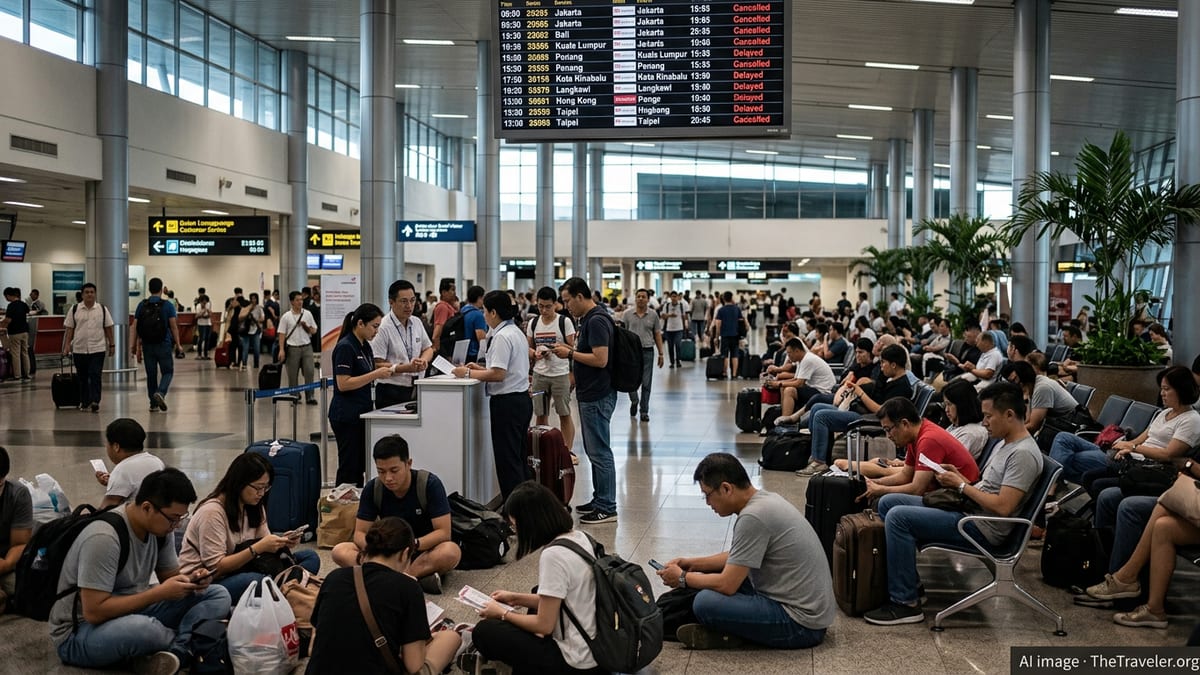
Key Asian Hubs Buckle Under Heavy Schedule Disruptions
The latest figures highlight how concentrated the disruption has become at Asia’s busiest gateways. Data from flight tracking and aviation analytics platforms indicates that Bangkok, Beijing, Delhi, Singapore, and key Saudi and Malaysian airports accounted for a large share of the 3,258 affected services, underscoring the vulnerability of regional hubs to knock-on operational shocks.
Bangkok and Delhi, both critical transfer points for South and Southeast Asia, have seen waves of rolling delays that build throughout the day. When early-morning departures depart late or are scrubbed, aircraft and crew rotations fall out of sync, forcing airlines to trim schedules through the afternoon and evening. Similar patterns are emerging at Beijing’s dual airports, where tight turnaround times leave little slack for recovery once operations start to slip.
In Singapore and Kuala Lumpur, the impact is particularly visible on regional routes linking secondary cities in Indonesia, Thailand, India, and southern China. Many of these services are operated by narrowbody aircraft that cycle through multiple countries in a single duty day, meaning a delay at one airport can cascade across several others in quick succession. For travelers, that often translates into misconnected itineraries and extended waits even when their own flight is technically still operating.
Saudi Arabian gateways, especially Jeddah and Riyadh, have also been pulled into the turbulence as long-haul and connecting traffic is rerouted around constrained airspace and congested corridors. The result is an uneven pattern where some departures leave broadly on time while others are significantly delayed or canceled outright with limited advance notice.
AirAsia, Singapore Airlines, Saudia and IndiGo Among Most Affected
The disruption has fallen heavily on some of the region’s largest carriers by volume. AirAsia, with its dense short-haul network spanning Thailand, Malaysia, India, and China, appears frequently in delay and cancellation logs, reflecting how exposed point-to-point low-cost operations are when aircraft utilization is high and schedule buffers are slim.
Singapore Airlines and its regional partners continue to grapple with the challenge of maintaining long-haul connectivity while managing regional turbulence. Even when flagship intercontinental services remain intact, upstream delays on feeder flights from neighboring countries can leave connecting passengers misaligned with their onward departures, forcing rebookings and overnight stays.
In India, IndiGo’s extensive domestic and regional footprint makes it particularly sensitive to any shock at major nodes such as Delhi. When operations at one or two large metros are constrained, aircraft that were due to fan out across the domestic network are suddenly out of position, prompting a mix of cancellations and short-notice retimings that ripple into smaller cities.
Saudia, which relies on Saudi hubs as both origin markets and transfer points between Asia, Europe, and Africa, faces the dual challenge of managing local demand and absorbing rerouted international traffic. Publicly available information shows that the carrier has already been adjusting schedules in recent weeks to account for evolving airspace and capacity constraints, and the latest figures suggest that pressure remains elevated.
Weather, Airspace Restrictions and Congested Corridors Drive Chaos
While no single cause explains the full scale of today’s disruption, several overlapping factors are placing sustained strain on airline and airport operations across Asia. Seasonal weather patterns, including heavy rain and thunderstorms over parts of Southeast and South Asia, have reduced usable runway time and forced temporary ground stops at some airports, compressing departures into narrower windows later in the day.
At the same time, ongoing airspace restrictions linked to geopolitical tensions in and around the Middle East continue to push Europe Asia and West Asia Asia traffic onto longer and more congested routes. Industry analyses describe airlines adding hours to flight times and threading through limited corridors, which in turn reduces schedule flexibility and increases the likelihood of missed connections and crew duty time exceedances.
China’s increasingly busy domestic skies add another layer of complexity. High traffic density around megacities such as Beijing and Guangzhou means small disruptions can quickly trigger holding patterns and sequencing delays that back up across multiple airports. When those delays intersect with already stretched schedules in Southeast Asia or India, airlines have few options other than to cancel selected departures to restore some level of order.
Operational capacity at some airports remains finely balanced as well. Ground handling resources, gate availability, and security processing often operate near peak even on normal days at major hubs. When flights run significantly out of timetable, crews and passengers can arrive simultaneously in waves, overwhelming infrastructure designed for a smoother flow.
Passengers Stranded, Missed Connections and Overnight Stays Mount
For travelers, the combined effect has been long queues, crowded terminals, and widespread uncertainty. Reports from affected airports describe passengers facing hours-long waits at check in counters and transfer desks as airlines attempt to rebook disrupted journeys onto limited remaining seats across the region.
Missed connections are a particular pain point at hubs like Bangkok, Singapore, and Beijing, where tight transfer windows are common for cost and efficiency reasons. When inbound flights arrive significantly late, even small schedule slippages can leave travelers unable to board their intended onward services. With many alternative flights also running full, rebooking options can involve rerouting through entirely different hubs or accepting overnight stays.
Accommodation and meal arrangements vary by carrier and jurisdiction, adding further confusion. Some passengers on disrupted services report being provided with hotel vouchers or flexible rebooking options, while others receive only basic refreshments or instructions to contact customer service remotely. Travelers on low cost carriers may be particularly exposed to out-of-pocket expenses when disruptions fall outside the scope of mandatory compensation rules.
Airports have responded by deploying additional staff to manage crowds and field questions, but information screens and mobile apps often lag behind real-time operational decisions. As a result, many travelers only learn of cancellations or extended delays after passing security or arriving at the gate, limiting their ability to adjust plans proactively.
What Today’s Turmoil Signals for Upcoming Travel Periods
The scale and spread of the latest disruptions offer a warning for travelers planning trips through Asia in the coming weeks. Aviation data from recent months points to a pattern of repeated high impact days in which cancellations may still be relatively limited in number, but extensive delays effectively erode schedule reliability across entire regions.
Analysts note that airlines and airports are operating with less operational slack than before the pandemic, particularly in terms of spare aircraft, trained crews, and frontline staff. This means that when external shocks arise whether from weather, airspace restrictions, or surging demand the system has fewer buffers to absorb them before passengers begin to feel the effects.
For many travelers, itineraries that once allowed confident same day connections between regional and long haul flights may now carry higher risk, especially when they rely on single daily services or complex routings through heavily impacted hubs. Aviation observers increasingly emphasize the value of longer connection windows, flexible tickets, and contingency planning as pragmatic responses to a more fragile operating environment.
While today’s tally of 203 cancellations and 3,055 delays is striking, it fits into a broader trend of chronic disruption that has defined Asia’s recovery period. Unless underlying constraints on airspace, infrastructure, and staffing ease meaningfully, similar flare ups are likely to recur, with passengers urged to factor that volatility into their travel decisions.