

More news on this day
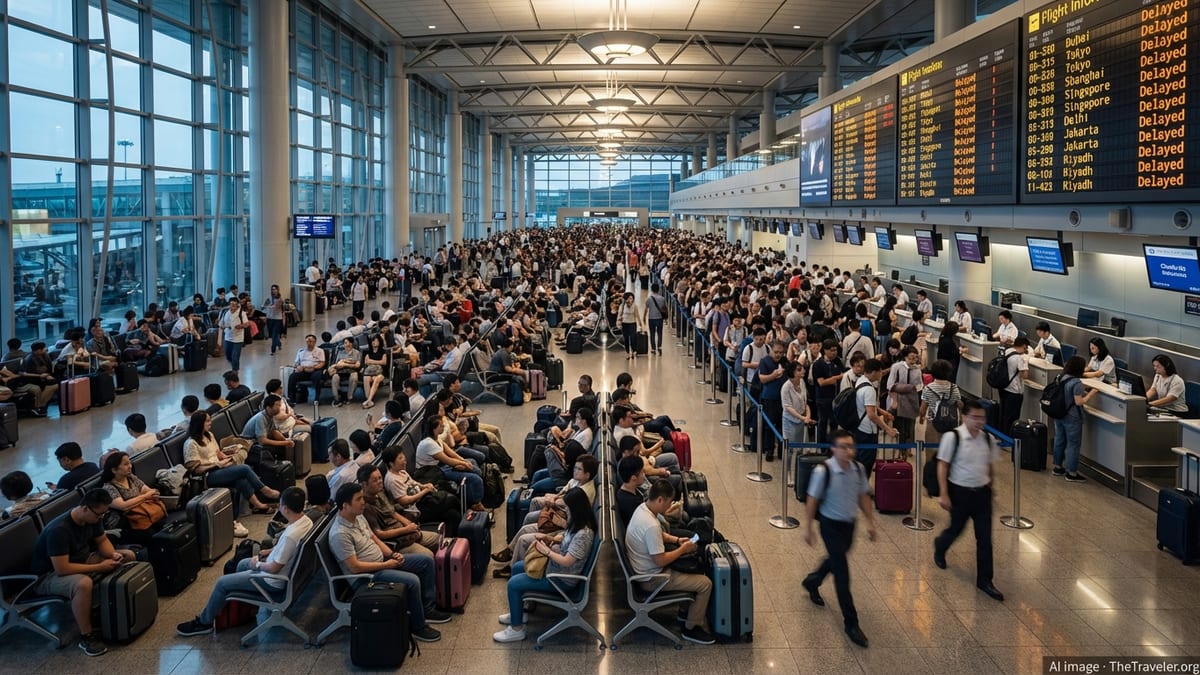
Thousands of passengers across Asia faced lengthy queues, missed connections, and overnight airport stays today as more than 3,600 flights were delayed and around 50 were cancelled across China, India, the United Arab Emirates, Singapore, Japan, Indonesia, Saudi Arabia, and other countries, disrupting operations for major carriers including Cathay Pacific, Singapore Airlines, Emirates, Japan Airlines, Korean Air, Air India, and several regional airlines.
Major Asian Hubs Buckle Under Intense Operational Strain
The latest wave of disruption swept through some of Asia’s busiest international hubs, from Dubai and Tokyo to Shanghai and Riyadh, compounding weeks of elevated delay levels across the region. Airport departure boards at Dubai International, Tokyo Haneda, Shanghai Pudong, Singapore Changi, Jakarta Soekarno Hatta, and Delhi Indira Gandhi showed long columns of late or rescheduled flights as airlines struggled to keep services running to timetable.
Operational data compiled from airport boards and aviation analytics firms indicates that roughly 3,600 flights were delayed and around 50 cancelled over the most recent 24 hour period, building on a pattern of repeated mass-disruption days earlier in February. On several of those days, major Asian gateways collectively logged between 2,800 and nearly 4,000 delays alongside dozens of cancellations, underscoring how fragile schedules have become at peak times.
India and Southeast Asia once again featured prominently, with Delhi and Mumbai among the hardest hit in South Asia and Jakarta, Bangkok, and Singapore suffering extensive knock-on effects in Southeast Asia. In East Asia, Tokyo and Shanghai recorded significant clusters of delayed departures and arrivals, while in the Gulf region, Dubai and Riyadh saw outbound and inbound services pushed back for hours, snarling long haul connections linking Asia with Europe and Africa.
Although the total number of outright cancellations remained relatively modest compared with the volume of delays, even a small number of scrubbed flights left aircraft and crews out of position. That further complicated efforts to recover schedules, particularly for airlines relying on tight turnaround times and high aircraft utilisation on dense intra-Asia routes.
Flag Carriers And Regional Giants Among Worst Affected
Among the airlines most heavily affected were some of Asia’s best known full service and low cost carriers. India’s IndiGo and Air India again reported large numbers of late departures at their primary hubs, while Singapore Airlines, Cathay Pacific, Japan Airlines, Korean Air, China Eastern, Emirates, Saudia, Flynas, Lion Air, Batik Air, and Thai Airways all contended with extensive disruption on their regional and long haul networks.
For several Indian operators, the latest wave of delays comes on top of an already challenging operational backdrop. IndiGo, which endured a major scheduling crisis in late 2025 after new crew duty rules came into force, continues to face high demand across its domestic network and limited room for error in its rostering and aircraft deployment. Air India, in the midst of a multi year transformation and fleet renewal programme, has also struggled at times to maintain punctuality while integrating new aircraft and ramping up international services.
In Southeast Asia, Lion Air and Batik Air saw large numbers of flights running behind schedule at Jakarta and other Indonesian airports, reflecting persistent congestion and weather related bottlenecks in the archipelago. Meanwhile, AirAsia and Malaysia Airlines have grappled with heavy delay volumes on days when Kuala Lumpur and Bangkok recorded several hundred late operations each, illustrating how quickly disruptions can cascade through point to point and connecting networks alike.
Gulf heavyweight Emirates and regional Saudi carriers including Saudia and Flynas were also drawn into the turbulence as their services to and from Dubai, Jeddah, and Riyadh were affected by knock on congestion, slot restrictions, and air traffic flow management measures. As those hubs handle large numbers of connecting passengers between Europe, Africa, and Asia, even moderate schedule changes reverberated widely.
From Shanghai To Riyadh, Passengers Face Long Queues And Missed Connections
For travellers on the ground, the statistics translated into frayed tempers, long queues at check in and transfer desks, and a scramble for scarce hotel rooms near airport terminals. At Shanghai Pudong, where hundreds of delayed movements were recorded on multiple recent days, passengers waited for hours as departure times were repeatedly pushed back and aircraft were reassigned to prioritise certain routes.
In Tokyo, where Haneda has seen daily delay tallies in the low to mid hundreds during several recent disruption peaks, domestic passengers were often spared outright cancellations but endured rolling delays that disrupted carefully timed day trips and business itineraries. International travellers transiting through the Japanese capital, however, were more vulnerable to missed onward connections, particularly on overnight routes to Southeast Asia and Oceania.
Dubai International, one of the world’s largest intercontinental hubs, again demonstrated both its resilience and its vulnerability. While the airport has extensive infrastructure and experience handling irregular operations, the sheer volume of connecting traffic meant that even short arrival delays could push travellers past their connection windows. Airline staff spent much of the day rebooking long haul passengers onto later departures, while airport lounges and nearby hotels filled quickly.
In Riyadh and Jeddah, where delays were more concentrated in certain waves of domestic and regional departures, travellers heading onward to South Asia and Southeast Asia on late night and early morning services encountered packed terminals and last minute gate changes. For workers travelling on tight schedules, particularly those returning to jobs in the Gulf from India, Pakistan, and Southeast Asia, any delay risked knock on consequences at their destinations.
Weather, Airspace Constraints, And Capacity Limits Drive Disruption
Aviation analysts point to a familiar mix of causes behind the recurring waves of disruption, with seasonal weather, constrained airspace, and infrastructural bottlenecks all interacting with surging post pandemic demand. Winter weather systems across parts of East Asia and the northern Indian subcontinent have periodically reduced airport capacity, forcing traffic management authorities to impose spacing restrictions that ripple through airline schedules.
At several mainland Chinese airports, variable visibility and low cloud ceilings contributed to holdings and diversions that strained already busy arrival and departure banks. In India, a combination of seasonal fog at Delhi and congestion at major metro airports added to delays, particularly in early morning and late evening peaks. Elsewhere, heavy rain and thunderstorms around Jakarta, Bangkok, and other tropical hubs temporarily halted ground operations and increased the risk of missed slots.
Beyond meteorological factors, airspace constraints are playing a larger role in Asia’s operational reliability. Rerouting around congested or restricted corridors has extended flight times on certain routes, leaving airlines with less buffer in their daily rotations. Some carriers have responded by building slightly longer scheduled block times into their timetables, but that approach can only go so far without eroding overall network efficiency.
Underlying these immediate triggers is a deeper capacity challenge. Passenger volumes at major Asian hubs have rebounded strongly and in many cases already exceeded pre pandemic levels, yet airport infrastructure, staffing, and air traffic management systems have not always kept pace. That mismatch leaves airlines and airports operating closer to their limits and more vulnerable to any shock, whether from weather, technical issues, or staffing shortages.
Crew Rostering And Maintenance Pressures Test Airline Resilience
Behind the scenes, airlines across Asia are contending with tight crew availability and maintenance windows, factors that can transform a modest delay into a day long disruption. New or updated crew duty and rest regulations in some jurisdictions have narrowed the options available to schedulers when flights run late, increasing the likelihood of crew going out of hours and aircraft being grounded until replacements can be found.
The experience of India’s largest airline in late 2025, when a failure to fully adapt schedules to revised crew work time rules helped trigger thousands of cancellations, remains a cautionary tale. While regulators subsequently granted temporary relief and operators adjusted their rosters, the incident underscored the complexity of managing rapidly growing fleets and tight wave bank structures under stricter safety regimes.
Maintenance capacity is also under pressure. With many airlines in the region taking delivery of new aircraft while extending the service life of older jets to keep up with demand, hangars and engineering teams are working at near full utilisation. Any unplanned technical issue, particularly on widebody aircraft used for long haul trunk routes, can force last minute equipment swaps or cancellations that ripple through an airline’s schedule.
For passengers, these back end pressures are invisible until they manifest as repeated gate announcements and revised departure times. Industry observers note that while safety is never compromised, the margin for keeping flights precisely on time has narrowed, especially for carriers operating dense intra Asia networks with multiple short turnarounds per day.
Travelers Confront Rising Costs And Limited Rebooking Options
The immediate human impact of the latest disruptions has been most visible in crowded terminals and social media posts from stranded travellers. Yet there are quieter consequences as well, including mounting incidental costs for food, local transport, and last minute accommodation that are not always fully reimbursed, particularly when delays are attributed to weather or air traffic control rather than airline fault.
On heavily booked routes, especially during school holidays and festival periods across Asia, rebooking options can be limited. Passengers whose flights are cancelled often find that alternative departures are already full or only available in higher fare classes, leaving them to wait for standby seats or accept significant changes to their itineraries. Those travelling on separate tickets, such as self connecting passengers linking low cost and full service carriers, face even greater financial risk if missed connections are not protected.
Travel insurance has offered some relief for better prepared passengers, though policies vary widely in their coverage of delays versus cancellations and in the documentation required to file claims. Consumer advocates in several markets have renewed calls for clearer, more harmonised compensation rules in Asia, pointing to the more robust passenger rights regimes in force in parts of Europe and North America as potential models.
Airport authorities and tourism bodies, aware that repeated disruption can tarnish a destination’s reputation, have stepped up communication efforts, deploying additional staff to assist with wayfinding and rebooking and using terminal screens and announcements to provide more granular updates. Nonetheless, many passengers report feeling left in the dark for long stretches as airlines and ground handlers juggle multiple operational priorities.
How Airlines And Airports Are Responding To The Ongoing Strain
In response to the ongoing turbulence in operations, airlines and airports across Asia are accelerating efforts to add resilience to their schedules and infrastructure. Some carriers have trimmed marginal frequencies or retimed certain flights to reduce congestion at peak hours, while others are adding tactical buffer time between legs on routes that have been repeatedly affected by airspace or weather related slowdowns.
Several major airports, including those in Singapore, Bangkok, Delhi, and Dubai, are investing in upgraded air traffic management tools and collaborative decision making platforms designed to improve information sharing between airlines, ground handling agents, and controllers. These systems aim to enable faster, more coordinated responses to disruption, reducing the time it takes to re sequence departures and allocate scarce gates and stands.
Carriers are also revisiting their crew and fleet planning models, using more sophisticated forecasting tools to anticipate days and time windows when fog, storms, or airspace constraints are most likely to disrupt operations. In some cases, airlines are pre emptively relaxing tight connections or building in spare aircraft and crew capacity on those days, accepting slightly higher costs in exchange for a more stable operation.
Industry analysts caution, however, that such measures will take time to fully bear fruit, particularly as passenger demand across Asia remains robust and many airlines continue to restore routes and frequencies that were cut during the pandemic years. In the meantime, travellers planning journeys through major hubs such as Dubai, Tokyo, Shanghai, Riyadh, Singapore, and the big Indian metros are being urged to allow extra time for connections and to stay alert for schedule changes in the hours before departure.