

More news on this day
Thousands of travelers across Asia and the Gulf are facing hours-long queues, missed connections and unexpected overnight stays after a fresh wave of disruption led to 283 flight cancellations and 3,972 delays in a single day across major hubs from Beijing and Tokyo to Delhi and Dubai.
Get the latest news straight to your inbox!
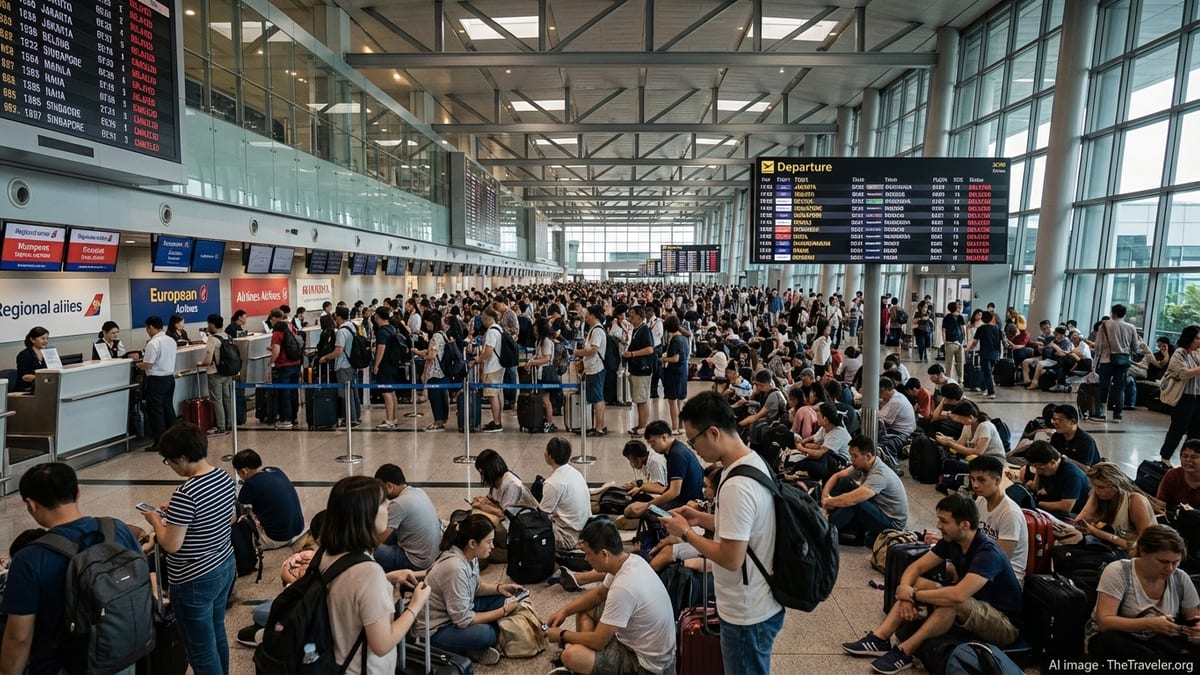
Major Hubs From Beijing to Dubai Under Strain
Publicly available flight-tracking data and specialist aviation analyses indicate that disruption has spread across a broad arc of countries, with China, Japan, Indonesia, South Korea and the United Arab Emirates among the hardest hit. The combined picture points to at least 283 cancelled departures and nearly 4,000 delayed services in a recent 24 hour window, underscoring how quickly operational issues can cascade across the region’s dense aviation networks.
Beijing’s primary airports, along with Tokyo’s Haneda and Narita, have recorded clusters of cancellations and rolling delays as airlines attempt to reset schedules and rotate aircraft back into position. In India, Delhi has seen mounting knock-on disruption as regional services connect into already stressed long haul banks. In the Gulf, Dubai has experienced extended queues and altered departure times as carriers rework timetables to accommodate rerouted long haul traffic.
Reports indicate that the pattern is not confined to a single airline or national market, but rather affects a wide mix of full service and low cost operators. Delays of more than an hour on trunk routes have had immediate consequences for connecting passengers, especially those linking Asia with Europe and Africa via Gulf and East Asian hubs.
Across the region, airport terminals have been dealing with familiar scenes of frustrated passengers, rebooking lines and hastily arranged hotel vouchers as airlines race to keep aircraft, crew and ground operations aligned with rapidly shifting schedules.
Flag Carriers and Regional Airlines Caught in the Ripple Effect
Network carriers such as Korean Air, ANA Wings and Qatar Airways are among those most exposed to the current wave of disruption, according to published coverage and aggregated operational data. Korean Air’s hub at Seoul Incheon has reported elevated departure delays and altered connection windows as late-arriving aircraft from China, Japan and Southeast Asia struggle to keep to planned turnaround times.
In Japan, ANA Wings and other domestic operators have faced a surge in delays across the Tokyo system, with impacts spreading to secondary cities as aircraft and crews arrive late from the capital. Separate published data from Japanese airports on recent busy days has shown more than a thousand delayed movements nationwide, highlighting the narrow margin for error in a tightly scheduled domestic market.
Qatar Airways, Emirates and other Gulf-based carriers have also adjusted services as airspace constraints and rerouting requirements in parts of West Asia lengthen flight times between Asia and Europe. Publicly available airline statements and media reports show that carriers have introduced schedule changes, capacity reductions on some routes and, in selected cases, temporary suspensions, measures that in turn affect feeder flights from Asian origins.
IndiGo and other Indian carriers have been drawn into the turbulence both through their own Middle East networks and through domestic knock-on effects when international services run late. Aviation analysts note that even small shifts in departure times on flagship routes can disrupt crew duty limits and aircraft rotations for an entire day’s program.
Drivers: Weather, Airspace Constraints and Congested Skies
The latest spike in cancellations and delays builds on several overlapping pressures that have been mounting since early March 2026. Published coverage from aviation data providers and regional news outlets points to a combination of adverse weather episodes, temporary airspace restrictions over parts of West Asia and already congested traffic flows at major Asian hubs as key contributors.
Short notice changes to routings to avoid sensitive airspace have added flying time on select long haul sectors linking Asia with Europe and North America. Longer tracks require additional fuel and tighter planning margins, leaving airlines with less flexibility when earlier sectors operate late. That added complexity has interacted with local weather disruptions, particularly low visibility and storm systems at large coastal airports, to create rolling delays that are difficult to unwind within a single operating day.
Capacity constraints on the ground have also played a role. Several regional hubs are operating near pre-pandemic traffic levels, with terminal congestion, limited spare runway slots and stretched ground handling resources. Under these conditions, even routine technical checks or minor operational issues can trigger a backlog that then affects subsequent waves of departures and arrivals.
Industry observers note that many carriers are still rebuilding staffing resilience after the pandemic period. Leaner buffers in crew scheduling and maintenance windows can amplify the impact of any shock to the system, leaving passengers more exposed to large-scale disruption when multiple stress factors coincide.
Impact on Passengers Across Asia and the Gulf
The practical impact for passengers has been significant. According to aviation analytics summarized by travel industry outlets, the tally of 283 cancelled flights and almost 3,972 delayed services translates into tens of thousands of disrupted journeys in a single day, with some travelers facing missed long haul connections and enforced overnight stays.
At hubs such as Beijing, Tokyo, Delhi and Dubai, travelers have reported long lines at airline service counters and packed transfer areas as they seek new itineraries. Publicly available guidance from airports and carriers has urged passengers to monitor mobile applications and departure boards closely, with same day gate and timing changes now common on affected routes.
For many, the greatest difficulty lies not in the initial delay but in the shortage of spare seats on alternative departures. Peak spring travel across Asia and towards the Middle East has left limited slack in capacity, meaning that passengers whose flights are cancelled can face waits of 24 hours or more for the next available departure on busy city pairs.
Travel insurance and passenger rights rules vary by jurisdiction and ticket type, leaving some travelers better protected than others. Consumer advocates in several countries have reiterated advice for passengers to keep receipts for meals and accommodation, to document boarding passes and delay notifications, and to pursue compensation or refunds once immediate travel needs are resolved.
What Travelers Can Do As Disruptions Continue
With operational data and specialist commentary indicating that schedules remain fragile across parts of Asia and the Gulf, travelers planning imminent trips through hubs such as Beijing, Tokyo, Seoul, Jakarta, Delhi and Dubai are being advised by travel portals and aviation analysts to build extra flexibility into their plans.
Recommendations highlighted in recent coverage include allowing longer connection times, particularly when self-connecting across separate tickets, and prioritizing itineraries that keep all legs on a single booking reference. This structure makes it more likely that airlines will take responsibility for rebooking onward segments when earlier flights are significantly delayed or cancelled.
Passengers are also being encouraged to check flight status repeatedly in the 24 hours before departure, rather than relying solely on initial booking confirmations. Many carriers now push real time updates through mobile applications and text messages, but delays in those systems are not uncommon during large-scale disruption, making direct checks on flight status tools and airport displays especially important.
Analysts note that while the current wave of disruption is severe, it fits a broader pattern of heightened volatility in global air travel. As airlines, airports and regulators adjust to changing traffic patterns and geopolitical conditions, passengers transiting key Asian and Gulf hubs may need to treat schedule resilience as a central factor in planning their journeys for the coming months.