

More news on this day
Thousands of airline passengers were left stranded or facing hours-long waits on Saturday as a fresh wave of cancellations and delays rippled across major airports in China, Qatar, Bahrain and the United Arab Emirates, with carriers including Qatar Airways, Sichuan Airlines, China Eastern, Gulf Air and Emirates forced to scrub more than 40 flights and delay over 200 services.
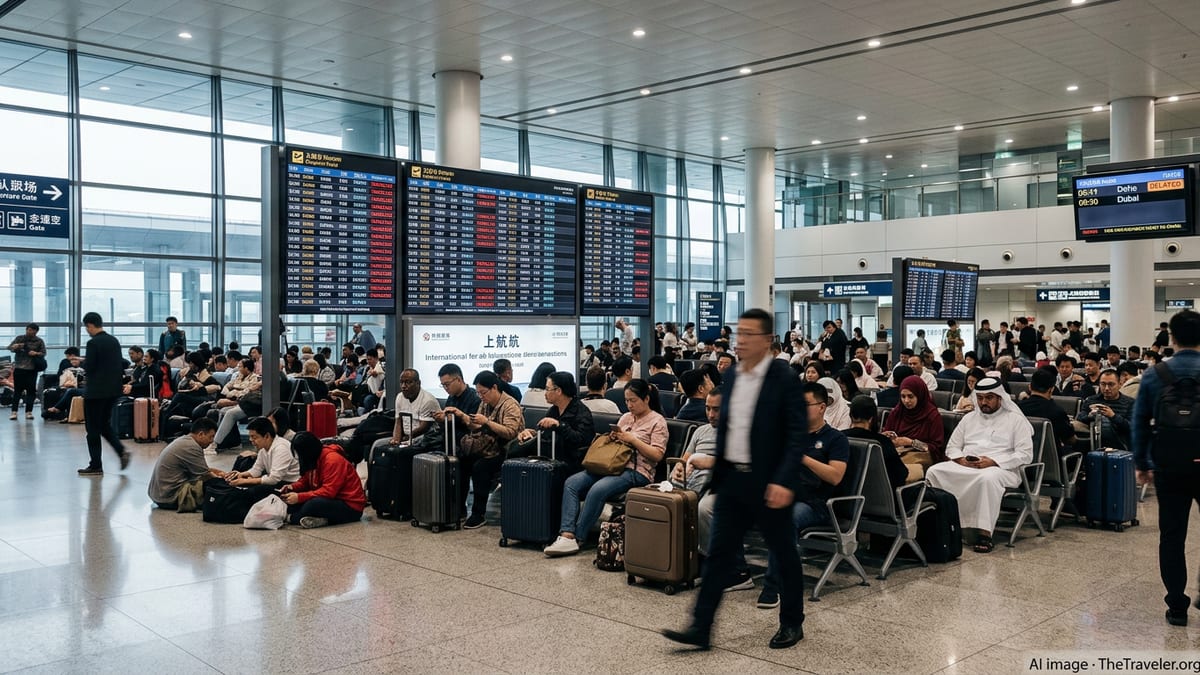
Renewed Turbulence Hits China’s Biggest Gateways
At Shanghai Pudong and Beijing Capital, already under strain from a week of rolling disruptions linked to Middle East airspace closures, departure boards again filled with red on March 7 as Chinese and Gulf carriers cut back or retimed services. Data compiled from airport operations indicated that combined cancellations and delays from Shanghai, Beijing and Chengdu alone ran into the dozens, with knock-on effects spreading to secondary Chinese cities as aircraft and crews fell out of position.
China Eastern and Sichuan Airlines, both key operators on China–Gulf routes, trimmed frequencies or pushed departure times into later slots as they attempted to thread limited safe corridors to the Middle East. Industry trackers reported that while overall operations from China to Saudi Arabia, the UAE and Oman were tentatively resuming after earlier suspensions, flights to Qatar remained severely restricted, complicating schedules for carriers that rely on Doha as a connecting hub.
For passengers, the impact was immediate. Long queues formed at transfer and ticketing counters in Shanghai and Beijing as travelers tried to salvage itineraries built around one-stop connections via Doha, Dubai or Abu Dhabi. Many were told that rebooking options were several days away or required circuitous routings through European or Southeast Asian hubs, often at additional cost.
In Chengdu and other inland cities, smaller but still significant numbers of cancellations compounded the disruption. Travelers bound for the Gulf on Sichuan Airlines and partner carriers faced last-minute notifications, with some flights downgraded to relief-style operations carrying only a fraction of their usual passenger loads as airlines prioritized repositioning aircraft and crew.
Qatar, Bahrain and UAE Hubs Struggle to Stabilize Schedules
Across the Gulf, airports in Doha, Manama, Dubai and Abu Dhabi remained under exceptional operational pressure. Although regional authorities have begun to reopen portions of previously closed airspace following the recent Iran–US–Israel crisis, traffic flows through key hubs are far from normal, and airlines are operating with a patchwork of temporary routings and relief flights.
Qatar Airways continued to run a skeleton schedule centered on repatriation services and essential links, with most regular commercial flights still suspended or heavily modified as of Saturday. While the Qatar Civil Aviation Authority has signaled limited reopening for emergency and evacuation traffic, Doha’s role as a high-frequency transfer hub remains sharply curtailed, forcing the airline to cancel or reroute a significant share of its network.
In Bahrain, Gulf Air grappled with its own wave of cuts and delays as restrictions on overflying parts of the region forced aircraft into longer detours or groundings. The carrier, which had already seen a large proportion of scheduled services canceled earlier in the week, was still operating a reduced timetable, prompting further disruption for passengers connecting through Manama to points in Asia and Europe.
Emirates and other UAE-based carriers, including those at Dubai International and Abu Dhabi International, have started to scale operations back up after days of mass cancellations. However, with some air corridors still constrained and aircraft scattered across diversion airports worldwide, the latest operational data show dozens of flights still being scrubbed each day, along with widespread delays that can stretch to several hours.
Forty Cancellations, Hundreds of Delays Mark a New Phase
While the peak of the crisis earlier in the week saw thousands of flights disrupted worldwide, aviation analysts say the current pattern of more than 40 targeted cancellations and over 200 delays across China and key Gulf states represents a new, more complex phase. Instead of blanket groundings, airlines are now making granular, day-by-day decisions based on evolving safety assessments, aircraft positioning and crew duty limits.
On March 7, that translated into a patchy mosaic of service: some long-haul routes were restored on adjusted flight paths, while others remained frozen; select airports reported near-normal domestic traffic even as international departures to the Middle East were halted or thinned out. For passengers, this means that two flights on the same route can face dramatically different fates within hours, depending on operational windows and regulatory clearances.
Operators serving Shanghai, Beijing and Chengdu into Doha, Dubai, Abu Dhabi and Manama have been particularly affected. China Eastern and Sichuan Airlines, alongside Gulf-based partners such as Qatar Airways, Gulf Air and Emirates, collectively accounted for a significant share of Saturday’s 40-plus cancellations and hundreds of delays, according to regional operations summaries and airport reports. Many of these disruptions were concentrated around traditional banked departure waves, amplifying the number of travelers stranded at once.
Aviation experts warn that such highly localized but intense pockets of disruption could persist even as headline cancellation rates fall. Airlines may be able to restore capacity on certain corridors quickly, but the challenge of unwinding backlogs, repositioning aircraft and resetting crew rosters can echo through schedules for days or weeks.
Stranded Passengers Face Long Queues and Limited Options
For travelers caught in the middle of the turmoil, Saturday brought another day of uncertainty. At Shanghai Pudong, passengers reported being handed paper vouchers and queue numbers as they waited to see whether they would be rebooked through alternative hubs such as Istanbul, Singapore or Frankfurt. In some cases, travelers were advised to secure their own tickets on different airlines and seek refunds later, an option many could not afford.
Similar scenes played out at Beijing Capital and Chengdu Shuangliu, where airport staff scrambled to manage crowds at service desks. Families with small children and elderly passengers were again prioritized for the limited seats available on outbound flights, echoing policies adopted by Qatar Airways and other Gulf carriers for their emergency services in recent days.
In Doha, Manama and Dubai, many passengers who had already spent nights sleeping on terminal floors faced yet more delays. Hotel rooms and meal vouchers remained in short supply, particularly near major hubs where local accommodation has been heavily booked since the first wave of cancellations late last week. Social media posts from stranded travelers described confusion as flight status updates shifted repeatedly throughout the day.
Travel agents and corporate travel managers reported heavy call volumes from clients seeking alternative routings that avoided Gulf hubs altogether. Some long-haul passengers have opted to reroute via European or Central Asian gateways, even at the cost of significantly longer travel times, in an effort to bypass the most volatile parts of the network.
Airlines Balance Safety, Capacity and Recovery Timelines
Behind the scenes, airlines across China and the Gulf are engaged in a delicate balancing act as they try to normalize operations without compromising safety. Carriers rely on coordination with civil aviation authorities and air traffic control providers to determine which corridors are usable and under what conditions, with daily assessments feeding directly into schedule decisions.
China-based airlines have begun cautiously rebuilding their Middle East networks, resuming select services to Saudi Arabia, the UAE and Oman, but they remain wary of reinstating full schedules while conditions are still fluid. Qatar Airways, Gulf Air and Emirates are following similar playbooks, layering in capacity gradually as aircraft return from diversion airports and as staff rosters are reconstituted after days of irregular operations.
Industry analysts note that the gradual resumption of flights does not necessarily translate into smooth travel for passengers. Even as some key routes from Shanghai, Beijing and Chengdu into the Gulf come back online, the lingering effects of more than 40 cancellations and over 200 delays on Saturday alone will continue to ripple across the network, with missed connections and displaced travelers likely to be felt well into the coming week.
For now, both airlines and regulators are urging passengers to monitor flight status closely, stay in contact with carriers before heading to the airport, and be prepared for last-minute changes. While there are signs that the worst of the disruption may be easing, Saturday’s groundings across China, Qatar, Bahrain and the UAE are a reminder of how fragile global air connectivity remains when a critical region’s skies are constrained.