

More news on this day
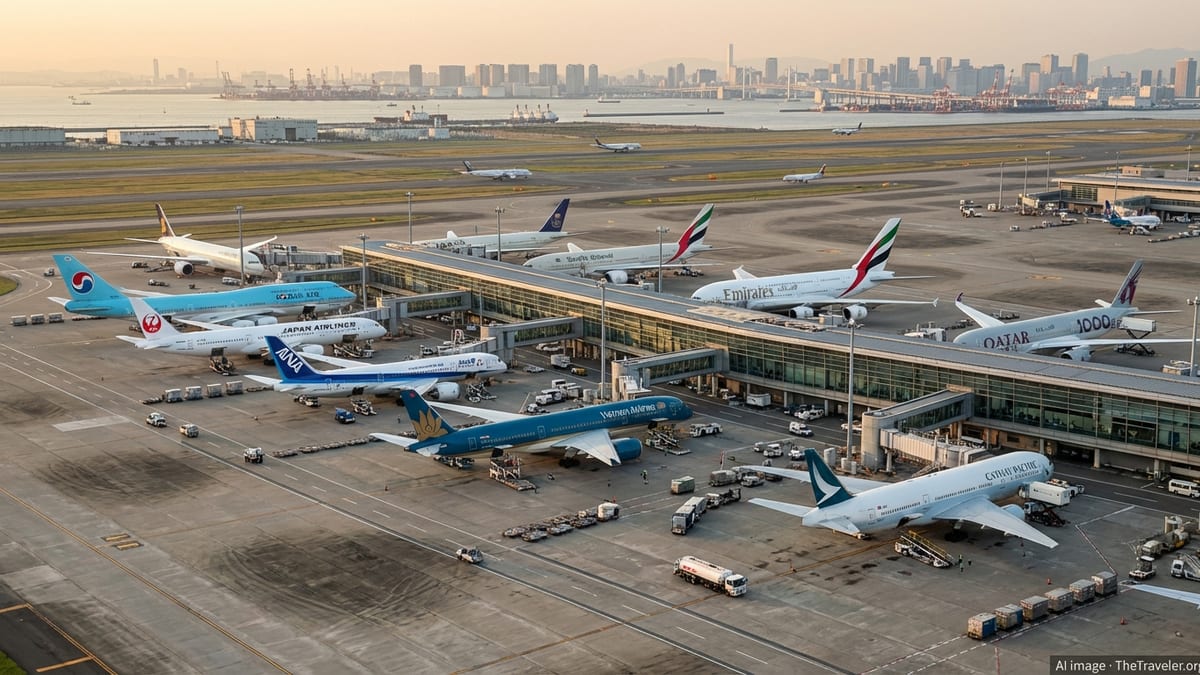
Asia’s aviation map has become the epicenter of global air traffic in 2025, with new data showing the world’s busiest airline routes now overwhelmingly clustered in South Korea, Japan, Vietnam and Saudi Arabia, and anchored by carriers such as Korean Air, Japan Airlines, All Nippon Airways, Vietnam Airlines and Saudi Arabia’s fast‑expanding airlines alongside Gulf and Hong Kong giants.
South Korea’s Jeju–Seoul Shuttle Remains the World’s Top Air Corridor
South Korea once again sits at the top of the global rankings, with the Jeju to Seoul Gimpo route retaining its status as the world’s busiest airline corridor in 2025. According to OAG’s latest Busiest Routes report, airlines scheduled around 14.4 million seats on the short domestic hop over the year, a slight increase on 2024 and far ahead of any other city pair worldwide. The sector has become emblematic of high-frequency, short-haul travel in Asia, where air links often outcompete rail or road for both convenience and capacity.
Seven carriers now operate between Seoul Gimpo and the volcanic island of Jeju, combining more than 100 return services on peak travel days. Korean Air and Asiana Airlines remain the anchor full-service brands on the route, while a growing roster of low-cost competitors keeps fares under pressure. Average one-way ticket prices fell year on year even as capacity ticked up, reflecting how intense competition and strong leisure demand are shaping South Korea’s domestic market.
The Jeju–Gimpo shuttle encapsulates broader trends in South Korean aviation. Korean Air and Asiana, still in the spotlight as they move toward merger, sit at the core of a domestic network heavily complemented by budget carriers such as Jeju Air, T’way Air and Jin Air. Together with services operated by other regional players including Emirates, Qatar Airways and Cathay Pacific into the wider South Korean market, the country has emerged as a major connecting point for passengers traveling within Northeast Asia and beyond.
Seoul’s international gateway at Incheon also plays a pivotal role in the world’s busiest cross-border routes. Links from Incheon to Tokyo Narita and Osaka Kansai are among the top five busiest international corridors globally by scheduled capacity in 2025, underlining how South Korean demand increasingly extends well beyond its borders and deep into the regional network maps of Korean Air and its Japanese and low-cost rivals.
Japan’s Domestic Giants Cement Asia’s Short-Haul Supremacy
Japan’s domestic network remains the backbone of Asia’s high-volume aviation landscape. In OAG’s 2025 global rankings, two Japanese routes follow close behind South Korea’s Jeju–Gimpo in total seats: Sapporo New Chitose to Tokyo Haneda and Fukuoka to Tokyo Haneda. Each of these corridors carries more than 11 million seats annually, underlining how central air travel remains to Japan’s internal connectivity despite the country’s famous high-speed rail system.
Japan Airlines and All Nippon Airways dominate these routes, operating dense shuttle-style schedules that serve both business and leisure demand. They are joined by domestic competitors such as Skymark Airlines and StarFlyer, which help spread capacity across full-service and hybrid models. The end result is a tightly contested marketplace linking regional centers like Sapporo and Fukuoka to the capital’s primary domestic hub at Haneda, with flights departing from early morning until late into the night.
Capacity on Japan’s busiest domestic routes has edged above or close to pre-pandemic levels, reflecting a near-complete recovery in internal demand. At the same time, these high-volume corridors feed international services for JAL, ANA and their partners, including connections from Tokyo to long-haul destinations in North America and Europe and to shorter regional hops across Asia. They also interface with Middle Eastern carriers such as Emirates and Qatar Airways, which funnel Japan-bound passengers through Dubai and Doha onto domestic connections via Tokyo’s airports.
Short-haul international traffic linking Japan and South Korea further reinforces the country’s position in the global top tier. The Seoul Incheon to Tokyo Narita and Seoul Incheon to Osaka Kansai routes rank among the world’s busiest cross-border corridors in 2025, supported by a crowded field of Korean and Japanese carriers. This dense mesh of services has pushed fares down even as seat volumes remain high, underscoring the strategic importance of Japan’s gateways in the regional travel ecosystem.
Vietnam’s North–South Spine Emerges as a Global Heavyweight
Vietnam’s core domestic corridor between Hanoi and Ho Chi Minh City has quietly become one of the world’s busiest flight routes, ranking fourth globally in 2025 by scheduled seats. OAG data shows that more than 11 million seats are on offer along the country’s north–south spine, placing it shoulder to shoulder with the biggest domestic trunk routes in South Korea and Japan. The service connects Vietnam’s political capital with its commercial powerhouse and is critical for both business travel and a booming tourism sector.
National carrier Vietnam Airlines and low-cost rivals VietJet and Bamboo Airways lead operations on the Hanoi–Ho Chi Minh City route, which routinely sees dozens of daily frequencies and a competitive spread of departure times. Fares have trended lower year on year, a sign that additional capacity and heightened competition are spilling over into better deals for travelers. This has helped sustain demand even as Vietnam’s rail and road infrastructure slowly improves, reinforcing aviation’s central role in domestic mobility.
Vietnam’s rise in the global route rankings reflects how fast its aviation market has matured. A decade ago, the country was an emerging player; today, its carriers are regular fixtures on top-10 lists and operate increasingly modern fleets on par with regional rivals. Vietnam Airlines has expanded its international footprint across Asia, Europe and Australia, while VietJet’s ultra-low fares and aggressive growth have redefined price expectations on many regional routes.
International connectivity weaves Vietnam even more tightly into Asia’s busiest traffic flows. Major Gulf carriers including Emirates and Qatar Airways, as well as Cathay Pacific and Korean Air, now treat Vietnamese cities as important spokes within their long-haul networks. Passengers traveling between Europe or the Middle East and Southeast Asia often connect through these hubs onto Vietnam’s domestic trunk, feeding additional volume onto an already crowded Hanoi–Ho Chi Minh City corridor.
Saudi Arabia Climbs the Rankings as Jeddah–Riyadh Surges
Saudi Arabia has emerged as the only non–Asia-Pacific country in the top tier of OAG’s 2025 domestic rankings, thanks to rapid growth on the Jeddah–Riyadh route. The corridor, linking the kingdom’s major western gateway with the capital, ranks fifth globally with just under 10 million seats. Capacity has grown by double digits compared with last year and now stands well above 2019 levels, reflecting the scale of economic and social transformation underway under Vision 2030.
Flag carrier Saudia remains the key full-service operator on Jeddah–Riyadh, supported by fast-expanding low-cost rivals Flynas and Flyadeal. Together they have built a shuttle-style service pattern tailored to business travelers, government officials, religious pilgrims and a rising number of leisure tourists. Fares on this route have trended higher than on many Asian counterparts, but the steady expansion of low-cost capacity has begun to curb price growth while preserving frequency.
The route’s importance extends beyond domestic travel. Jeddah and Riyadh are also critical nodes in Saudi Arabia’s ambition to become a global aviation hub, a strategy built around new and existing airports that aim to rival Dubai and Doha as connecting points between Europe, Africa and Asia. Gulf carriers such as Emirates and Qatar Airways remain influential competitors in the region, channeling passengers through their own megahubs, while Saudia and its low-cost partners seek to capture a larger share of connecting traffic via Saudi gateways.
The inclusion of Jeddah–Riyadh among the world’s busiest airline routes highlights how the Middle East’s growth story interlocks with Asia’s dominance. Much of the demand on Saudi Arabia’s domestic and regional routes ultimately links back into Asia, whether via labor travel to and from South and Southeast Asia or through religious tourism that combines visits to Saudi Arabia with broader itineraries across the region.
Asia Dominates Both Domestic and Cross-Border Rankings
Beyond the headline-grabbing domestic routes in South Korea, Japan, Vietnam and Saudi Arabia, Asia also commands the global league table for cross-border traffic. OAG’s 2025 rankings show seven of the ten busiest international routes operating within or from Asia, led by the Hong Kong–Taipei corridor, which retains its position as the world’s busiest international route with around 6.8 million seats. That sector is served by a mix of full-service and low-cost carriers, with Cathay Pacific and major Taiwanese airlines at the forefront.
Other top-performing international corridors include Kuala Lumpur–Singapore, Seoul Incheon–Tokyo Narita and Seoul Incheon–Osaka Kansai. These pairings are intensely competitive and often see half a dozen or more airlines vying for market share, including regionally focused low-cost carriers and full-service brands linked to global alliances. Airfares on many of these routes have fallen compared with last year, a sign that capacity growth has outpaced demand and that carriers are using pricing to stimulate traffic and defend their positions.
Middle Eastern connectors also appear in the international top ten, notably Cairo–Jeddah and Dubai–Riyadh, again highlighting the deep integration between Asia and the Gulf in shaping global travel patterns. Huge flows of migrant workers, religious pilgrims, business travelers and tourists move along these corridors every year, many of whom go on to connect into wider networks operated by Emirates, Qatar Airways and Saudia. Those networks frequently link back into the same Asian markets that dominate the busiest-route rankings.
Against this backdrop, long-haul corridors between Europe and North America now play a supporting role in the global top ten. Iconic routes such as New York JFK–London Heathrow remain among the busiest intercontinental sectors by capacity, but their seat totals are overshadowed by the dense, short-haul routes that knit together Asia’s megacities. The data underscores a structural shift in global aviation toward high-frequency regional travel anchored firmly in the Asia-Pacific and Gulf regions.
Low-Cost and Full-Service Carriers Battle for Short-Haul Supremacy
The dominance of Asian and Saudi routes in 2025 is also a story of how low-cost and full-service airlines coexist and compete. On domestic corridors such as Jeju–Seoul, Tokyo–Sapporo, Tokyo–Fukuoka and Hanoi–Ho Chi Minh City, national flag carriers like Korean Air, Asiana Airlines, Japan Airlines, ANA and Vietnam Airlines face stiff competition from budget operators including Skymark Airlines, StarFlyer, VietJet, Bamboo Airways, Flynas and Flyadeal. This mix has driven a notable decline in average fares on several of the world’s busiest routes while preserving or even increasing total seat capacity.
Low-cost carriers typically dominate by frequency and price, offering dense schedules that appeal to leisure travelers and price-sensitive business passengers. Full-service airlines counter with loyalty programs, premium cabins and seamless connections to long-haul networks. In many cases, both models thrive side by side: full-service carriers feed international traffic into domestic trunks, while low-cost rivals tap into local demand and stimulate new segments that may not have flown before.
In the cross-border arena, the picture is similarly mixed. Routes such as Seoul Incheon–Tokyo Narita and Seoul Incheon–Osaka Kansai feature a strong presence from Korean low-cost airlines, which collectively operate the majority of flights. At the same time, Japanese legacy carriers and regional players maintain strategically timed services to protect high-yield corporate traffic. On Southeast Asian corridors like Kuala Lumpur–Singapore, the balance tilts heavily toward budget operators, which have turned the route into one of the most price-competitive city pairs in the world.
Gulf and Hong Kong carriers also shape the competitive landscape on and around these busy routes. Emirates and Qatar Airways have built global reputations on high-quality long-haul service and extensive connecting networks, while Cathay Pacific positions Hong Kong as a premium hub linking China, Southeast Asia and long-haul markets. Their presence in markets such as South Korea, Japan, Vietnam and Saudi Arabia adds another layer of choice for travelers and reinforces the centrality of these countries in worldwide travel flows.
Infrastructure and Policy: How Governments Are Enabling Growth
The concentration of the world’s busiest airline routes in a handful of Asian and Middle Eastern markets is not solely a product of demand; it also reflects years of investment in airport infrastructure and proactive aviation policy. South Korea has steadily upgraded both Seoul Gimpo and Incheon, optimizing them for domestic and international operations respectively. Slot coordination, terminal expansion and improved public transport links have allowed carriers like Korean Air and Asiana Airlines to operate very high-frequency schedules while maintaining reasonable on-time performance.
Japan has pursued a similar strategy, particularly at Tokyo Haneda, where curfews, slot restrictions and terminal upgrades are finely calibrated to balance community concerns with the needs of airlines operating some of the world’s densest short-haul schedules. Regional airports such as Sapporo New Chitose and Fukuoka have benefited from expanded terminal capacity and improved access, enabling carriers including Japan Airlines, ANA, Skymark Airlines and StarFlyer to deploy additional flights without overwhelming local infrastructure.
Vietnam and Saudi Arabia, by contrast, are in the midst of rapid expansion programs aimed at catching up with demand. Vietnam has outlined plans for new and upgraded airports, including the long-planned Long Thanh International Airport near Ho Chi Minh City, which is expected to relieve pressure on the existing Tan Son Nhat hub and support further growth on the north–south corridor. Saudi Arabia is pushing ahead with a sweeping aviation strategy that includes new airports, terminal expansions and the development of large-scale tourism projects designed to attract tens of millions of additional visitors each year.
Policy reforms have gone hand in hand with infrastructure investment. Liberalization of air service agreements, support for low-cost airline growth and targeted tourism campaigns have all contributed to rising seat capacity on the world’s busiest routes. At the same time, regulators in South Korea, Japan, Vietnam and Saudi Arabia are under pressure to manage environmental impacts and ensure that airport and airspace capacity keeps pace with demand without compromising safety or sustainability goals.
What Asia’s Busiest Routes Signal for Global Travelers in 2025
The 2025 rankings of the world’s busiest airline routes offer a clear signal to global travelers and the industry alike: Asia, together with key Middle Eastern partners, now sets the tempo for short-haul and regional air travel. From Jeju and Seoul to Tokyo, Hanoi, Ho Chi Minh City, Jeddah and Riyadh, the thickest air corridors are increasingly found within four countries whose carriers are reshaping expectations on price, frequency and connectivity.
For travelers, this concentration of capacity translates into more choice and often lower fares on routes that feed into some of the world’s most important hub airports. Passengers flying long haul with Emirates, Qatar Airways, Saudia, Korean Air, Japan Airlines, ANA, Vietnam Airlines or Cathay Pacific are likely to connect onto the same domestic and regional corridors that dominate the global rankings, benefiting from high-frequency schedules and a diversity of cabin products.
For airlines and airports outside the region, the data is a reminder that future growth will increasingly be determined by how well they plug into Asia’s high-volume networks. Partnerships, alliances and new route launches that link into Seoul, Tokyo, Hanoi, Ho Chi Minh City, Jeddah and Riyadh will be central to tapping the demand coursing through these corridors. As 2025 progresses, all eyes in the aviation world are on how these routes evolve, and which carriers will secure the largest share of traffic across a region that now anchors the busiest skies on earth.