

More news on this day
Newly released 2026 global aviation rankings underscore Asia’s growing dominance in the skies, with Singapore Changi Airport and Qatar Airways securing marquee positions that are reshaping expectations for airport design, long-haul comfort, and international connectivity.
Get the latest news straight to your inbox!
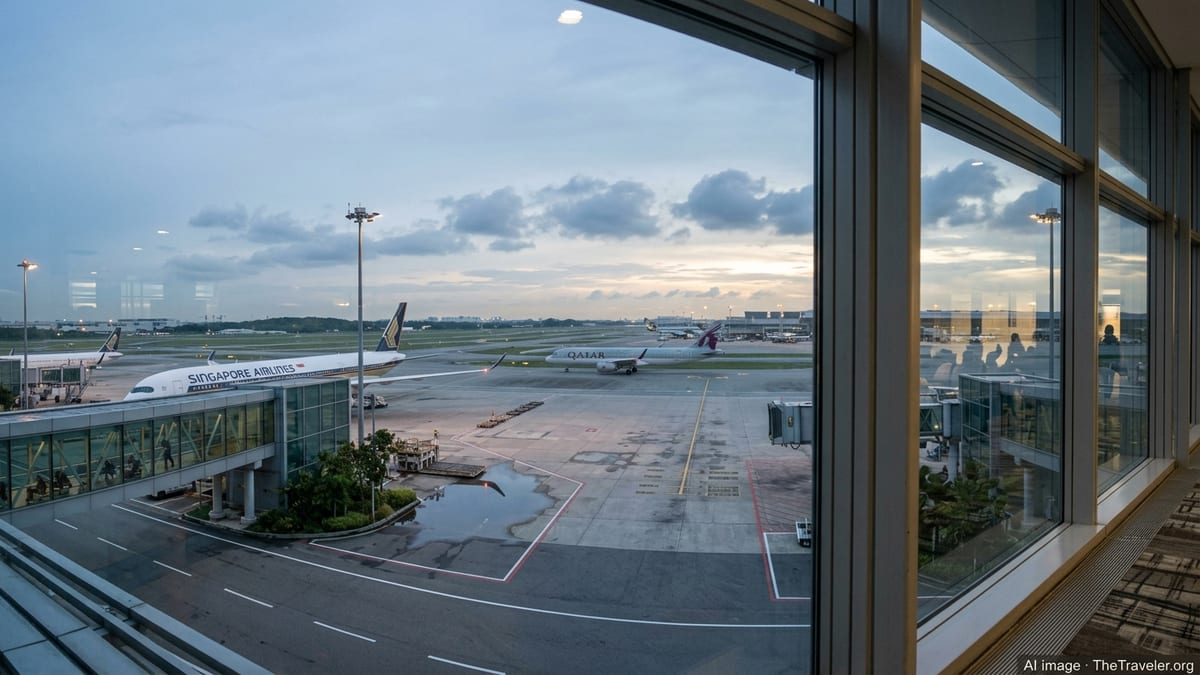
New Rankings Underscore Asia’s Gravitational Pull in Global Aviation
The latest wave of 2026 aviation league tables and industry surveys points to a clear center of gravity for international air travel shifting toward Asia. Singapore Changi Airport is again positioned at or near the top of global airport rankings published so far this year, while Qatar Airways builds on its Airline of the Year 2025 title from Skytrax and remains firmly embedded in the upper tier of 2026 carrier assessments. Together, these two flagships are reinforcing a wider pattern in which Asian hubs and airlines are setting the benchmarks for passenger experience.
Publicly available traffic statistics for 2024 and 2025 show that Asian and Middle Eastern hubs have rebounded strongly from the pandemic era, with international passenger flows and transfer volumes that rival or exceed pre‑crisis levels. Industry reports highlight dense regional networks linking Southeast Asia, the Gulf, Northeast Asia, and the Indian subcontinent, supporting some of the world’s busiest international routes, including heavy‑traffic corridors such as Kuala Lumpur to Singapore and Jakarta to Singapore. These flows are helping to sustain high service standards as airports and airlines compete aggressively for transit passengers.
Against this backdrop, the prominence of Singapore Changi and Qatar Airways in 2026 rankings is less an outlier and more an emblem of a broader geographic realignment. Even as North American hubs continue to dominate in total departures and domestic volumes, the premium segment of long‑haul and connecting travel is increasingly defined by what leading Asian and Gulf operators are offering at both ends of the journey.
Singapore Changi Raises the Bar on the Ground
Singapore Changi’s performance in the 2026 cycle builds on a long record of global recognition. Airport data released in January 2026 showed that Changi handled close to 70 million passengers in 2025, supported by around 374,000 aircraft movements, while still accumulating dozens of service and design awards in a single year. More recent brand surveys in 2026 have ranked Changi among Singapore’s strongest consumer brands, underscoring its visibility beyond aviation circles.
Analysts point to Changi’s multi‑terminal layout, integrated visitor attractions, and emphasis on wayfinding and dwell‑time experiences as reasons it continues to feature at or near the top of global rankings. Its terminals increasingly blur the line between airport and destination, with multi‑use commercial spaces, extensive greenery, and leisure facilities designed to make long layovers more palatable for the growing proportion of transfer passengers moving between Asia, Europe, and Oceania.
Operational metrics also play a role in Changi’s continued prominence. Passenger movement data from late 2025 indicates that peak days regularly exceeded 200,000 travellers across its terminals, a volume managed alongside ongoing expansion and renovation projects aimed at modernising older infrastructure. Industry coverage notes that, instead of relying solely on new terminals, Changi has prioritised continuous upgrades to existing spaces to maintain service quality as traffic rebounds.
In the context of 2026 rankings, this combination of scale, resilience, and customer‑focused design has positioned Changi as a reference point for other airports seeking to capture more long‑haul transfer traffic. Airport consultants increasingly cite the Singapore hub as a case study in how non‑aeronautical revenue, experiential retail, and efficient operations can reinforce one another.
Qatar Airways Extends Its Premium Lead in the Skies
In the airline segment, Qatar Airways enters 2026 with strong momentum after being named Airline of the Year 2025 in Skytrax’s global survey and topping that organisation’s Top 100 Airlines list. Early 2026 commentary and updated rankings from aviation analysts continue to place the Doha‑based carrier at or near the summit, particularly in premium cabins, where its business‑class product remains a frequent benchmark in independent reviews.
The airline’s strategy hinges on pairing an expansive global network with a premium service proposition centered on its Qsuite and other long‑haul cabins. Coverage from late 2025 and early 2026 notes that Qatar Airways continues to refine its onboard product, including seating configurations, soft‑product upgrades, and digital enhancements, at a time when many competitors are still restoring capacity and retrofitting fleets after the pandemic period.
Qatar Airways also benefits from the positioning of Doha’s Hamad International Airport, which has itself been recognised in recent years in global airport awards and traffic reports for its role as a key long‑haul transfer hub. High transfer volumes between Europe, Africa, the Middle East, and Asia support dense schedules that allow the airline to offer short connection times on many long‑haul itineraries, reinforcing its status in customer satisfaction rankings that privilege punctuality and connectivity alongside cabin quality.
For the 2026 ranking cycle, this network‑and‑product combination has cemented Qatar Airways as one of the carriers shaping expectations for what business‑ and first‑class travel should look like on intercontinental routes. Competitive responses from European and Asian full‑service airlines, including new premium‑cabin launches and cabin retrofits, are often framed directly against what Qatar Airways is offering.
Data Shows Asia’s Hubs Dominating High‑Value International Flows
Beneath the headline rankings, operational data for 2024 and 2025 illuminates how Asia’s airports have positioned themselves to dominate high‑value international flows. Schedules and seat‑capacity analyses referenced in 2025 industry reports show that many of the world’s busiest international routes by available seats are within or connected to Asia, including links between Hong Kong and Taipei, Kuala Lumpur and Singapore, and several trunk routes from Bangkok and Jakarta.
Lists of the busiest airports by international passenger traffic for 2024, updated in early 2026, place Asian and Middle Eastern hubs such as Hong Kong, Dubai, Singapore, and Doha near the top of the global rankings. These airports not only move large volumes of passengers but also host wide‑body operations and premium‑heavy configurations that generate disproportionate revenue compared with domestic‑focused hubs.
At the same time, more specialised metrics, such as the ranking of low‑cost carrier megahubs published in late 2025, highlight the diversity of Asia’s aviation ecosystem. Kuala Lumpur International Airport was identified as the leading low‑cost carrier megahub globally, with other regional airports like Singapore, Manila, and Bangkok also appearing prominently. This mix of premium and budget capacity within the region helps sustain a dense mesh of routes that funnels connecting passengers through leading hubs like Changi and Doha.
Global aviation monitoring reports released in early 2026 further indicate that among the world’s 25 largest airports by departures, several major Asian airports occupy mid‑to‑upper positions, particularly in China, Japan, and India. While North American airports still dominate in sheer departure counts, the Asian hubs often register higher proportions of international and long‑haul flights, which translate into outsized influence over global connectivity rankings.
Competitive Pressures and Evolving Standards for Travellers
The strong showing of Singapore Changi and Qatar Airways in 2026 rankings is intensifying competitive pressure on airports and airlines worldwide. European and North American hubs that traditionally relied on geographic advantages are now confronted with passengers who increasingly benchmark their experiences against the standards set in Singapore, Doha, and other Asian and Gulf hubs, from security and immigration processing times to lounge design and digital wayfinding.
Industry commentary suggests that passengers are becoming more sensitive to the full door‑to‑door journey rather than judging a trip solely on ticket price or onboard comfort. Smooth transfers, intuitive terminal layouts, diversified retail and dining options, and reliable real‑time information are now core expectations rather than bonuses. In this environment, hubs that fall behind on investment or customer‑experience innovation risk slipping down global rankings, even if their traffic volumes remain high.
For Asia’s leading players, the challenge in 2026 and beyond will be to sustain these elevated standards while managing rapid growth and infrastructure constraints. Expansion programs at major hubs aim to add capacity without diluting the qualities that earned them top rankings, including design coherence and ease of transfer. As new terminals and runways come online across the region, observers will be watching whether the balance between efficiency and experience can hold.
For travellers, the current ranking cycle confirms that routes anchored by Singapore Changi and serviced by Qatar Airways and other top‑rated Asian and Gulf carriers are likely to remain among the most sought‑after options for long‑haul journeys. As more airlines and airports attempt to match their offerings, the net result may be a sustained uplift in global travel standards, driven in large part by Asia’s continued dominance of the skies.