

More news on this day
Asia-Pacific airfares are set to climb again in 2026 as Cathay Pacific, Qantas, Air New Zealand and Thai Airways move to raise fuel surcharges in response to a sharp spike in global jet fuel prices, putting fresh pressure on long-haul leisure and business travellers alike.
Get the latest news straight to your inbox!
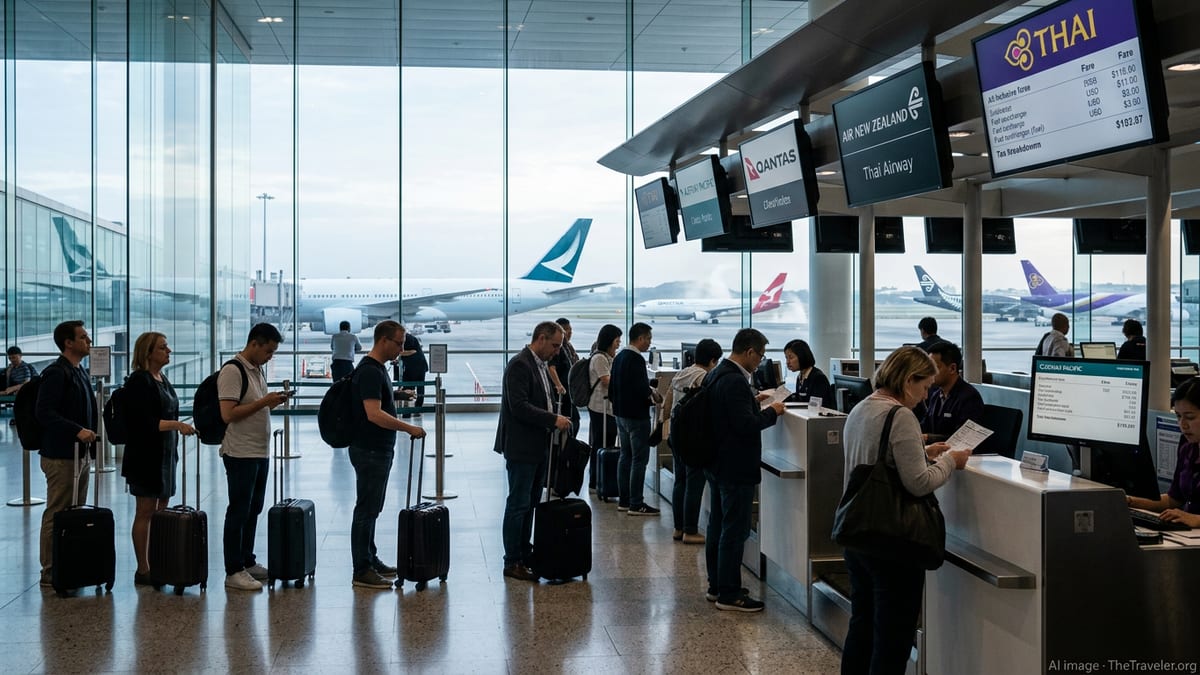
Jet Fuel Shock Forces a New Round of Surcharge Hikes
The latest surge in aviation fuel prices is rippling quickly through airline balance sheets and into passenger fares. Jet fuel benchmarks have nearly doubled since January, driven by supply disruptions linked to conflict in the Middle East and tighter refining capacity across Asia. For full-service carriers with extensive long-haul networks, fuel can account for a third or more of total operating costs, leaving little choice but to pass on at least part of the increase to customers.
Industry data show that Asia Pacific airlines have already begun adjusting base fares and surcharges on key routes, particularly between Asia and Europe, North America and the South Pacific. On some heavily trafficked city pairs, average economy fares have jumped by double digits in a matter of weeks, even before the latest surcharge rounds are fully reflected in global booking systems. Forward fares for peak northern summer travel are now being repriced almost weekly as carriers reassess their exposure.
For travellers, the impact will be most visible not just in higher all-in prices, but in the often opaque line item labelled “fuel surcharge” or “carrier-imposed charge” that sits alongside government taxes. While headline ticket prices on airline websites typically bundle these fees into a single figure, agency fare breakdowns and frequent flyer award tickets make clear that the fuel component is again becoming a major driver of what passengers ultimately pay.
Cathay Pacific Leans on Automatic Surcharge Mechanism
Cathay Pacific, one of the region’s largest long-haul operators, is relying on its established fuel surcharge mechanism to escalate costs in line with the market. The Hong Kong-based airline reviews surcharges monthly against jet fuel price movements and applies them on a per-sector basis across long-range routes linking Hong Kong with North America, Europe, the Middle East, Africa and the Southwest Pacific. Updated tables taking effect from early 2026 show higher carrier-imposed charges on many of these sectors, even where base fares remain unchanged.
For customers, that means a growing share of the ticket is now tied to volatile energy markets rather than underlying demand. Travel agents in Hong Kong and across the region report that surcharges on some intercontinental itineraries now rival or exceed airport taxes, particularly in premium cabins. While the airline stresses that surcharges are absorbed into the total price shown on its own booking channels, corporate travel managers say the increases are evident when they compare year-on-year fare structures for contracted routes.
Cathay Pacific’s approach underscores a broader trend among full-service carriers: using formula-based surcharges as a shock absorber instead of constantly rewriting base fares. That allows pricing teams to respond quickly to monthly fuel swings without renegotiating corporate deals or publishing entirely new fare families. However, it also raises questions about transparency for leisure travellers booking complex itineraries, especially when different segments carry different surcharge levels.
Qantas Passes Rising Costs to Domestic and Trans-Tasman Flyers
In Australia, Qantas is also lifting the cost burden on passengers as fuel bills swell. The flag carrier had already imposed additional surcharges and higher base fares in late 2025 to cover broader cost inflation and network rebuilding. With jet fuel now spiking again, the airline is adjusting pricing on both domestic trunk routes and international services, including popular links between Australia, Asia and North America.
Travel consultants in Sydney and Melbourne report sharp jumps in quoted fares on high-frequency business routes, with some last-minute economy tickets effectively doubling in price compared with earlier in the year. While part of that is attributed to strong demand and tight capacity, the airline has publicly acknowledged that higher fuel and operational costs are a central factor in recent price movements. Frequent flyers are also seeing higher carrier charges when redeeming points, eroding the relative value of award travel on long-haul flights.
Qantas has historically used a mix of fuel hedging, dynamic fares and surcharges to smooth cost shocks. This time, however, hedging only partially offsets the speed of the latest spike, and the airline is signalling that more adjustments may come if energy markets remain volatile. For Australian travellers planning big-ticket trips to Europe or the United States in late 2026, locking in dates early may offer only limited protection if carriers continue to reprice surcharges on newly issued tickets.
Air New Zealand Scraps Guidance and Lifts Ticket Prices
Across the Tasman, Air New Zealand is under similar pressure. The airline recently withdrew its profit guidance for the 2026 financial year, citing what it described as unprecedented volatility in jet fuel markets and warning that earnings will be meaningfully affected in the second half of the year. Management has pointed to a rapid escalation in fuel costs, which now threatens to outpace earlier assumptions embedded in its financial plans.
To protect margins, the carrier has begun raising fares and reviewing surcharges across its international network, including services to North America, Asia and Australia. Local media reports indicate that thousands of customers face schedule changes and selective capacity reductions as the airline tries to prioritise more profitable routes and aircraft deployments. Industry analysts say those moves, combined with higher carrier charges, will push average ticket prices higher through at least the southern winter season.
Air New Zealand’s challenge is compounded by its distance from key markets and reliance on long overwater sectors, where fuel burn per flight is relatively high. The airline has invested in sustainable aviation fuel agreements and fleet efficiency measures, but those initiatives only partially insulate it from short-term price spikes. For travellers, that translates into steeper increases on long-haul itineraries than on shorter regional hops, with premium economy and business class fares rising fastest.
Thai Airways Raises Fares as Demand Stays Strong
Thai Airways, which has been rebuilding after a high-profile restructuring, is now confronting a new test as fuel costs climb. The Bangkok-based carrier has announced ticket price increases of around 10 to 15 percent to offset higher jet fuel expenses and supply chain pressures. Executives say demand remains robust, particularly from passengers rerouting between Europe and Asia to avoid conflict zones, giving the airline some room to raise prices without significantly denting load factors.
The airline already operates a dedicated fuel surcharge mechanism, coordinated with the Civil Aviation Authority of Thailand for routes where a formal ceiling applies. New surcharge levels for certain international sectors, including services from Japan to Bangkok, have been published for tickets issued in the first quarter of 2026. These charges are layered on top of the recent base fare hikes, meaning total out-of-pocket costs for travellers can be substantially higher than last year, especially on peak holiday departures.
Despite the increases, Thai Airways is signalling confidence in its medium-term outlook, planning fleet growth and new route launches into 2026. Industry observers note that the airline is trying to strike a balance between recouping fuel costs and maintaining Thailand’s appeal as a competitively priced leisure destination. How far it can push surcharges without driving tourists to low-cost rivals on regional routes will be closely watched over the coming months.
What Travellers Can Expect for 2026 Budgets
For passengers flying with Cathay Pacific, Qantas, Air New Zealand and Thai Airways, the practical effect of these moves will be higher average fares across most long-haul and many regional routes in 2026. While the exact amount depends on origin, destination and cabin, travel agencies estimate that fuel-linked charges alone could add the equivalent of tens to several hundreds of dollars to a return ticket compared with early 2025 pricing levels, particularly in premium cabins.
Experienced travellers are already adapting their strategies. Some are bringing forward bookings in the hope of avoiding further surcharge rounds tied to ticket issue dates, while others are using flexible points currencies to comparison-shop across alliances and alternative hubs. However, with most major carriers in the region facing similar cost pressures, the scope for arbitrage is narrowing, especially on key business and holiday corridors.
For now, the direction of jet fuel prices will largely determine whether this latest round of fuel surcharges proves a temporary spike or the new baseline for Asia-Pacific air travel costs. Until markets stabilise, passengers planning long-haul trips with these flagship airlines should brace for elevated prices, scrutinise fare breakdowns more closely and budget extra for flights that just a year ago looked significantly cheaper.