

More news on this day
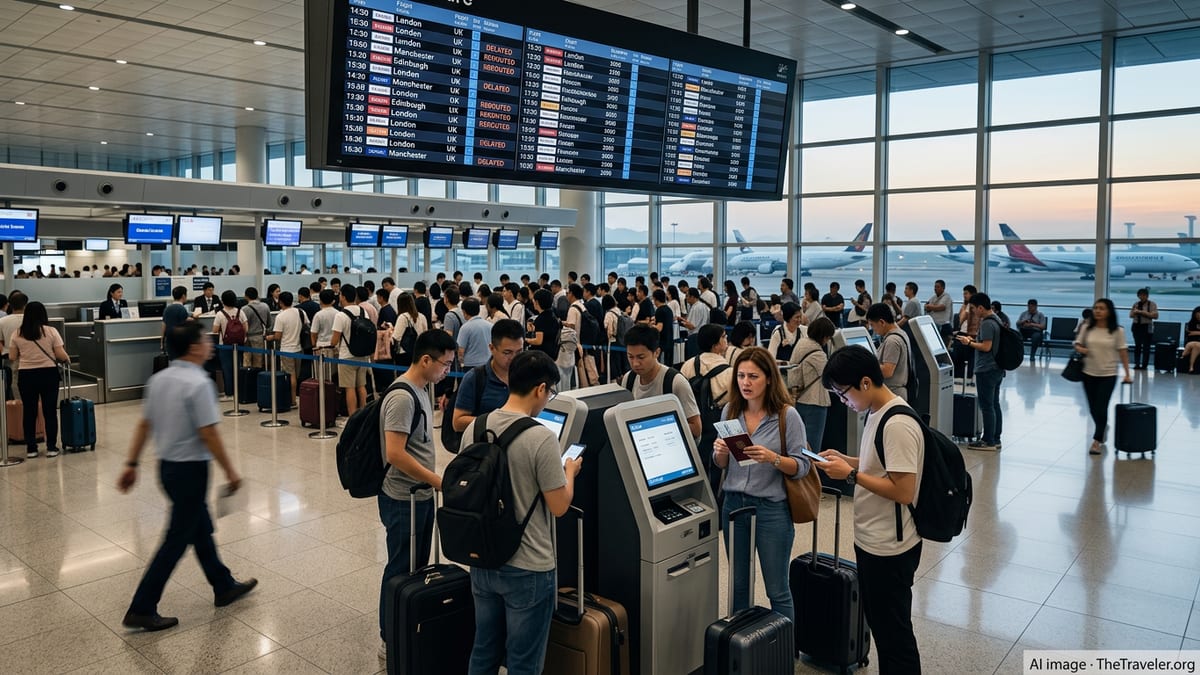
Air fares from Asia to the United Kingdom have surged in recent days as airlines scramble to reroute around conflict-hit Middle Eastern airspace, leaving passengers facing sky-high prices and a debate over whether carriers are exploiting the crisis or simply passing on soaring costs.
Get the latest news straight to your inbox!
Conflict Closes a Crucial Aviation Corridor
The latest escalation of the Iran war and instability around the Strait of Hormuz has triggered sweeping airspace closures across parts of Iran, Iraq and the Gulf, according to recent international coverage. With several key flight information regions restricted and traffic into major Gulf hubs curtailed, one of the world’s busiest corridors linking Asia and Europe has been abruptly constricted.
Publicly available flight tracking and airline schedule data show thousands of flights cancelled or diverted since the beginning of March 2026, disrupting the carefully choreographed web of connections that normally funnel travellers between Asian cities and the UK via Doha, Dubai and Abu Dhabi. These hubs have long served as essential waypoints for UK-bound passengers from South Asia, Southeast Asia and Australasia.
With Russian and Ukrainian skies already effectively off limits to many international carriers since 2022, the Middle East corridor had become even more vital for long-haul connectivity. The sudden loss or degradation of that route has forced airlines to improvise longer, less fuel-efficient paths that add hours to flight times and strain both crew rosters and aircraft availability.
Industry analyses indicate that many Asia–Europe services are now being routed north via Turkey and the Caucasus or far south over Egypt and Saudi Arabia, while some itineraries from Asia to the UK are being stitched together through East Asian or North American gateways. Each detour chips away at usable capacity and increases exposure to higher fuel burn and operational complexity.
Ticket Prices From Asia to the UK Jump Sharply
The impact on travellers buying tickets from Asia to the UK has been immediate and stark. Fare trackers and travel trade reports in markets such as Pakistan and India show economy-class prices on some UK-bound routes rising three to fourfold compared with earlier in the year, with last-minute one-way tickets reportedly pushing above the equivalent of 3,000 to 4,000 US dollars in certain cases.
In Pakistan, recent local travel industry data cited by regional media describe fares on some UK flights climbing from around 250,000 rupees to as high as 1 million rupees per ticket within weeks, reflecting the squeeze on seats as airlines cancel or reroute services and reduce frequencies. Similar patterns are being reported on popular South Asia to London corridors, where cheaper fare buckets are selling out quickly, leaving only higher fare classes available.
Broader analyses of Europe–Asia travel published this month point to increases of up to nearly 300 percent on some direct routes, particularly where capacity was already tight before the latest crisis. For UK-bound passengers, this translates into steep premiums on routes via remaining hubs such as Istanbul, Singapore and certain European gateways, as displaced demand from the Gulf flows into alternative connections.
For many travellers, the headline price is only part of the challenge. Itineraries that once involved a single connection now often require two or more stops, extended layovers and increased risk of missed onward flights. While some airlines are offering fee waivers or limited flexibility for existing bookings, newly purchased tickets to the UK from parts of Asia are increasingly expensive and logistically complex.
Costs, Capacity and the Mechanics of Pricing
At the heart of the debate over profiteering versus service lies the way airfares are built. Public financial outlooks from global airline bodies indicate that, even before the latest crisis, carriers were operating on relatively thin net margins, with profitability in regions such as the Middle East supported by high long-haul yields but constrained by elevated fuel, labor and regulatory costs.
The new conflict has pushed oil and jet fuel prices higher as markets factor in potential disruption to energy shipments through the Strait of Hormuz and the Red Sea. Economic research and aviation chartbooks released in recent weeks highlight that earlier geopolitical shocks in the region were already feeding into regional variations in ticket-price inflation, with supply chain issues and longer routings eroding previous efficiency gains.
Operationally, flying around closed airspace can add one to three hours to typical Asia–Europe legs, increasing fuel burn, crew duty time and the number of aircraft needed to maintain a given schedule. Airlines also face pressure on maintenance cycles and airport slots as irregular operations ripple across networks. These costs are typically recouped through higher fares and fuel surcharges, particularly on long-haul sectors such as flights from Asia to the UK.
Capacity constraints magnify the pricing effect. With some Gulf carriers trimming schedules and others unable to use their most efficient corridors, the total number of available seats between Asia and the UK has dropped at the very moment when pent-up post-pandemic demand and strong migrant and student flows were keeping planes full. Revenue management systems respond to this imbalance by moving quickly through cheaper booking classes, leaving many consumers exposed to the most expensive fare buckets.
Are Airlines Profiteering or Just Staying Airborne?
The scale of fare increases has led to growing public scrutiny over whether airlines are merely covering higher costs or extracting windfall profits from a captive market. Consumer advocates and travel commentators point to examples where previously affordable routes now price at levels comparable to business class, even when only economy seats are on offer, and question whether such jumps reflect underlying costs.
On the other side of the argument, aviation economists note that global forecasts released before the crisis anticipated only modest changes in average ticket prices for 2025, suggesting that widespread structural profiteering was not built into industry expectations. Instead, they argue that the current spikes are a textbook reaction to a sudden capacity shock layered on top of already strong demand and constrained fleets.
Published analyses from international airline associations describe how geopolitics has been reshaping the competitive landscape, particularly for routes linking Asia, the Middle East and Europe. Carriers most exposed to conflict zones must either accept higher operating costs or temporarily retreat from certain markets, while airlines with alternative routings or home bases outside the most affected areas can capture displaced demand at higher yields.
Whether this constitutes profiteering is, in part, a question of transparency. While base fares and surcharge structures are publicly filed, the precise allocation of additional revenue between higher fuel bills, rerouting costs and profit is difficult for outsiders to verify in real time. For now, most assessments rely on broader financial reporting cycles that will only reveal the full impact of the crisis on airline balance sheets later this year.
New Routes, Limited Relief for UK-Bound Travellers
In response to the turmoil, some European and Asian airlines are accelerating plans to diversify away from traditional Gulf-centric networks. Recent route announcements covered by aviation industry outlets show carriers in Europe and Southeast Asia boosting direct services between their hubs, partly to reduce reliance on West Asian airspace and to capture demand that previously flowed through Gulf connections.
For UK-bound passengers in Asia, these adjustments may eventually provide more options via continental European or North Asian hubs, as airlines upgauge aircraft or add frequencies on routes linking London with cities such as Istanbul, Singapore, Bangkok or Seoul. However, such changes require aircraft, crews and airport slots that cannot be reallocated overnight, limiting the immediate impact on prices.
Industry chartbooks tracking traffic between the Middle East, Asia and major European markets show that demand growth on corridors involving the UK had been strong even before the latest conflict, with seat capacity struggling to keep pace. The present disruption risks widening that gap, at least in the short term, as airlines await clarity on airspace restrictions and energy markets.
For now, travellers from Asia to the UK face a difficult calculus: pay elevated fares on longer, more convoluted journeys or postpone trips in the hope that tensions ease and capacity returns. Whether history ultimately judges current pricing as opportunistic or simply the cost of keeping planes safely in the air will depend on how long the crisis lasts, how quickly airlines adapt their networks and how transparently they share the financial story behind today’s soaring ticket prices.