

More news on this day
Air travel across Asia faced fresh disruption today as airports in China, Japan, Singapore, India, Saudi Arabia and other countries reported 264 flight cancellations and 3,829 delays, disrupting operations for carriers including Batik Air, IndiGo, Air China and FlyDubai and stranding passengers from Tokyo and Shanghai to Kolkata and Abu Dhabi.
Get the latest news straight to your inbox!
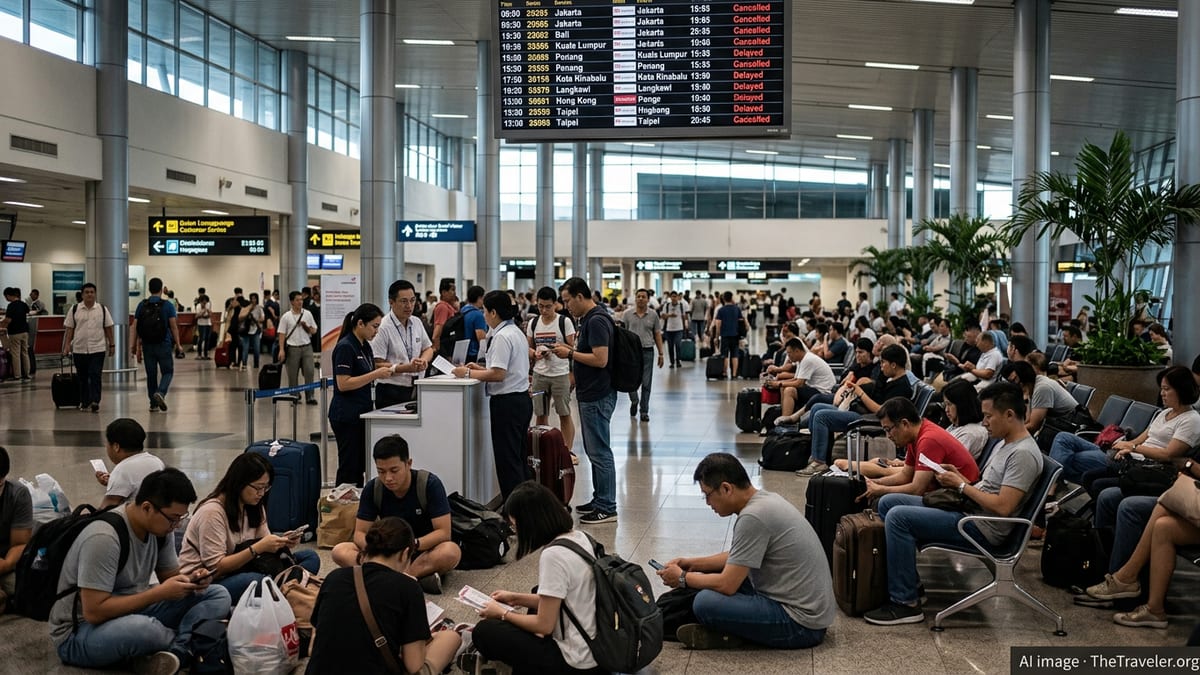
Widespread Disruptions Across Key Asian Hubs
Published coverage indicates that multiple major airports recorded significant operational issues, with cancellations and delays concentrated at hubs such as Tokyo, Shanghai, Kolkata and Abu Dhabi. The disruption totals of 264 canceled and 3,829 delayed flights highlight how a combination of operational bottlenecks and knock-on effects from regional instability are weighing on Asia’s already stretched aviation network.
In Japan, international and domestic traffic through the Tokyo area has been affected by weather systems moving across the country, compounding congestion at already busy terminals. At the same time, Chinese coastal gateways, including Shanghai, have reported growing backlogs as delayed aircraft and crews ripple through tightly scheduled networks.
Further west, airports serving the Gulf region, particularly Abu Dhabi, continue to experience residual schedule pressure linked to ongoing airspace restrictions and diversions around conflict zones. Publicly available data show that these constraints are forcing airlines to re-time or reroute services, leading to late arrivals that cascade into missed departures across Asia-focused networks.
India’s eastern hub of Kolkata has also appeared in disruption tallies, with affected flights connecting to Southeast Asia and the Gulf. These disturbances are adding to broader strain on Indian carriers, some of which are still rebalancing after earlier scheduling challenges and route adjustments.
Impact on Airlines Including Batik Air, IndiGo, Air China and FlyDubai
The latest figures indicate that a wide spectrum of airlines have been caught in this wave of disruption, from full-service flag carriers to low-cost regional operators. Among the names most prominently cited are Batik Air, IndiGo, Air China and FlyDubai, each of which maintains dense schedules across the affected hubs.
For Batik Air, the disruption intersects with heavy utilization on routes linking Southeast Asian cities to major transit points in East Asia and the Gulf. When aircraft and crews arrive late into hubs such as Singapore or Kuala Lumpur because of upstream issues in places like Shanghai or Tokyo, follow-on flights are at heightened risk of delay or cancellation.
IndiGo, one of India’s largest carriers by frequency, remains particularly sensitive to network shocks given its extensive schedule of short- and medium-haul segments. Even a modest spike in ground delays at airports such as Kolkata or other Indian gateways can quickly translate into missed rotations and tighter turnaround windows on subsequent services.
Air China and FlyDubai, both integral to linking Asian cities with broader global networks, are also heavily exposed to congestion at their core hubs. Disruptions at Shanghai and Abu Dhabi can reverberate through connecting banks of flights, affecting passengers headed onward to Europe, Africa or North America and increasing the volume of missed connections and rebookings.
Operational and Geopolitical Pressures Behind the Numbers
Reports on the current spate of disruption point to a mix of proximate causes. Seasonal weather patterns in parts of East Asia have contributed to temporary air traffic control restrictions and reduced runway capacity, particularly around major metropolitan airports that already operate near their limits during peak periods.
At the same time, the lingering impact of regional conflicts and airspace closures in and around the Middle East continues to reshape flight paths between Asia and Europe. With some routes forced onto longer trajectories or narrowed corridors, schedules have less built-in flexibility to absorb local delays at Asian origin and destination airports, making knock-on effects more severe.
Industry data and recent analyses further suggest that airlines and airports are still in the process of rebuilding staffing and resilience after several years of volatility. Ground handling, maintenance and crew availability remain tight in many markets, so any surge in delays or diversions can quickly exceed contingency capacity and result in cancellations.
These factors combine to create a feedback loop in which isolated disruptions in one region, such as low visibility in East Asia or temporary closures near the Gulf, propagate across multiple time zones. The current tally of 264 canceled and 3,829 delayed flights illustrates the scale of that interconnected vulnerability on a single operating day.
Passenger Experience: Longer Queues, Missed Connections and Rebookings
For passengers, the operational statistics translate into longer queues at check-in and transfer desks, extended waits on board aircraft and an uptick in missed onward connections. Travelers passing through hubs such as Tokyo, Shanghai, Kolkata and Abu Dhabi are facing heightened uncertainty around departure times, even when flights are ultimately able to operate.
Publicly available accounts from recent disruption events show that rebooking demand can quickly overwhelm available seats on popular routes, particularly during busy travel periods. When delays in one direction cause crews to exceed duty time limits, additional flights risk being canceled outright rather than merely rescheduled, further tightening capacity.
Families and business travelers transiting between Southeast Asia, South Asia and the Gulf have been especially exposed, as many rely on tightly timed connections involving carriers such as IndiGo, Batik Air, Air China and FlyDubai. Missed links at one hub can result in unplanned overnight stays, visa complications or the need to reroute through alternate cities with limited availability.
Airports have been urging travelers, through public advisories and online updates, to monitor flight status frequently and to arrive early for departures, particularly when traveling through known congestion points. However, with disruption affecting multiple regions simultaneously, even well-prepared passengers may find that itineraries change with little notice.
What Today’s Disruptions Signal for Asia’s Aviation Recovery
The scale of cancellations and delays reported today underscores both the strength and the fragility of Asia’s aviation recovery. Passenger volumes across many Asian markets have rebounded sharply, filling aircraft and restoring route networks, yet infrastructure and staffing have not always kept pace with demand.
Analysts note that high-frequency carriers operating short-haul fleets, including low-cost operators and large domestic players, are particularly susceptible to cascading delays. With turnarounds often measured in minutes rather than hours, any disruption at a busy airport can reverberate throughout a day’s schedule, as appears to be the case in the latest data.
The involvement of key transit hubs such as Tokyo, Shanghai, Kolkata and Abu Dhabi also highlights how dependent long-haul connectivity has become on a relatively small set of mega-airports. When several of these hubs experience pressure at once, even carriers based outside the immediate region can face schedule challenges.
Looking ahead, the current episode may reinforce calls for expanded air traffic management capacity, more flexible scheduling practices and greater investments in ground operations resilience. Until such measures are fully in place, travelers across Asia and beyond are likely to remain vulnerable to similar waves of large-scale disruption triggered by a combination of weather, geopolitical tension and operational strain.