

More news on this day
Thousands of air travelers across Asia faced another day of severe disruption as publicly available aviation data indicated that 203 flights were canceled and 3,055 delayed across major hubs in Thailand, Singapore, Saudi Arabia, China, India, and Malaysia, snarling operations for carriers including AirAsia, Singapore Airlines, Saudia, IndiGo, and others.
Get the latest news straight to your inbox!
Regional Hubs Buckle Under Mounting Operational Strain
Compiled figures from airport departure boards and third-party tracking platforms for early April 2026 show that the latest wave of irregular operations is concentrated around a dense network of Asian and Gulf gateways. Major hubs including Bangkok, Beijing, Delhi, Singapore, Jeddah, Riyadh, and Kuala Lumpur have all recorded elevated levels of late departures and arrivals, with some seeing rolling delays tip into outright cancellations on short and medium haul routes.
In Thailand, Bangkok Suvarnabhumi and Don Mueang airports continue to experience a high volume of late-running services, particularly on regional routes linking to Malaysia, Singapore, and China. Reports indicate that the pattern first visible over the weekend has persisted into the new week, leaving aircraft and crew out of position and triggering further schedule knock-on effects.
China’s major coastal hubs, including Beijing and key secondary cities, are likewise reporting congested departure banks and lengthening queues at immigration and security. Publicly available data suggests that extended turnaround times and weather related flow restrictions have combined to limit the number of movements per hour, compressing already tight schedules and pushing on-time performance sharply lower.
India and Saudi Arabia are also prominent in the disruption tallies, with Delhi and other large Indian gateways facing a mix of late arriving international flights and domestic services forced into holding patterns. In the Gulf, Saudi Arabian airports that serve as important East West connections are contending with heavy through traffic, diversions from other parts of the Middle East, and the cumulative impact of previous days of irregular operations.
AirAsia, Singapore Airlines, Saudia, IndiGo and Others Face Network Wide Headaches
The disruption is affecting a broad swath of airlines, from low cost carriers to full service flagships. AirAsia and its regional affiliates, which rely heavily on fast turnarounds and dense point to point flying across Southeast Asia, feature in many of the delay statistics linked to Bangkok, Kuala Lumpur, and other regional gateways. When a single rotation departs late, subsequent flights using the same aircraft often inherit the delay, amplifying passenger frustration.
Singapore Airlines is managing a complex operational picture that includes both regional routes and long haul connections to Europe and North America. Publicly available schedules and airline advisories in recent days show that the carrier has already been navigating suspended services on selected Middle Eastern routes and rerouting traffic around sensitive airspace, leaving little slack in the broader network when new delays arise in Asia’s core hubs.
In Saudi Arabia, Saudia continues to play a central role in carrying connecting traffic between Asia, the Gulf, and Europe. The current pattern of disruptions means that even modest schedule changes in one region can cascade across multiple continents, with missed connections, crew rest constraints, and aircraft positioning challenges all feeding into the day’s tally of delayed and canceled flights.
India’s IndiGo, one of the region’s largest low cost operators, has also been heavily exposed to the upheaval. With a schedule built around high frequency domestic services and a growing web of international routes to Southeast Asia and the Gulf, any congestion at major nodes such as Delhi and Mumbai quickly reverberates across smaller cities, trapping passengers far from their ultimate destinations.
Weather, Capacity Limits, and Fuel Pressures Combine
Aviation trackers and industry coverage point to a convergence of factors driving the latest disruption totals. Adverse weather in parts of China and Southeast Asia, including heavy rain, low cloud, and thunderstorms, has prompted air traffic control authorities to slow the rate of arrivals and departures at several airports. That reduction in capacity pushes flights into holding patterns, slots are reshuffled, and some services ultimately drop out of the schedule altogether.
The region is also grappling with ongoing congestion and staffing constraints at airports and air navigation facilities. Ground handling teams and security checkpoints in some locations are reported to be operating at or near maximum capacity during peak banks, lengthening turnaround times. When flights miss their planned departure windows, they in turn can lose their takeoff slots, forcing further delays.
Overlaying these operational issues is a sharp rise in jet fuel costs across Asia, which has prompted airlines to rationalize marginal routes and trim certain frequencies. While the bulk of the 203 cancellations recorded in the latest dataset appear directly tied to day of operations challenges such as weather and traffic flow restrictions, analysts note that higher underlying costs have reduced the financial incentive for carriers to operate lightly booked or severely delayed flights.
The network effects are particularly visible on connecting itineraries linking Southeast Asia with the Middle East and Europe. Rerouted traffic around parts of the Gulf region has increased flight times on some corridors, tightening aircraft utilization patterns. When flights arrive late at hubs such as Jeddah, Riyadh, Singapore, or Bangkok, onward connections often require reaccommodation, contributing to crowded customer service desks and packed departure halls.
Passengers Confront Long Queues, Rebookings, and Overnight Stays
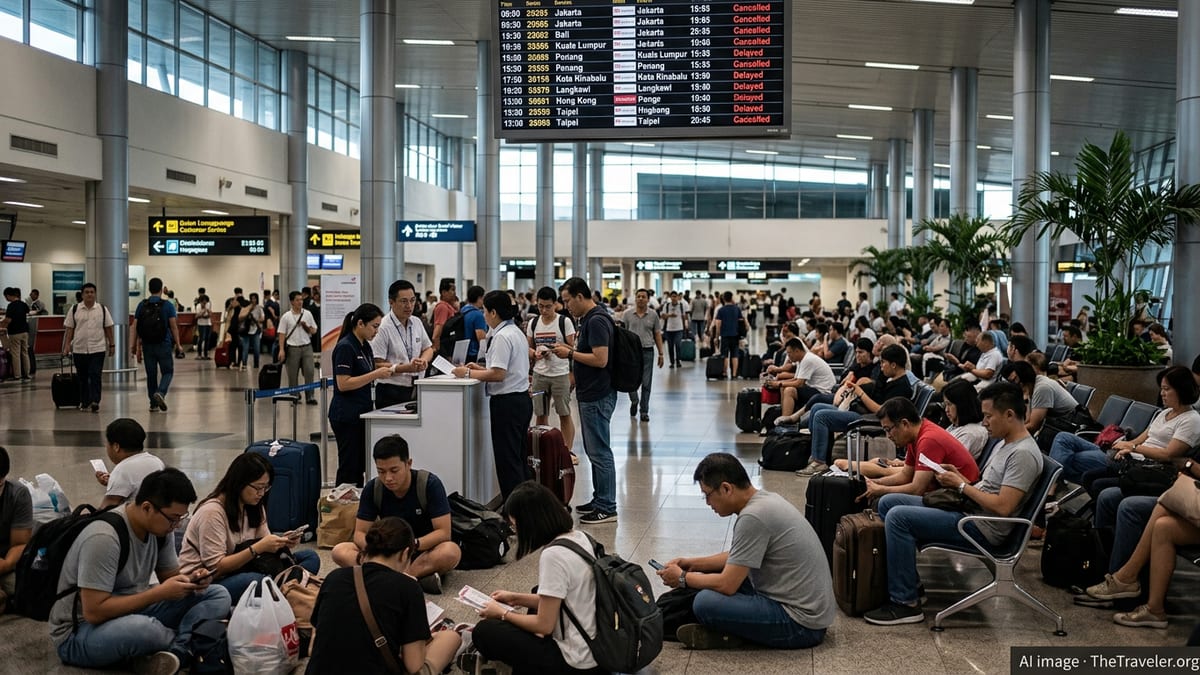
For passengers, the statistical picture of 203 cancellations and 3,055 delays translates into long queues at check in counters, rebooking desks, and transfer security checkpoints. Images and reports from affected airports depict crowded departure halls in Bangkok, Beijing, Delhi, and Singapore, with travelers resting on terminal floors, seeking updates on departure screens, and competing for limited hotel availability near airports.
Travelers holding separate tickets on low cost carriers face particular challenges when delays cause them to miss onward flights. In such cases, airline policies often treat each leg independently, leaving passengers to purchase new tickets or claim any available travel insurance. Even on full service carriers, rebooking options can be constrained when flights on subsequent days are already heavily sold due to earlier disruptions.
Families and business travelers heading to or from religious events, school holidays, and major trade fairs are among those most affected. With some Saudi Arabian and Indian airports acting as key transit points for South and Southeast Asian labor and pilgrim traffic, flight irregularities ripple into visa validity windows, employer reporting deadlines, and prepaid land arrangements in destination countries.
Publicly available consumer advisories urge passengers traveling in the coming days to monitor flight status frequently, allow extra time at the airport, and maintain flexible plans where possible. Many carriers are also highlighting digital self service tools for rebooking and notifications, in an effort to ease the strain on airport help desks and call centers already coping with several days of heightened demand.
Outlook: Continued Volatility as Peak Travel Season Nears
While the current snapshot of 203 cancellations and 3,055 delays reflects a specific 24 hour period, aviation data for recent weeks suggests that Asia’s air transport system is experiencing sustained volatility rather than isolated spikes. Previous days have recorded similarly elevated disruption figures across overlapping sets of countries, indicating that latent fragilities remain in aircraft availability, staffing, and airport capacity.
Looking ahead, the approach of peak summer travel for key origin markets such as China, India, and Southeast Asia raises the prospect of fresh strain on already busy terminals and air routes. Airlines are working to restore capacity lost during earlier downturns while also responding to shifting demand patterns and geopolitical constraints on certain corridors, a juggling act that leaves little margin for error when weather or technical problems arise.
Industry observers note that incremental improvements in operational resilience, such as more flexible crew rostering, increased spare aircraft, and investments in airport infrastructure, will take time to materialize. In the near term, passengers planning multi stop itineraries through hubs like Bangkok, Singapore, Jeddah, Riyadh, Beijing, and Delhi may continue to face a heightened risk of missed connections and unplanned overnight stays.
For now, the data from Thailand, Singapore, Saudi Arabia, China, India, and Malaysia underlines how tightly interconnected Asia’s aviation networks have become. A storm over one city, a bottleneck at one airport, or a closure in one section of airspace can rapidly propagate across thousands of kilometers, leaving travelers across the region to cope with the cumulative impact of a single day’s 203 cancellations and 3,055 delays.