

More news on this day
Thousands of passengers across Asia faced severe disruption today as airports in Thailand, Singapore, Saudi Arabia, China, India and Malaysia reported 203 flight cancellations and 3,055 delays, unsettling tight airline schedules and stranding travelers from Bangkok and Beijing to Delhi and Kuala Lumpur.
Get the latest news straight to your inbox!
Major Asian Hubs Buckle Under Mounting Disruptions
Publicly available flight-tracking data indicate that the latest wave of disruption has hit some of Asia’s busiest gateways, including Bangkok Suvarnabhumi, Singapore Changi, Beijing Capital, Beijing Daxing, Delhi’s Indira Gandhi International Airport, and Kuala Lumpur International Airport. Regional tallies show that, combined, airports in Thailand, Singapore, Saudi Arabia, China, India and Malaysia have logged 203 cancellations alongside 3,055 delayed departures and arrivals in a single operating window.
The pattern mirrors broader turbulence reported in recent weeks across Asian skies, where similar spikes of several hundred cancellations and more than 3,000 delays have been recorded in Japan, South Korea, Hong Kong and the Philippines. These recurring surges in disruption are creating rolling backlogs that are difficult for airlines and airport operators to clear within the same day, leaving passengers facing missed connections and extended waits in crowded terminals.
Operational data suggest that today’s impact is felt most acutely at large transfer hubs, where a late arrival from one country can cascade into knock-on delays for multiple onward flights. In Bangkok, Beijing and Delhi, densely banked departure waves have little slack built in, so even modest schedule disturbances can ripple rapidly through entire networks serving Asia, the Middle East and beyond.
While individual airports remain open and functioning, the elevated disruption levels have pushed the regional system close to saturation. Once runway slots and gate availability are fully spoken for, airlines have limited options other than to postpone or cancel services outright, a dynamic that is now visible across several major Asian markets at the same time.
AirAsia, Singapore Airlines, Saudia and IndiGo Among Affected Carriers
The latest figures show that both low cost and full service airlines are caught up in the turbulence. AirAsia and its affiliated brands, with significant operations in Thailand and Malaysia, are seeing network pressure as delays in cities such as Bangkok and Kuala Lumpur spill into subsequent sectors. Recent reports of long, overnight delays on selected AirAsia routes underscore how a single late aircraft rotation can upend plans for hundreds of travelers.
Singapore Airlines, a key operator at Changi Airport, is simultaneously managing today’s regional delays and a separate layer of cancellations on routes affected by the geopolitical situation in the Middle East. The carrier has already announced extended suspensions on some services to the Gulf and beyond, and any additional day-of-operation disruption in Asia further complicates aircraft and crew planning across its long-haul network.
In Saudi Arabia, Saudia is contending with congested airspace and altered routings that stem from wider Middle East constraints, which have been forcing airlines across the region to re-plan flights and, in some cases, reduce frequencies. These pressures feed directly into today’s cancellation and delay counts associated with Saudi hubs.
India’s IndiGo, one of Asia’s largest low cost carriers and a dominant player at Delhi, is also prominently affected. The airline has faced intense schedule strain in the recent past, and the latest bout of regional disruption adds further complexity to managing turnarounds and crew duty limits at already busy Indian airports.
Weather, Airspace Restrictions and Congestion Drive the Numbers
Several overlapping factors appear to be contributing to the 203 cancellations and 3,055 delays now reported across Thailand, Singapore, Saudi Arabia, China, India and Malaysia. Seasonal weather systems in parts of Southeast and South Asia are bringing bouts of heavy rain and thunderstorms, which routinely slow arrivals and departures as controllers increase separation between aircraft and temporarily halt ground handling activities during lightning.
At the same time, continuing airspace restrictions and rerouting requirements linked to the conflict in the Middle East have compressed traffic into narrower corridors and lengthened flight times between Asia, Europe and Africa. Industry analyses in recent weeks have highlighted how closures and risk-avoidance measures over several Middle Eastern countries are forcing airlines to adopt longer, more complex routings, using sectors of airspace over Saudi Arabia and other states that are experiencing heightened demand.
These longer routings can cause knock-on delays when aircraft arrive late into Asian hubs with no spare turnaround time before their next scheduled departure. When multiple late-arriving flights converge on a single airport, the result is congestion at runways, taxiways and gates, a dynamic now being reported at airports in Bangkok, Singapore, Beijing, Delhi and Kuala Lumpur.
Airport capacity constraints are compounding the problem. Many of the affected hubs entered the northern spring travel period with traffic volumes approaching or exceeding pre-pandemic levels. With schedules already dense, the system has limited resilience. Once delays accumulate early in the day, clearing them often requires carriers to consolidate services or cancel lower-priority rotations to keep crews within duty-time limits.
Passengers Face Missed Connections and Limited Options
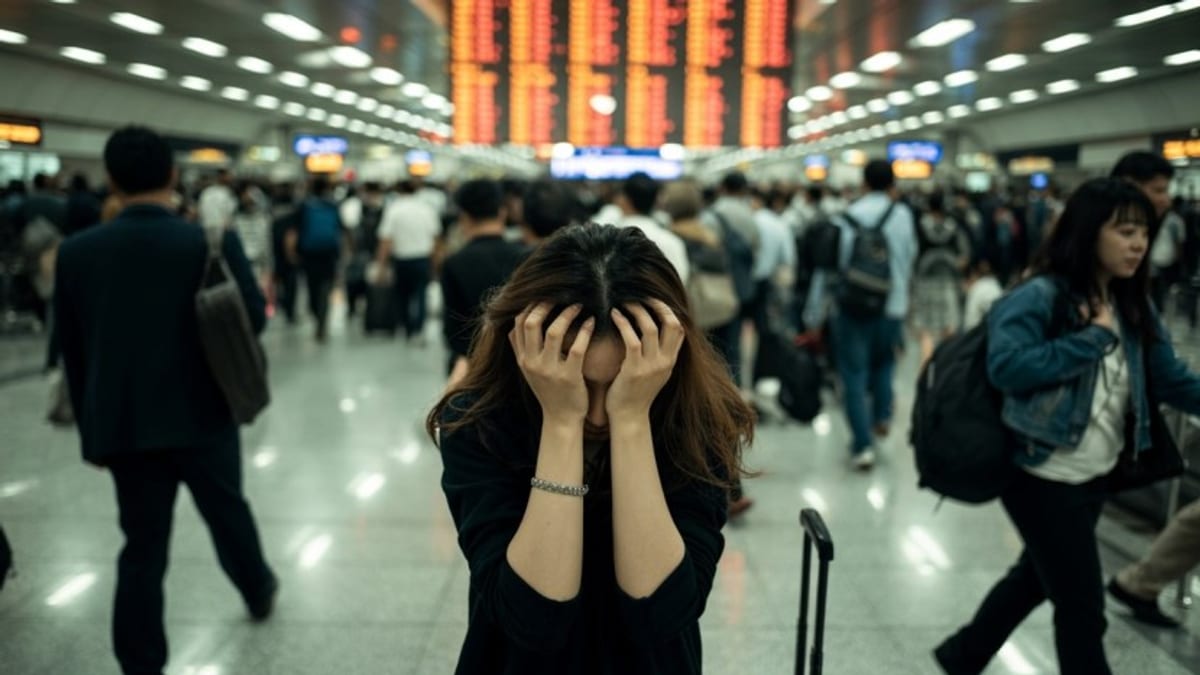
For travelers, today’s disruption translates into long lines at check in, immigration and customer service desks, as well as crowded gate areas where rolling departure time changes are now common. Reports from recent disruption events in Asia show passengers enduring waits of several hours and, in some cases, overnight stays as airlines work to rebook them onto later flights.
Missed connections are a particular challenge at transfer-heavy hubs such as Singapore, Bangkok and major Chinese airports. When an inbound flight from, for example, India or Malaysia arrives several hours late, entire banks of onward flights to other Asian cities, the Middle East or Europe may already have departed, or be fully booked with their own delayed passengers. Re-accommodating disrupted travelers then becomes a multi-day process, especially on popular routes where available seats are scarce.
Low cost carriers such as AirAsia and IndiGo typically operate point-to-point networks, which may give affected passengers more flexibility to rebook single sectors, but also often provide fewer automatic protections for missed onward travel arranged separately. Full service airlines, including Singapore Airlines and Saudia, can in some cases rearrange complete itineraries, but face the same basic constraint of limited spare capacity on heavily subscribed routes.
Passenger advocacy groups and travel industry observers consistently advise travelers caught in such disruption to document delay durations, keep boarding passes and receipts, and monitor airline channels for schedule updates. However, in large-scale events where thousands are affected across multiple countries, even well-prepared passengers can find themselves waiting many hours before alternative arrangements become available.
Broader Impact on Regional Aviation Networks
The simultaneous rise in cancellations and delays in Thailand, Singapore, Saudi Arabia, China, India and Malaysia underscores how interconnected Asia’s aviation system has become. A weather-related slowdown in one subregion, or a new airspace restriction thousands of kilometers away, can quickly reverberate across dozens of airports and multiple airline networks.
Recent analyses of disruption patterns in Asia show that on days when more than 3,000 flights are delayed across the region, punctuality metrics for major carriers can drop sharply, affecting not only intra-Asian routes but also long haul services linking the continent with Europe, North America and Oceania. For airlines already navigating higher fuel costs and complex geopolitical risks, the operational strain of persistent delays adds further financial and logistical pressure.
Industry watchers note that airports and airlines are investing in technology and planning tools designed to improve resilience, including better real-time data sharing and more dynamic use of runway and gate resources. Yet the latest wave of disruption illustrates that, when multiple stress factors collide, even well resourced hubs can struggle to maintain on-time performance.
With the northern summer travel season approaching, today’s figures of 203 cancellations and 3,055 delays serve as a warning signal for Asia’s aviation sector. Unless weather, airspace and congestion challenges ease, passengers flying through Bangkok, Singapore, Saudi hubs, major Chinese cities, India and Malaysia may need to prepare for a period of continued unpredictability in the skies.