

More news on this day
From Seoul to London and Dubai, aviation regulators and airlines are rapidly rewriting the rulebook on portable chargers, thrusting Asia’s tech-centric hubs and major European and Middle Eastern carriers into the center of a new, safety-driven shift in how international travelers fly with power banks.
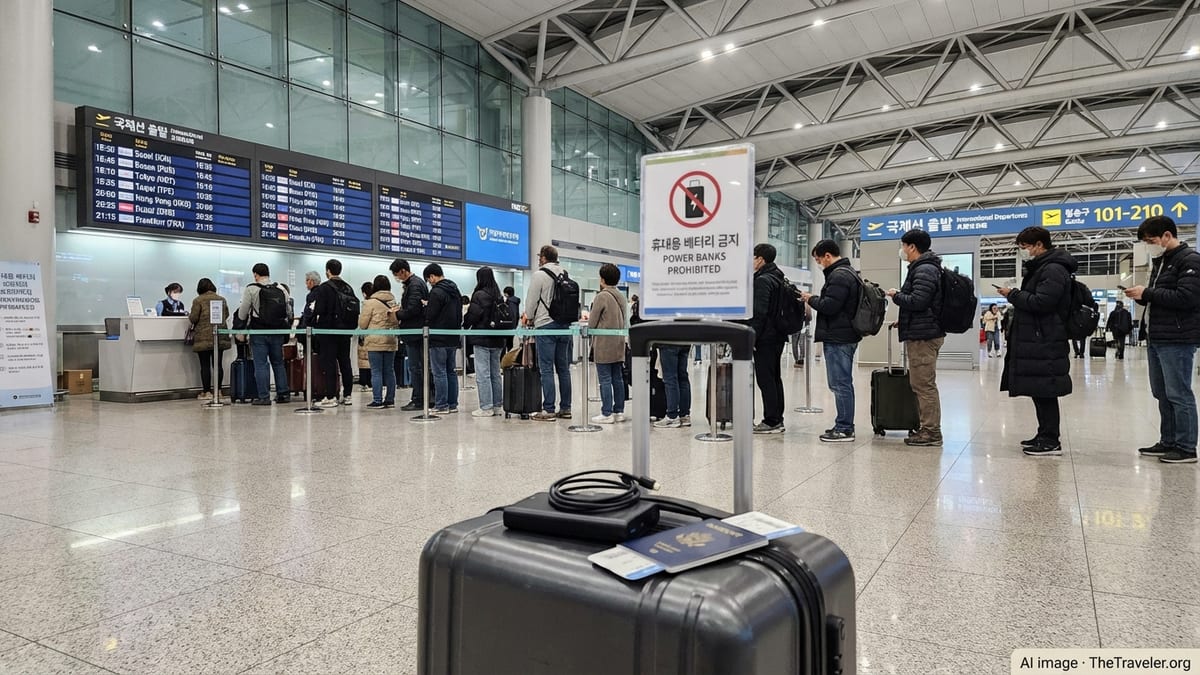
Why Lithium Batteries Are Forcing a Global Rethink
The quiet culprit behind the rule changes is the lithium battery inside every power bank. Regulators have long warned that damaged or poorly made cells can overheat and trigger thermal runaway, a chain reaction fire that is difficult to extinguish at altitude. Global aviation bodies now say the growing number of devices onboard has pushed the risk from theoretical to operational.
Current guidance from international aviation organizations already requires spare lithium batteries and power banks to be carried only in cabin baggage, never in checked luggage, so that crews can respond quickly if something goes wrong. National regulators including the United States Federal Aviation Administration and security agencies in Europe and Asia have echoed that message, stressing that even small personal devices can pose a serious hazard if they ignite unseen in a cargo hold.
What has changed over the past year is not whether travelers may bring power banks, but how and where they may use and store them once onboard. Airlines across multiple regions are layering new operational limits on top of existing technical rules about battery size, location and packaging.
Seoul and Busan: Korean Carriers Move First After Cabin Fire
South Korea’s busy aviation corridor, anchored by Seoul’s Incheon and Gimpo airports and Busan’s Gimhae hub, has emerged as an early test case. A widely reported fire in January 2025 on an Air Busan aircraft, traced to a power bank left in an overhead bin, became a turning point. The blaze, which injured passengers and scorched the cabin before the aircraft was fully evacuated on the ground, prompted intense scrutiny from regulators in Seoul.
By late 2025, Korean low cost carriers such as Eastar Jet and Jeju Air had introduced restrictions on in flight use of power banks, limiting where they could be stored and whether they could be used to charge devices while airborne. In January 2026, major full service operators including Korean Air and affiliates tightened the net further, issuing cabin wide bans on using or charging power banks during flights and instructing crews to treat any sign of overheating as an immediate safety incident.
For travelers connecting through Seoul and Busan, that means portable chargers are still generally allowed in carry on bags, but are increasingly treated as dormant emergency backup rather than in flight power sources. Passengers are being urged to fully charge phones and laptops on the ground and to keep any power banks they do carry visible, accessible and out of overhead lockers.
Tokyo and Taipei Align With Asia’s Cautious Turn
Japan and Taiwan, two of East Asia’s most important aviation markets, are now aligning with this more cautious approach. Japanese authorities have confirmed that, from April 2026, the use of mobile batteries and power banks on passenger flights will be banned, with additional limits on how many units each traveler can carry. The decision reflects broader aviation safety updates overseen by Japan’s transport ministry and mirrors earlier restrictions adopted by leading Asian and Gulf carriers.
Tokyo’s Haneda and Narita airports, among the region’s busiest international gateways, are already seeing airlines adjust pre flight announcements and signage to reflect the upcoming changes. Travelers can expect a clear message: carry your power bank in the cabin if it meets watt hour limits, but do not expect to use it inflight, and be prepared for security or gate staff to inspect labels and capacity markings more closely.
Taipei’s Taoyuan airport, a major stopover point between Northeast and Southeast Asia and North America, has likewise seen local carriers and regulators emphasize strict compliance with international lithium battery rules. While the precise wording of policies may vary by airline, the pattern is consistent with regional peers: no power banks in checked luggage, tighter scrutiny of large capacity devices, and growing reluctance to permit mid air charging from personal battery packs.
Hong Kong, Europe and the Middle East Tighten the Screws
Hong Kong, long a bellwether for aviation trends in Greater China, has also moved to highlight the risks of lithium powered devices. Recent safety advisories from regional regulators and carriers based in the city have underscored that power banks must stay in hand luggage and may be subject to additional inflight restrictions, particularly regarding storage in overhead bins and use during long haul services.
In Europe, large airline groups have started to codify similar limits. Germany’s Lufthansa group introduced new rules in 2025 and early 2026 that cap the number and size of power banks per passenger, forbid their storage in overhead compartments and prohibit using them with in seat power outlets. Rival carriers are following with comparable measures that pair technical limits with behavioral rules intended to keep devices visible and quickly reachable if something goes wrong.
Middle Eastern giants are moving in parallel. Emirates has announced that, from late 2025, power banks may still travel in cabin baggage but cannot be used to charge devices during the flight. Other Gulf and regional airlines have set comparable watt hour thresholds and in flight bans on using portable chargers, turning what was once a convenience into a controlled safety risk that must remain switched off from takeoff to landing.
What This New Era Means for International Travelers
For passengers flying between Asian hubs such as Seoul, Busan, Tokyo, Taipei and Hong Kong and major hubs in Europe and the Middle East, the message is converging even if the details differ by airline. Portable chargers are increasingly treated like matches: permitted in small quantities, confined to carry on bags and subject to strict rules on when and how they may be used. The days of casually tossing multiple high capacity power banks into a backpack and charging throughout a long haul flight are quickly ending.
Practically, travelers should now assume three things when planning itineraries across these regions. First, power banks belong only in cabin baggage, with terminals protected and capacity clearly labeled. Second, many airlines will either limit or outright ban inflight use, especially on routes touching Asia, Europe and the Gulf. Third, larger batteries, including those used for professional cameras, drones or medical equipment, may require advance airline approval or be refused altogether.
As more carriers synchronize policies with emerging international standards, airport announcements and check in questions about lithium batteries are likely to become as routine as those about liquids and sharp objects. For connected travelers, that means adjusting habits: prioritizing fully charged devices before boarding, relying more on seatback power and USB outlets where available, and treating the once ubiquitous power bank as an emergency backup rather than a primary energy source at 35,000 feet.