

More news on this day
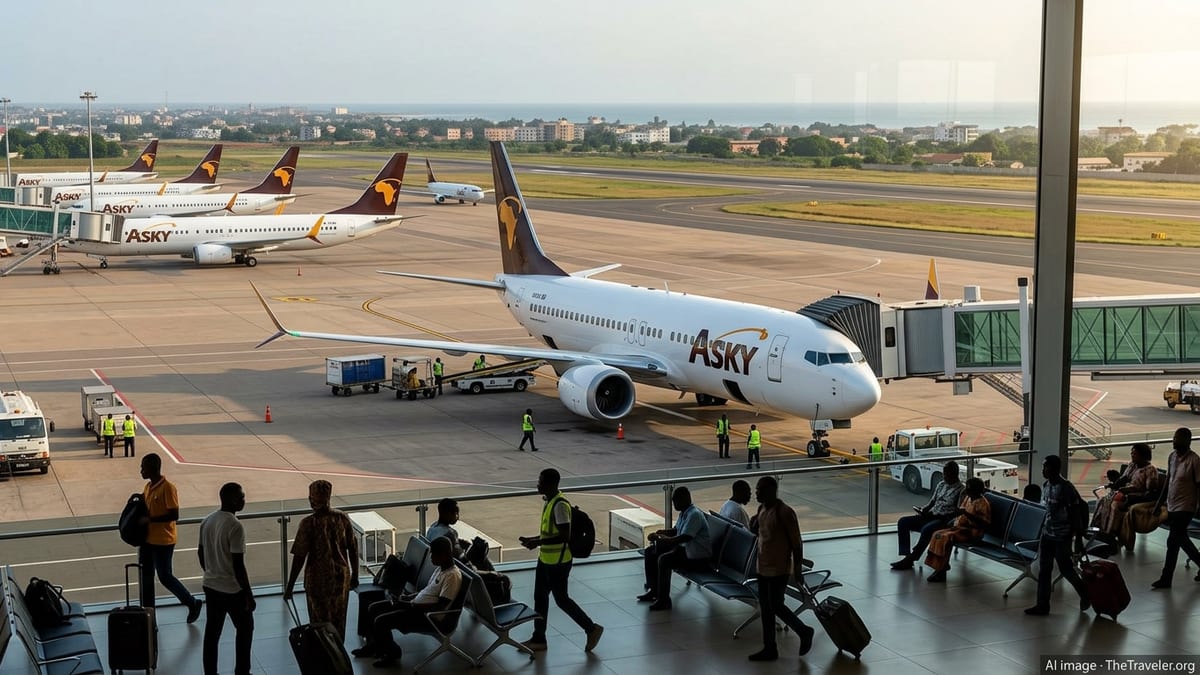
ASKY Airlines is stepping up its growth strategy from Lomé, deepening its West and Central African network, modernizing its fleet and laying groundwork for eventual links from Togo’s capital to major intercontinental gateways.
Get the latest news straight to your inbox!
Lomé Hub Strategy Enters a New Phase
Publicly available information shows that ASKY Airlines has turned Lomé’s Gnassingbé Eyadéma International Airport into one of West Africa’s more dynamic regional hubs, with a network that now reaches around 30 cities across nearly as many countries. The carrier’s model is built on connecting secondary and capital cities that often lack nonstop links, funnelling passengers through Lomé for onward travel around the continent.
Recent coverage from regional business media indicates that the airline is steadily adding new spokes to this hub-and-spoke system, positioning Lomé as a transfer point between West, Central and parts of Southern Africa rather than a simple point-to-point origin. That strategy is seen by industry observers as a way to capture growing intra-African travel and trade while preparing for future long-haul connectivity to Europe, the Middle East and North America.
Analysts note that Lomé’s geographic position on the Gulf of Guinea allows for relatively efficient triangular routings linking coastal and inland capitals. This has helped ASKY carve out a role that is complementary to larger pan-African groups, while still allowing it to pursue its own growth plans anchored in Togo.
The transformation of Lomé into a higher-traffic hub also aligns with broader infrastructure upgrades at the airport and within Togo’s transport sector, which aim to attract logistics, finance and tourism flows that benefit from more frequent, reliable air links.
New African Routes Extend Regional Reach
Recent route announcements highlight how ASKY is filling gaps in regional connectivity before leaping into intercontinental markets. In 2025, the carrier inaugurated service between Lomé and Nouakchott, Mauritania, adding a 30th destination to its African network and creating new one-stop links between northwest Africa and cities further south via Togo. Reports from aviation-focused outlets describe the route as a strategic move that shortens journey times which previously required circuitous connections through non-African hubs.
Industry round-ups of African aviation developments also point to growing cooperation through codeshare agreements that effectively widen ASKY’s reach without the airline needing to launch every route itself. A partnership with Air Senegal allows passengers to connect via Dakar into destinations such as Casablanca and Paris, while travelers from Senegal gain easier access to ASKY’s West and Central African network through Lomé.
These network moves are viewed by analysts as preparatory steps toward deeper integration with global traffic flows. By solidifying coverage across its home region, ASKY is seeking to ensure that any eventual long-haul links into Europe or the Middle East can tap into a robust feeder network, anchoring those future services with steady flows of connecting passengers.
Regional observers also underline that this pattern supports continental policy priorities such as the Single African Air Transport Market, which encourages airlines to improve cross-border connectivity within Africa. ASKY’s focus on adding intra-African city pairs from Lomé positions it as a practical example of that policy in action.
Fleet Growth Anchored in Boeing 737 MAX
Fleet expansion has become a central pillar of ASKY’s strategy. According to the airline’s published updates, the carrier now operates a fleet of 15 aircraft, including Boeing 737-800s and an increasing number of Boeing 737 MAX 8 jets. Aviation industry coverage notes that the airline took delivery of multiple MAX aircraft between 2023 and 2025, raising its profile as one of Africa’s most significant operators of the type.
Reports from specialized aviation outlets in March 2025 indicated that ASKY’s fifth 737 MAX 8 entered service that month, cementing the carrier’s status as the second-largest MAX operator on the continent behind its strategic partner Ethiopian Airlines. The aircraft are typically configured in a two-class layout, providing both business and economy cabins suited to regional and medium-haul missions.
These deliveries form part of a wider long-term expansion plan cited in regional business media, which describe ambitions to grow the fleet toward around 20 aircraft over the next few years. While earlier commentary referenced interest in longer-range models for potential intercontinental services, the immediate focus appears to remain on single-aisle jets that can efficiently serve high-frequency regional routes and medium-haul flights to North and Central Africa.
Industry analysts suggest that a homogenous narrowbody fleet allows ASKY to keep operating and maintenance costs in check as it scales up. At the same time, the adoption of newer-generation aircraft such as the 737 MAX is presented in public communications as a contribution to lower fuel burn per seat and reduced emissions compared with older models.
Maintenance and Training Investments in Lomé
Beyond aircraft acquisitions, ASKY is investing in support infrastructure that underpins long-term growth from Lomé. Recent summaries compiled by the African Airlines Association highlight plans for a dedicated maintenance, repair and overhaul facility in Togo’s capital, to be developed through a joint venture structure with Ethiopian Airlines, which holds a minority stake in ASKY.
The proposed maintenance center is designed to specialize in Boeing 737 Next Generation and 737 MAX aircraft, serving both ASKY’s own fleet and third-party operators across West and Central Africa. Industry observers view the project as a response to the region’s limited heavy-maintenance capacity, which often forces airlines to send aircraft to distant facilities, increasing downtime and costs.
Public information on the project indicates that the value of the planned investment is around 100 million US dollars, with the facility positioned as a future regional hub for technical services. This is expected to support higher aircraft availability for ASKY as its fleet grows, while also generating ancillary revenue streams from external customers.
The airline has also been developing its training capabilities in Lomé, with documentation from aviation associations mentioning a simulator and training center focused on Boeing narrowbody types. This is intended to support pilot, cabin crew and maintenance staff development both for ASKY and for other airlines in the region, helping address chronic skills shortages in African aviation.
European Ambitions and the Path to Global Capitals
While ASKY’s current scheduled network remains concentrated within Africa, the carrier’s public messaging and strategic partnerships point toward longer-term ambitions to connect Lomé to major global capitals. Industry commentary frequently highlights the potential for future services to cities such as Paris, London and key Middle Eastern hubs, leveraging feed from ASKY’s regional network alongside partner traffic.
Documents from African aviation forums and regional economic publications describe Lomé’s evolution into a hub intended to bridge West and Central Africa with global markets. Under this vision, ASKY’s network would provide the intra-African backbone, while long-haul capacity could be deployed either directly by ASKY in the future or via deeper cooperation with partner airlines that already operate intercontinental fleets.
For now, travelers from ASKY destinations typically reach long-haul flights to Europe, North America or Asia through partner hubs, including Addis Ababa with Ethiopian Airlines and Dakar with Air Senegal, as indicated by publicly available schedules and codeshare announcements. However, the consolidation of routes, fleet modernization and investment in maintenance and training in Lomé are widely interpreted as building blocks for eventual nonstop services between Togo and leading global capitals.
As Africa’s air travel market continues to grow and liberalization initiatives make cross-border operations more accessible, ASKY’s combination of a strengthening regional network, a young Boeing fleet and a hub-oriented strategy from Lomé is expected by sector observers to keep the carrier well positioned for a future phase of intercontinental expansion.