

More news on this day
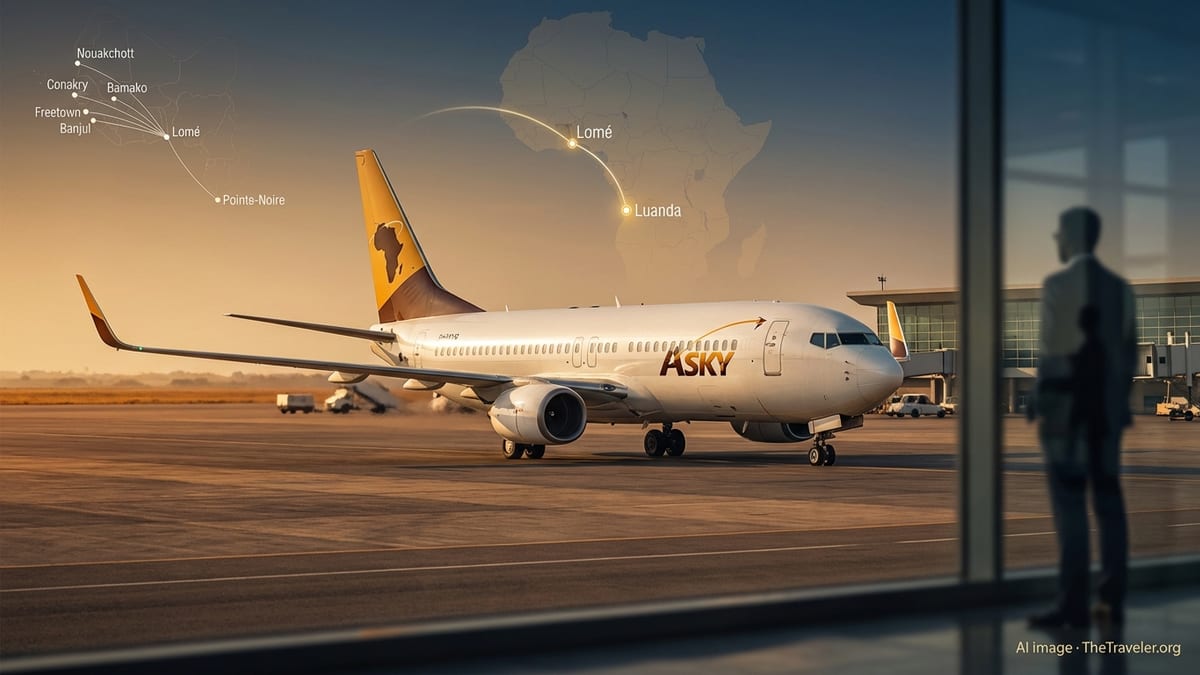
ASKY Airlines is quietly rewriting the rulebook on regional connectivity in Africa, and nowhere is that more evident than on its corridor between Luanda, Angola and Lomé, Togo.
What began as a niche link between two capitals has quickly become one of the most strategically important routes on the continent, underpinning trade, plugging Angola into West Africa’s aviation hub in Lomé and offering a new, non-stop option in a market long dominated by slow, multi-stop journeys.
More News
- TSA Rolls Out $45 ConfirmID Fee for Travelers Without REAL ID at Security
- Flying Blue Launches February 25% Promo Rewards on Transatlantic and Regional Routes
- United Fast-Tracks Starlink Wi‑Fi Across Fleet, Free for MileagePlus Members
A Direct Bridge Between Angola And West Africa’s Emerging Hub
For years, travelers moving between Angola and West Africa had to accept a patchwork of connections, detours through other regions, or long overland legs. ASKY Airlines has changed that equation with a direct Luanda–Lomé link that cuts travel time to around three and a half hours and removes the need for cumbersome regional routings.
Operating from Luanda’s Quatro de Fevereiro Airport to Lomé Tokoin, the route brings together one of Africa’s biggest oil economies and one of its fastest-rising aviation hubs. ASKY serves Lomé as a central nerve center for its pan-African network, allowing passengers arriving from Luanda to connect onward across West, Central and parts of Southern Africa without leaving the continent’s air system.
Timetables show three non-stop flights per week, giving both business and leisure travelers predictable options on set days. From Luanda to Lomé, direct services are typically scheduled on Tuesdays, Thursdays and Saturdays, while the return legs from Togo to Angola operate on Mondays, Wednesdays and Fridays. That pattern is geared toward both corporate travelers who need week-spanning trips and those connecting to weekend departures beyond Lomé.
Crucially, the service is not an isolated experiment. Data on ASKY’s KP77 flight between Luanda and Lomé shows a consistent pattern of operations, with the carrier maintaining regular service and solid on-time performance ratings relative to regional norms. Together with another ASKY-operated pattern that links Lomé to Pointe-Noire via Luanda, the Angolan capital has become a critical intermediate point on a broader west–central African air corridor.
Why This Route Is Suddenly On Every Travel Insider’s Radar
The Luanda–Lomé flight was once a quiet business tool, used largely by corporate travelers tied to Angola’s energy sector and regional institutions. Over the past year, however, a combination of aviation strategy, fleet upgrades and shifting trade links has elevated it into what many analysts now call one of West and Central Africa’s most interesting routes.
ASKY has been actively repositioning itself as a modern, pan-African carrier rather than a niche regional airline. The arrival of a new Boeing 737 MAX 8 into its fleet in early 2025 signaled that intent. The aircraft brings greater fuel efficiency, lower emissions and reduced cabin noise, as well as a more contemporary passenger experience. While the carrier still deploys Boeing 737-800 aircraft widely on its regional routes, the introduction of the MAX 8 has underlined its capacity to sustain longer regional runs like Luanda–Lomé with more efficient jets.
At the same time, ASKY’s network planning has increasingly centered on Lomé as a connective hub. The airline has been adjusting routings across West Africa, adding new spoke destinations such as Nouakchott and fine-tuning links to cities like Conakry, Bamako, Freetown and Banjul. Every new spoke that plugs into Lomé increases the value of a direct feed from Luanda, turning Angolan-origin passengers into potential travelers to dozens of African markets, and vice versa.
Travel industry watchers have also pointed to the rarity of a non-stop service on this particular city pair. While many African capitals remain one or two stops apart, Luanda–Lomé now stands out as a fast, single-hop bridge with business class seating and scheduled morning departures that facilitate same-day meetings or onward afternoon connections in Lomé.
Schedules, Fleet And Onboard Experience On The Luanda–Lomé Run
ASKY’s scheduling on Luanda–Lomé appears designed around productivity. Outbound flights from Luanda generally depart in the morning, around 09:10 local time, landing in Lomé in the late morning to early afternoon after a block time of around three hours and thirty minutes. That timing syncs with wave departures from the Togolese hub, enabling passengers to step directly into connecting flights to other West and Central African cities.
In the opposite direction, published schedules indicate afternoon departures from Lomé to Luanda around 13:10, again with a flight time of approximately three hours and thirty minutes. The result is a same-day, daylight journey in both directions, with minimal disruption to business schedules and an easier experience for passengers less comfortable with overnight or red-eye flights.
The route is typically operated with Boeing 737-800 equipment configured with both business and economy cabins. The 737-800 is a workhorse aircraft across Africa, valued for its range, capacity and reliability. ASKY’s cabin layouts generally include a small business class section with more generous seat pitch and upgraded service, alongside a larger economy cabin that offers standard regional-jet comfort, in-flight meals and beverages depending on time of day.
Although the 737 MAX 8 has been specifically highlighted in ASKY communications as part of a fleet modernization push, the airline’s broader 737 fleet benefits from incremental comfort improvements and operational efficiencies. Lower fuel burn and more modern avionics help the carrier keep costs in check on longer regional sectors like Luanda–Lomé, which can translate into more competitive fares and improved schedule resilience compared with older aircraft types.
From Oil Fields To Boardrooms: Who Is Using This Flight?
The passenger mix on Luanda–Lomé reflects the growing economic and diplomatic ties between Angola and West Africa. Business travelers dominate, from executives in the oil and gas sector and mining supply chains to consultants, development agencies and regional organization staff who now rely on ASKY’s network for multi-country missions.
Luanda, as Angola’s capital and key port, is central to one of the continent’s largest petroleum industries and a growing services economy. Lomé, for its part, has become a niche logistics and financial hub, supported by its deepwater port and an aviation strategy that positions the city as a crossroads for intra-African travel. The non-stop flight allows decision-makers from Luanda to reach not only Togo but a swath of West and Central Africa by transferring in Lomé.
Trade flows are quietly shifting as a result. Angolan businesses seeking partners or projects in Francophone West Africa now have a more straightforward route into markets such as Burkina Faso, Niger, Mauritania and Guinea via ASKY’s hub. Similarly, companies based in those markets can reach Angola’s energy and construction sectors with fewer barriers, using Lomé as a staging point before continuing on to Luanda.
Leisure traffic, while still secondary, is growing as awareness spreads. Tour operators have begun to consider combined itineraries that link Angola’s Atlantic coastline or national parks with West African cultural circuits anchored around Lomé and neighboring capitals. For diaspora travelers with roots in several countries, the route also offers a cleaner way to piece together multi-country family visits without retracing steps through Europe or the Middle East.
Reliability, Performance And The Growing Importance Of Regional Carriers
In Africa, where infrastructure can be inconsistent and alternative transport options limited, reliability is a key differentiator. Flight data for ASKY’s KP77 service shows three weekly operations with an average flight time just under three hours in the air, and a strong on-time performance score across recent months. While some flights have experienced delays, the overall pattern points to a route that functions dependably by regional standards.
For travelers who once had to fly from Luanda north or east to a distant hub, then backtrack into West Africa, the ability to complete the journey in a single daylight hop is a significant improvement in both reliability and cost. Fewer connections mean fewer missed flights and less time waiting in unfamiliar airports, a point that matters to corporate travel managers and individual passengers alike.
The Luanda–Lomé link also underlines a broader shift in African aviation, where regional carriers are increasingly stepping in to provide the connectivity that global airlines have struggled to offer profitably. ASKY’s partnership structures and cooperation with other African and Middle Eastern airlines help it to fill gaps in intra-African travel, with Lomé acting as a consolidation point for traffic that might otherwise disperse through foreign hubs.
In practice, that means a traveler boarding in Luanda can use a single African carrier to reach cities that would previously have required multiple airlines on separate tickets. In a market where schedule disruptions are a reality, that consolidation under one operator helps simplify rebooking, customer support and, critically, the handling of missed connections.
What Travelers Can Expect On The Ground In Luanda And Lomé
At Luanda’s Quatro de Fevereiro Airport, ASKY operates as a visiting carrier in an environment dominated by Angola’s national airline and long-haul operators. The airport has been undergoing gradual improvements aimed at handling rising passenger volumes in a more streamlined way, though travelers still report peak-time congestion at security and check-in areas. Flying on a morning departure gives some respite from the busiest evening surges, and ASKY’s use of standard Boeing 737 equipment eases turnaround processes on the ground.
Lomé Tokoin Airport, sometimes referred to as Gnassingbé Eyadéma International Airport, is where the experience becomes more distinctive. Designed as a hub for ASKY and its partners, the airport’s layout and operations are optimized for fast transfers between regional flights. Passengers arriving from Luanda can connect to other destinations with relatively short minimum connection times, helped by compact terminal design and coordinated flight banks.
Business class passengers benefit from access to lounges in Lomé, where hub operations are increasingly tailored to frequent travelers and corporate accounts. Even in economy, however, the convenience of staying within a single terminal rather than navigating sprawling hub airports has become a selling point. Travelers report that formalities in Lomé are generally manageable, though, as in many regional airports, peak bank times can bring queues at immigration and security for those terminating there.
For passengers whose journey ends in Togo, the proximity of Lomé’s airport to the city center is another advantage. The modest transfer time to hotels and offices makes same-day arrival meetings more realistic compared with gateways where airports sit far outside downtown areas. This is especially relevant for business travelers arriving from Luanda on the late morning service who wish to schedule late-afternoon negotiations or site visits in Lomé.
FAQ
Q1. How many direct flights per week does ASKY operate between Luanda and Lomé?
ASKY currently operates three non-stop flights per week between Luanda’s Quatro de Fevereiro Airport and Lomé Tokoin, generally on Tuesdays, Thursdays and Saturdays from Luanda, with corresponding return services on different days from Lomé.
Q2. How long is the flight between Luanda and Lomé?
The scheduled block time for the Luanda–Lomé route is around three hours and thirty minutes, placing it firmly in the medium-haul category for intra-African travel.
Q3. Which aircraft does ASKY use on the Luanda–Lomé route?
The route is typically operated by Boeing 737 aircraft, most commonly the 737-800, configured with both business and economy cabins as part of ASKY’s regional fleet.
Q4. On which days does the Lomé–Luanda flight usually depart?
Timetables show direct flights from Lomé to Luanda scheduled three times weekly, commonly on Mondays, Wednesdays and Fridays, with afternoon departures from Togo and evening arrivals in Angola.
Q5. Is business class available on ASKY’s Luanda–Lomé service?
Yes. ASKY offers a business class cabin on its Boeing 737 services, providing wider seats, more legroom and enhanced onboard service compared with the economy cabin.
Q6. Can I connect onward from Lomé to other African cities on the same ticket?
Yes. Lomé functions as ASKY’s primary hub, so passengers arriving from Luanda can connect on the same carrier to a wide range of West and Central African destinations using coordinated schedules.
Q7. How reliable is the Luanda–Lomé route in terms of on-time performance?
Recent flight statistics show the KP77 service achieving a strong on-time performance rating relative to regional benchmarks, although, as with any route, individual flights can still experience delays due to weather, air traffic or operational constraints.
Q8. Why is this flight considered strategically important for African travel?
The Luanda–Lomé link provides a rare non-stop bridge between Angola and a major West African hub, reducing reliance on distant overseas hubs and strengthening intra-African trade, diplomatic and tourism flows.
Q9. Is the route used mainly by business travelers or is there growing leisure demand?
Business travelers, particularly from the energy, logistics and development sectors, still make up much of the demand, but leisure and diaspora traffic are steadily growing as awareness of the non-stop option spreads.
Q10. How does ASKY’s fleet modernization affect passengers on this route?
ASKY’s introduction of newer, more efficient aircraft such as the Boeing 737 MAX 8 into its fleet supports better fuel economy, lower emissions and a quieter cabin, reinforcing the airline’s ability to maintain competitive, comfortable medium-haul services like Luanda–Lomé over the long term.