

More news on this day
The UK train drivers’ union Aslef is renewing pressure for a second safety-critical member of staff on passenger services, arguing that modernising Britain’s rail safety regime must prioritise on-board staffing levels as disputes continue over driver-only operation and network expansion plans.
Get the latest news straight to your inbox!
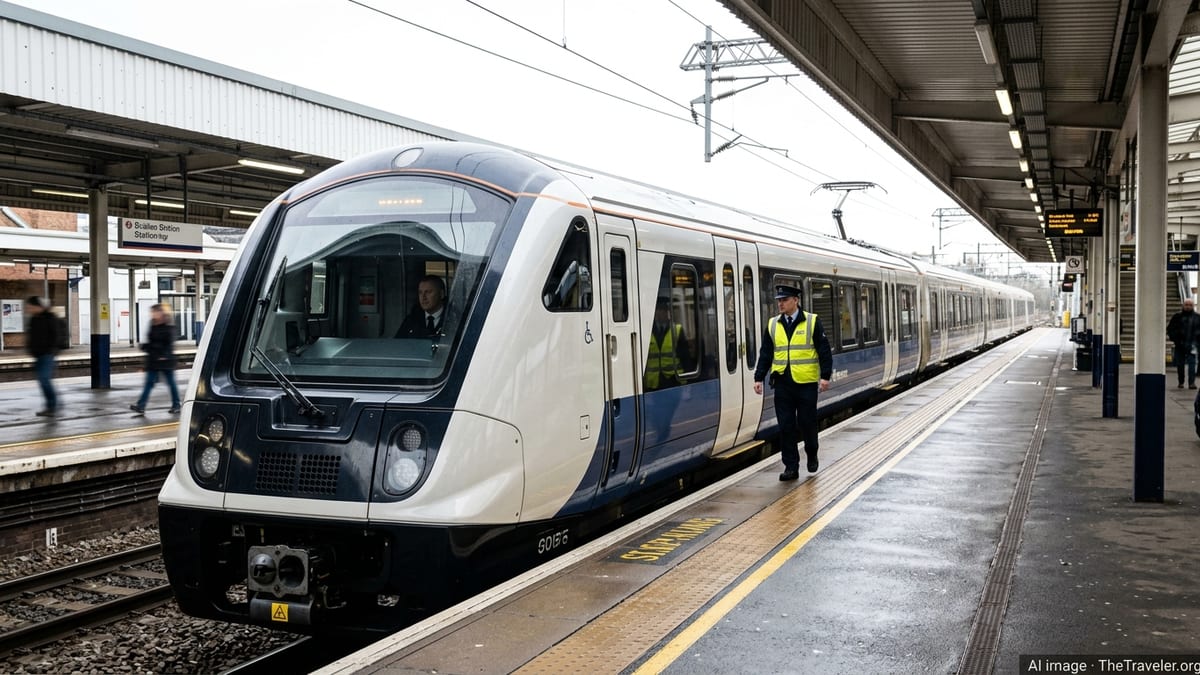
Safety Debate Intensifies Around Driver-Only Operation
Arguments over driver-only operation have become a defining fault line in UK rail industrial relations, with Aslef positioning the presence of a second safety-critical person as a core safety standard rather than an optional add-on. The union has consistently opposed further roll out of trains run solely by a driver, warning that technological measures do not fully replace a trained on-board colleague able to manage incidents, support evacuations and assist vulnerable passengers.
Recent coverage of disputes on new and upgraded routes highlights how crew composition has moved from a technical staffing question to a headline public policy issue. Reports indicate that plans for new intercity links, such as key sections of the East West Rail project, have been slowed in part by disagreements over whether services can be safely and reliably operated without a guaranteed second safety-critical member of staff on every train.
Supporters of driver-only models point to modern signalling, remote monitoring and platform staff as sufficient mitigations, noting that similar concepts operate in other countries. Aslef counters that Britain’s heavily used mixed-traffic network, crowded commuter routes and an ageing infrastructure demand on-board human redundancy when things go wrong, from medical emergencies to infrastructure failures.
Union Demands Framed as Modernisation, Not Nostalgia
Aslef is seeking to frame its demands as a forward-looking modernisation of safety practices rather than a return to historic operating methods. Publicly available submissions to parliamentary committees and industry groups stress that changes in technology, passenger expectations and security risks require a reassessment of how many trained staff are present on moving trains, and what duties they perform.
Written evidence from the union to national policymakers over recent years has linked staffing levels to broader concerns about fatigue, medical fitness and the growing pressures on safety-critical workers. By arguing for a second qualified person on board, the union presents its case as part of a layered safety system that includes better medical standards, improved facilities for staff and updated risk assessments, rather than a single-issue campaign about guards or conductors.
Industry commentary suggests that this reframing resonates with parts of the travelling public, particularly disabled passengers and those concerned about late-night security. Campaigners for accessible transport have long argued that a second trained member of staff is crucial for spontaneous “turn up and go” journeys and for managing complex boarding and alighting assistance at busy or unstaffed stations.
Regulators and Operators Confront Changing Risk Landscape
Britain’s rail safety framework is undergoing its own evolution, with regulators and standards bodies reassessing how safety-critical roles are defined and monitored. Recent updates to medical assessment guidance for rail staff, for example, have been presented as an attempt to reflect current understanding of risk while maintaining high standards. These changes sit alongside ongoing work on platform-train interface safety and management of stranded trains, both of which highlight the importance of trained personnel on board.
Official health and safety reports on Britain’s railways point to a generally strong overall safety record, but they also underline the complexity of managing risk on a busy, fragmented network. Initiatives targeting infrastructure, such as stricter oversight of structures and signalling, are increasingly accompanied by attention to human performance and staffing models. In that context, Aslef’s push for a second safety-critical person is being interpreted by some observers as part of a broader debate about how to blend automation, remote monitoring and human oversight.
Train operating companies, many still grappling with post-pandemic travel patterns and tight financial settlements, are balancing these safety considerations with cost pressures and calls for greater efficiency. Some operators have invested in expanded “travel safe” teams and additional late-night staff in specific regions, while others are working within existing agreements that already guarantee a second person on certain routes or services.
Passenger Experience and Disability Access at the Forefront
For many passengers, the discussion about a second safety-critical person is less about technical standards and more about lived experience on board trains. Reports from passenger groups and disability advocates highlight concerns that reducing on-board staffing can make spontaneous travel more difficult, especially where assistance needs to be arranged in advance or where stations are lightly staffed.
The combination of driver-only operation with unstaffed or partially staffed stations has been described in public consultations as particularly challenging for wheelchair users, older passengers and those with hidden disabilities. A second safety-critical member of staff is often presented by campaigners as both a safety measure and a customer service role, bridging the gap between operational safety, personal security and accessibility obligations.
Incidents where passengers report being left without assistance, or facing confusion during service disruptions, have added urgency to these concerns. While such events remain relatively rare in the context of millions of journeys made each year, they are becoming touchpoints in the public debate about what constitutes an acceptable level of staffing on modern railways.
Implications for Future Projects and National Rail Policy
The outcome of Aslef’s campaign is likely to influence how new lines and rolling stock are specified in the coming years. Ongoing projects, from regional upgrades to flagship intercity routes, are being designed in parallel with evolving expectations about minimum crew levels, on-board technology and accessibility standards. Delays or redesigns linked to staffing disagreements highlight the need for earlier alignment between unions, operators and government on what “modern” rail safety should look like in practice.
Policy debates over the future structure and funding of Britain’s railways, including proposals for new public bodies and revised contracts, are expected to revisit the question of mandated staffing levels. Some analysts predict that greater central coordination could lead to clearer, nationwide standards on whether a second safety-critical person is required on all or most passenger services, rather than leaving the issue to be resolved franchise by franchise or route by route.
For now, Aslef’s insistence on a guaranteed second safety-critical staff member keeps the human element at the centre of the UK rail safety conversation. As the network adapts to new technology and shifting travel patterns, the balance between automation, cost control and on-board expertise is set to remain a defining issue for passengers, workers and policymakers alike.