

More news on this day
Aspen Hotels of Alaska is stepping into 2026 with an assertive growth strategy, adding new properties, refreshing existing suites and introducing an enhanced guest rewards program as Alaska’s hotel market enters a new phase of expansion.
Get the latest news straight to your inbox!
Alaska’s Homegrown Chain Scales Up for a New Tourism Cycle
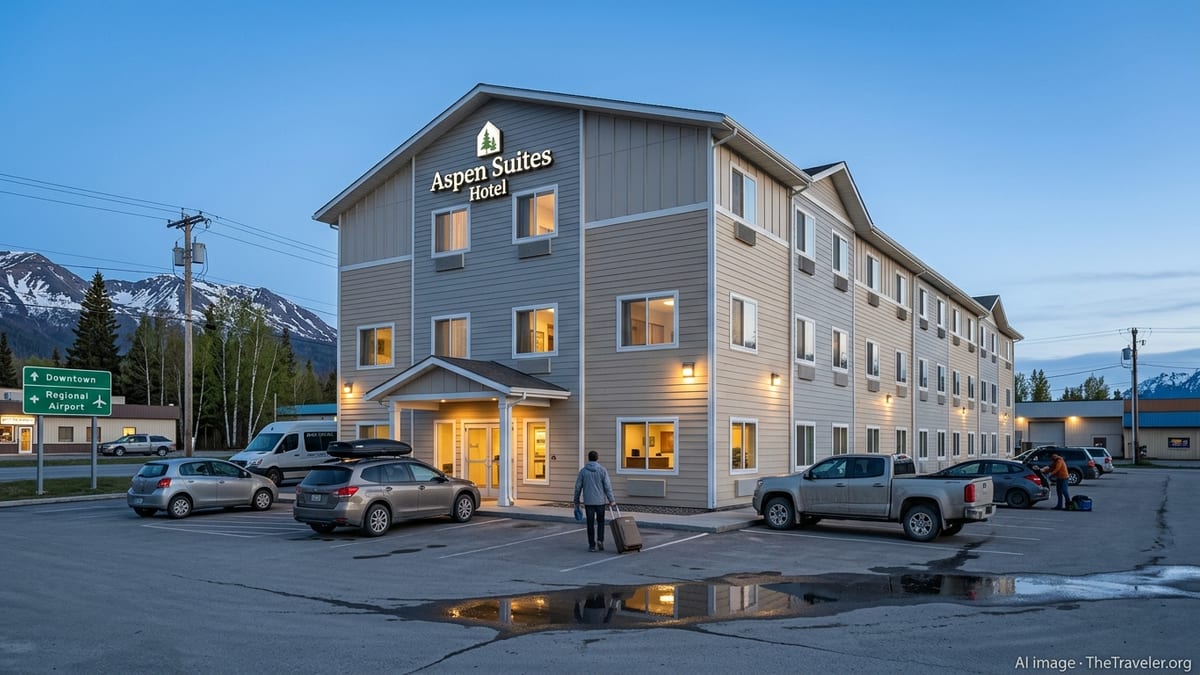
Publicly available information shows that Aspen Hotels of Alaska, a homegrown extended-stay chain, is positioning itself at the forefront of the state’s hospitality boom in 2026. The company, known for its Aspen Suites-branded properties, is expanding on a platform that already spans Anchorage, Haines, Juneau, Kenai, Soldotna, Homer and Sitka, giving it one of the widest purely Alaskan footprints in the market.
Reports indicate that Alaska’s broader hotel pipeline has accelerated on the back of renewed visitor demand and major infrastructure projects. Industry data for late 2025 showed a record number of hotel projects under development across the United States, with Alaska capturing a growing share as cruise capacity returns, independent travelers seek longer stays and business travel tied to resource and logistics sectors stabilizes. In that context, Aspen’s emphasis on extended-stay rooms with kitchenettes and flexible layouts aligns closely with shifting traveler behavior.
The chain has benefitted from years of incremental expansion supported by local financing partners. Earlier documentation from Alaska’s development agencies highlighted Aspen properties as case studies in how targeted lending participation can bring new room supply to underserved markets. That track record is now providing a springboard for a more ambitious, multi-market push as 2026 unfolds.
While national brands are adding flags in Anchorage, the Mat-Su Valley and along key cruise corridors, Aspen Hotels is seeking to compete by deepening its regional network rather than chasing marquee labels. The company is concentrating on practical locations near airports, ferry terminals and commercial districts, appealing to both Alaskans traveling within the state and visitors planning self-guided itineraries.
New Openings and Renovations Extend Reach Across Alaska
According to information on the company’s own channels and regional tourism listings, Aspen is moving ahead with a slate of new and upgraded properties in 2026. The most closely watched project is Aspen Suites Hotel Fairbanks, listed as “coming soon” and expected to add extended-stay capacity in Alaska’s Interior as the city prepares for heavier summer tourism and year-round government and university-related demand.
Industry coverage notes that Aspen’s recent development model leans heavily on midscale, all-suites designs that can be adapted to smaller markets. That approach was illustrated in earlier Anchorage projects, where four-story, limited-service hotels were built with kitchen-equipped rooms, streamlined public spaces and relatively small meeting facilities. The same template is now being refined for new locations, allowing the company to move quickly in communities where full-service hotel development may not pencil out for national operators.
Renovation activity is also gathering pace. Travel trade materials referencing Aspen’s Homer and Juneau properties describe refreshed interiors and upgraded in-room technology designed to meet expectations of remote workers and long-stay guests. Meeting-room collateral for Juneau highlights upgraded audiovisual capabilities, underscoring Aspen’s push to capture small conferences, government trainings and association gatherings that require reliable but modestly sized facilities.
Combined, the new Fairbanks property, incremental room count increases and rolling refurbishments are expected to lift Aspen’s total inventory in Alaska through 2026, reinforcing its status as one of the most visible independent players in the state’s lodging landscape.
Guest Rewards Program Targets Repeat Travelers and Long Stays
Alongside bricks-and-mortar growth, Aspen Hotels is turning to loyalty to defend market share against national chains. Public descriptions of the company’s business-focused offerings show a strong emphasis on corporate accounts, weekly and monthly rates, and standardized amenities across locations. In 2026, that framework is being formalized into a more structured guest rewards initiative aimed at both frequent Alaska travelers and extended-stay guests.
Travel-industry summaries of regional loyalty trends indicate that smaller hotel groups are increasingly rolling out points-based or tiered perks to remain competitive with global programs. Aspen’s updated rewards concept, as described in marketing materials, focuses on straightforward benefits such as discounted multi-night bookings, flexible cancellation for corporate travelers and occasional complimentary upgrades, rather than complex elite tiers.
For Alaska-based organizations that routinely move staff between communities, the program is pitched as a way to lock in predictable pricing and familiar room standards across the state. For leisure travelers, particularly those combining road trips with ferry or flight segments, the ability to earn benefits across multiple coastal and Interior stops strengthens Aspen’s value proposition compared with booking a patchwork of unaffiliated independents.
The initiative also dovetails with Aspen’s efforts to grow direct online reservations. Historical trade coverage of the company highlighted earlier investments in centralized web booking, and the renewed emphasis on loyalty in 2026 suggests a continued push to reduce reliance on third-party distribution while building a recognizable Alaska-first brand.
Competing in a Crowded Market of Global and Local Brands
Aspen’s 2026 strategy is unfolding within an increasingly competitive Alaska hospitality scene. Recent coverage of hotel development around Anchorage and Denali points to fresh investment from cruise-aligned operators, lifestyle brands under major international groups and independent lodge concepts catering to high-end adventure travelers. New-build extended-stay products in Wasilla and a wave of branded conversions in downtown Anchorage illustrate how national players are targeting many of the same demand drivers as Aspen Hotels.
Despite that crowding, Aspen retains advantages rooted in its Alaskan identity and existing distribution across smaller communities. With properties in places such as Haines, Sitka and Homer, the chain is embedded along routes that are central to independent touring, fishing trips and regional events. This positions the company to assemble itineraries and rate packages that link coastal and Interior destinations in a way few competitors can replicate.
Analysts following the state’s tourism recovery note that travelers are showing greater interest in authenticity and locally anchored experiences. Aspen’s branding as a “True Alaskan” hotel experience, as described in its promotional copy, speaks directly to that sentiment. The company’s challenge in 2026 will be to maintain that local character as it scales, while also matching the technology, sustainability features and design expectations set by new-build national properties.
How the chain navigates that balance could set a template for other regional groups in Alaska and across the North Pacific, where independent operators are weighing whether to grow, affiliate with larger systems or remain niche specialists.
Outlook: A Pivotal Year for Aspen and Alaska Hospitality
Industry observers broadly describe 2026 as a pivotal year for Alaska’s hotel sector, with construction pipelines, cruise deployment and air capacity all pointing to sustained growth. Aspen Hotels enters this period with the advantages of a mature statewide network, a growing development pipeline and a sharpened focus on loyalty and direct bookings.
If the Fairbanks opening proceeds as planned and renovation programs stay on schedule, Aspen could exit 2026 with more rooms, higher brand recognition and deeper relationships with Alaska’s corporate and government travel buyers. Success would reinforce its role as a key midscale pillar in a market increasingly defined by a mix of luxury wilderness lodges, lifestyle urban hotels and budget options tied to national brands.
For travelers, the company’s expansion means more consistent extended-stay choices in both major gateways and smaller coastal towns. For communities, it adds year-round lodging capacity that can support events, seasonal workers and emergency needs, complementing the seasonal peaks driven by the cruise and tour industries.
As Alaska’s hospitality boom continues, Aspen Hotels’ 2026 playbook of targeted new builds, measured renovations and customer-focused rewards will help determine whether the chain remains primarily a regional staple or emerges as a model for independent hotel growth in frontier markets.