

More news on this day
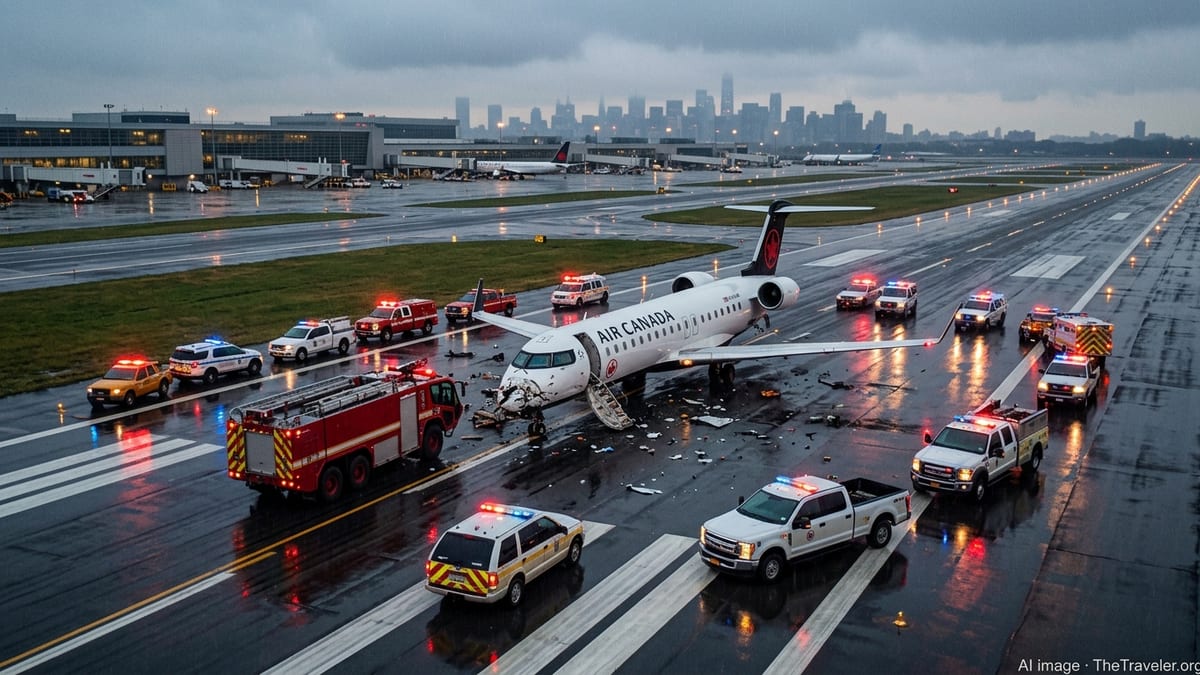
An overnight collision between an Air Canada Express jet and an airport fire truck on LaGuardia Airport’s Runway 4 has left two pilots dead, injured dozens of people and focused global attention on how an apparent air traffic control error allowed a rescue vehicle to cross an active runway just seconds before touchdown.
Get the latest news straight to your inbox!
Late-Night Landing Ends in Tragedy on Runway 4
The crash occurred late on Sunday, March 22, when Air Canada Express Flight 8646, a Bombardier CRJ900 operated by Jazz Aviation from Montreal to New York, was on final approach to LaGuardia’s Runway 4 in rainy nighttime conditions. The regional jet was carrying more than 70 passengers and crew.
According to publicly available tracking data and published coverage, the aircraft had already touched down and was rolling along the runway when it struck a large airport fire truck operated by the Port Authority. The vehicle was heading across Runway 4 in response to a separate ground emergency elsewhere at the airport.
The force of the impact tore open the forward fuselage of the aircraft and heavily damaged the rescue vehicle. The pilot and co-pilot in the jet’s cockpit were killed, while multiple passengers and crew members on board sustained injuries ranging from minor to serious.
Images and footage circulated by major news outlets show the front of the Air Canada jet shredded nearly to the first passenger rows, with debris scattered around the disabled fire truck resting on its side near the runway centerline.
ATC Clearance to Cross Runway Under Scrutiny
Early investigative updates indicate that an air traffic controller in LaGuardia tower had cleared the fire truck to cross Runway 4 shortly before the collision. Reports based on tower audio suggest that the clearance was given when Flight 8646 was already on short final, only seconds from touchdown.
In subsequent reconstructions published by aviation analysts, the crucial sequence appears to show the controller attempting to halt the vehicle when it became clear that the jet and fire truck were converging on the same stretch of pavement. However, there was insufficient time or distance for either the aircraft or the truck to avoid impact.
The National Transportation Safety Board has opened a full investigation, seeking to understand why LaGuardia’s multilayered defenses against runway incursions did not prevent the accident. Key questions include whether ground radar and runway status lights generated any warning and how the controller’s workload and coordination between air and ground traffic may have contributed.
Publicly available information also points to the challenging context: it was late at night, the weather was poor and the controller was handling both airborne traffic and emergency vehicle movements during an active incident. Safety specialists note that these factors can sharply increase the risk of human error in complex airfield environments.
Passengers, Injuries and Airport Disruption
Most passengers evacuated the damaged aircraft using emergency slides, with some exiting through ruptures in the fuselage created by the impact. According to airline statements summarized in news reports, all but a small number of seriously injured passengers had been released from hospital by midweek following the crash.
The collision led to an immediate shutdown of LaGuardia Airport as responders worked to secure the scene, treat the injured and assess potential fire risk from spilled fuel. Operations were gradually restored after several hours, but one of the airport’s primary runways remained closed while investigators documented the wreckage and heavy equipment crews prepared to remove the jet.
For travelers, the crash translated into widespread delays and cancellations across LaGuardia’s already congested schedule. Flights were diverted to other New York-area airports, and airlines implemented rebooking measures for affected passengers. In the days following the incident, residual disruptions continued as the damaged runway surfaces and lighting systems were inspected and, where necessary, repaired.
Air Canada has stated in public updates that it is cooperating with investigators and offering support services to passengers, crew members and families of those killed in the collision. Jazz Aviation, which operated the flight under the Air Canada Express brand, has likewise said through published statements that it is participating fully in the safety inquiry.
Runway Safety Systems and Human Factors in Focus
The LaGuardia crash has renewed attention on the broader issue of runway incursions, in which aircraft or vehicles mistakenly enter active runways, sometimes leading to near misses or collisions. Major U.S. airports, including LaGuardia, are equipped with advanced surface movement radar and runway status light systems designed to warn controllers of potential conflicts.
Analysts commenting in aviation trade coverage note that such systems are intended to act as a final safeguard when human oversight falters. One focus of the current investigation is whether those tools detected the presence of the fire truck on Runway 4 in time, and if so, whether any alerts were acted upon or missed during the intense moments preceding the crash.
Another area of scrutiny is staffing and workload in the control tower. Reports referencing federal records say that only two controllers were on duty overnight, with responsibilities divided between air and ground movements. Questions are being raised as to whether that configuration is sufficient for a complex, high-density airport, especially when emergency responses require coordinating multiple rescue vehicles across runways and taxiways.
Experts also point to the training and procedures governing emergency vehicle access to runways. Even with ATC clearance, standard practice calls for vehicle operators to visually confirm that a runway is clear. Poor weather, glare, and the difficulty of estimating aircraft position at night can all undermine that last line of defense.
Implications for Travelers and Future Operations
For travelers using LaGuardia and other busy hubs, the collision underscores how rare but catastrophic breakdowns on the ground can be. Commercial aviation remains statistically one of the safest modes of transport, and fatal runway crashes involving scheduled passenger flights are uncommon. Still, a high-profile accident at a major New York airport is likely to prompt policy changes that passengers may notice in the months ahead.
These could include revised overnight staffing levels in control towers, tighter protocols for coordinating emergency vehicles, and adjustments to how and when runways are closed during incidents elsewhere on the field. Some aviation commentators anticipate renewed investment in automated runway incursion warning systems and additional training drills that bring together controllers, fire crews and airline operators.
In the near term, people flying through LaGuardia may continue to experience slightly longer taxi times or more conservative spacing between arrivals and departures as the airport evaluates interim safety measures. Occasional ground holds or diversions during poor weather could also become more frequent while risk assessments are updated.
For those directly affected on Flight 8646, the focus now shifts to recovery, support and, ultimately, clarity on how a chain of decisions and missed signals allowed a fire truck and an arriving airliner to occupy the same piece of pavement at the same moment. The findings of the ongoing federal investigation are expected to shape runway safety policies well beyond New York, influencing how airports worldwide manage the complex choreography of jets and emergency vehicles on the ground.