

Athens has reached a critical milestone in its largest ongoing public works project, as the tunnel boring machine "Athena" has completed a 5.1-kilometer section of Metro Line 4 between Katehaki and Evangelismos, a breakthrough that officials say will reshape daily commuting, support tourism growth and advance the Greek capital’s sustainability goals.
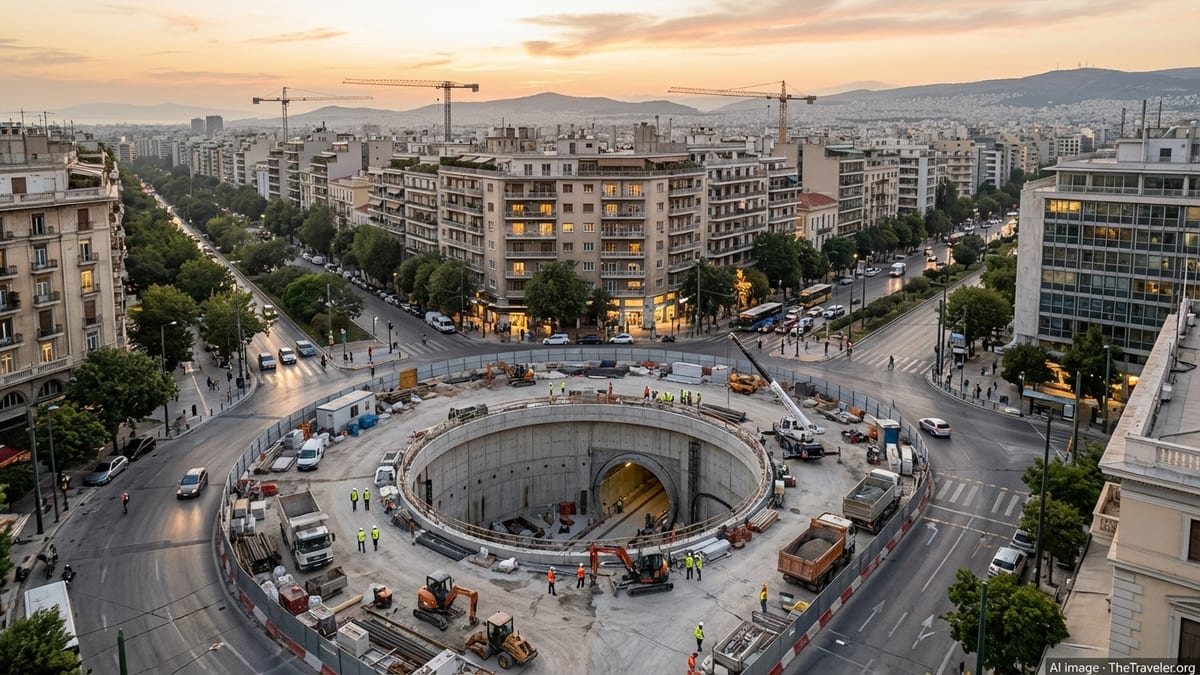
A Landmark Moment for Athens’ New “Orange Line”
The breakthrough at the Evangelismos shaft in mid-February capped a demanding underground journey through some of the most densely populated districts in the Greek capital. Advancing from the Katehaki shaft, the tunnel boring machine navigated beneath neighborhoods including Goudi, Zografou, Ilisia, the University Campus and Kaisariani, installing nearly 3,400 concrete rings as it progressed to form a fully lined tunnel.
Infrastructure and Transport Minister Christos Dimas hailed the achievement as a defining step for Metro Line 4, which is frequently described by Greek officials as the largest public infrastructure project currently under way in Athens. With the 5.1-kilometer section now structurally in place, attention is turning to station works and the systems that will eventually carry driverless trains beneath the city.
The newly completed tunnel is part of Section A of Line 4, a 12.8-kilometer “U-shaped” alignment that will initially connect Alsos Veikou in Galatsi to Goudi, adding 15 underground stations to the Athens Metro network. When fully developed in later construction phases, Line 4 is planned to extend to 38.2 kilometers with 35 stations, radically expanding coverage to residential districts and key employment and education hubs.
The large tunnel boring machine, stretching roughly 100 meters in length, will now be dismantled and removed from the Evangelismos shaft. Engineers expect its components to be refurbished and stored for possible redeployment on future underground projects, underscoring how the Line 4 build is also strengthening Greece’s technical capacity in complex tunneling works.
How Line 4 Will Redraw the Urban Mobility Map
The first phase of Line 4 has been designed to relieve pressure on existing routes and to serve areas of Athens that have historically relied on buses, private cars or long walks to reach rail stations. The new line will form a sweeping arc from Alsos Veikou through central neighborhoods such as Galatsi, Kypseli, Exarchia, Akadimia and Kolonaki, before curving southeast to Evangelismos, Kaisariani, the University Campus, Zografou and Goudi.
Transport planners expect the line to carry hundreds of thousands of passengers daily once fully operational, offering new interchange points with Lines 2 and 3 and the wider bus network. In practice, this will mean shorter cross-city journey times, more direct north to southeast connections and reduced congestion on surface corridors such as Alexandras Avenue and central radial streets that currently bear the brunt of car and bus traffic.
The automated, driverless trains planned for Line 4 are being promoted as a step change in service reliability and frequency. With advanced signaling systems and platform doors at stations, the aim is to run trains at shorter headways, offering frequent service throughout the day and evening and improving the attractiveness of public transport for both residents and visitors.
For daily commuters, the new line is expected to cut travel times between educational campuses, hospitals, court complexes and central business districts. Students at the National and Kapodistrian University of Athens, for example, should have faster, more direct access to downtown areas and other lines, while workers in densely populated residential zones will gain metro access within a short walk of their homes.
Tourism Connectivity Set for a Major Upgrade
Although the 5.1-kilometer section completed this month runs beneath primarily residential and institutional districts, it is a crucial link in a network that will significantly improve access to major cultural and tourism sites across the capital. Evangelismos station, at the western end of the new tunnel, sits near central hotels, museums and key arteries leading to the historic core around Syntagma and the Acropolis.
As more segments of Line 4 come online, visitors arriving in Athens will find it easier to move between accommodation districts in central neighborhoods such as Kolonaki, Kypseli or Galatsi and cultural institutions, shopping areas and dining hotspots without relying on taxis or private transfers. The line’s multiple interchanges with existing metro services will also streamline journeys from the airport or Piraeus to inland districts that have traditionally been harder to reach.
Tourism stakeholders say the project dovetails with broader efforts to spread visitor activity beyond a narrow band of central sites. With faster, rail-based connections to residential neighborhoods that host emerging restaurant scenes, local markets and smaller museums, Line 4 is expected to support more diverse visitor itineraries and distribute tourism spending more evenly across the city.
In addition, improved public transport reliability is seen as essential in reducing seasonal congestion in central Athens, especially during peak summer months when cruise arrivals, short city breaks and longer holidays all converge. By offering a high-capacity underground alternative along key travel corridors, Line 4 is poised to become a backbone for more sustainable and manageable tourism growth.
Cutting Congestion and Emissions in a Car-Dependent Capital
Athens has long grappled with heavy car dependence, chronic congestion and air quality challenges. Transport experts view Line 4 as a critical instrument in shifting more trips from private vehicles to public transport, particularly in densely populated neighborhoods where new stations will place tens of thousands of residents within a short walking distance of the metro.
Official forecasts for the complete Line 4 project point to significant reductions in road traffic volumes and associated emissions once the line is operational. Each kilometer of new metro infrastructure can remove thousands of car trips from the surface network daily, translating into lower fuel consumption, fewer emissions and less noise on busy arterial roads and in residential side streets.
The project’s environmental credentials are bolstered by modern rolling stock and infrastructure design. The new line’s automated trains are expected to be energy efficient, with regenerative braking and lightweight materials that reduce power demand. Stations are being designed with contemporary ventilation systems, energy-saving lighting and enhanced accessibility features, making them more comfortable and inclusive for passengers.
For Athens, where temperature spikes and heatwaves have become more frequent in recent summers, the long-term shift to electric, high-capacity urban rail is increasingly framed as part of the city’s response to climate pressures. By providing a cooler, faster alternative to driving or bus travel on overheated roads, Line 4 is expected to make sustainable mobility an easier everyday choice.
Engineering a Five-Kilometer Tunnel Beneath a Living City
The completion of the Katehaki to Evangelismos tunnel section underscores the complexity of driving a multi-kilometer tube beneath an active, historic city. Operating around the clock, the tunnel boring machine advanced in small increments, installing a concrete ring for roughly every meter and a half of progress. Over the course of the drive, hundreds of thousands of cubic meters of soil and rock were excavated and transported to the surface.
Engineers had to navigate challenging ground conditions, dense urban building stock and the ever-present risk of intersecting unknown underground utilities or archaeological remains. Sophisticated guidance systems, continuous monitoring of ground settlement and coordination with municipal services were all needed to ensure that surface disruption remained limited while the machine steadily carved its path far below.
To save time, the tunnel boring machine passed through the future sites of several stations along its route, leaving behind a completed tunnel shell that will later be opened out to form full station boxes. This approach minimizes the duration of major surface works at each site, helping to limit local disruption and traffic detours, even as construction crews move into the next stage of excavation and fit-out.
The successful management of this 5.1-kilometer drive is seen as a strong reference point for future underground projects in Greece, whether further extensions of the Athens Metro or entirely new tunnels. It demonstrates that large-scale mechanized tunneling can be executed on schedule beneath complex urban environments when supported by robust planning and close public oversight.
Progress of the Second Tunnel and the Road to Completion
While Athena’s drive from Katehaki has now finished, tunneling on Line 4 continues from the opposite end of the alignment. A second tunnel boring machine, named Niki, is advancing from Alsos Veikou, in the northern part of the city, towards Evangelismos. This machine has already excavated close to three kilometers of tunnel, passing beyond Kypseli and heading for key central stations such as Dikastiria, Alexandras, Exarchia, Akadimia and Kolonaki.
Combined, the two machines have excavated roughly eight of the 12.8 kilometers of tunnel needed for the first phase of Line 4, placing total tunneling progress at about two thirds. Once Niki eventually reaches Evangelismos and completes its assigned route, attention will shift more fully to station construction, track laying and the installation of signaling, power and communications systems across the new line.
Despite the recent tunneling milestone, officials and contractors acknowledge that important challenges lie ahead. Station sites such as Exarchia and the University Campus have previously faced delays related to site handovers, local opposition and archaeological investigations. These issues have contributed to schedule pressures that have pushed likely opening dates beyond the original target of 2029.
Current estimates from industry observers suggest that full operation of Section A could slip by two to three years compared with the initial timetable, with broader Line 4 completion moving into the early 2030s. However, authorities maintain that the strong pace of tunneling and ongoing resolution of bottlenecks at difficult sites provide grounds for cautious optimism that no further major delays will emerge.
Funding, Jobs and Wider Economic Impact
Metro Line 4 is more than a transport scheme; it is also a major economic lever for Athens and Greece as a whole. The first phase of the project, with a budget in the range of 1.5 billion euros, is co-financed by the European Union under the 2021 to 2027 funding framework. This support reflects Brussels’ emphasis on sustainable transport, urban renewal and climate-friendly infrastructure in member states.
Construction activity has generated thousands of direct and indirect jobs, from highly specialized tunneling engineers and geologists to skilled trades and support roles across logistics, materials supply and site services. For local businesses in areas around station works, the construction period has meant a mix of challenges and opportunities, with some disruption offset by increased demand from on-site workers and contractors.
In the longer term, new metro stations are expected to catalyze investment in housing, retail and services in adjacent neighborhoods. Experience from previous Athens Metro extensions suggests that improved accessibility tends to lift property values and stimulate the refurbishment of older building stock, while also drawing new commercial tenants to locations that become more attractive for offices, hospitality and small enterprises.
Officials argue that these local development effects, combined with productivity gains from faster commutes and reduced congestion, will deliver economic returns that far exceed the project’s construction cost over its lifetime. Line 4 is therefore framed not only as a mobility project but as a structural investment in Athens’ competitiveness and quality of life.
What This Means for Future Travel in Athens
For residents and visitors, the completion of the 5.1-kilometer tunnel section offers a concrete sign that, despite setbacks, the ambitious Line 4 project is advancing. While trains will not be running through the new tunnel for several years, the structural link it provides between Katehaki and Evangelismos anchors the future network and clarifies how the next stages of work will unfold.
Travel behavior in Athens is unlikely to transform overnight, but as Line 4 stations open and connections integrate with existing lines, many habitual car users are expected to reassess their options. Shorter, more reliable journeys by metro, coupled with growing awareness of environmental concerns and the rising costs of driving, could tip the balance toward public transport for a larger share of daily trips.
For the travel and tourism industry, the line’s evolution will be closely watched. Tour operators, hoteliers and destination marketers are already factoring upcoming stations into their plans, anticipating a future in which visitors can explore a wider geography of the city with ease. Neighborhoods once considered peripheral to the tourist map may find themselves newly connected and increasingly prominent in guidebooks and itineraries.
In that sense, the freshly completed tunnel beneath Athens is more than an engineering achievement. It is a preview of a city in the making, one in which urban mobility, tourism growth and sustainable travel are increasingly intertwined, and where journeys across the capital can be faster, cleaner and more inclusive than ever before.