

More news on this day
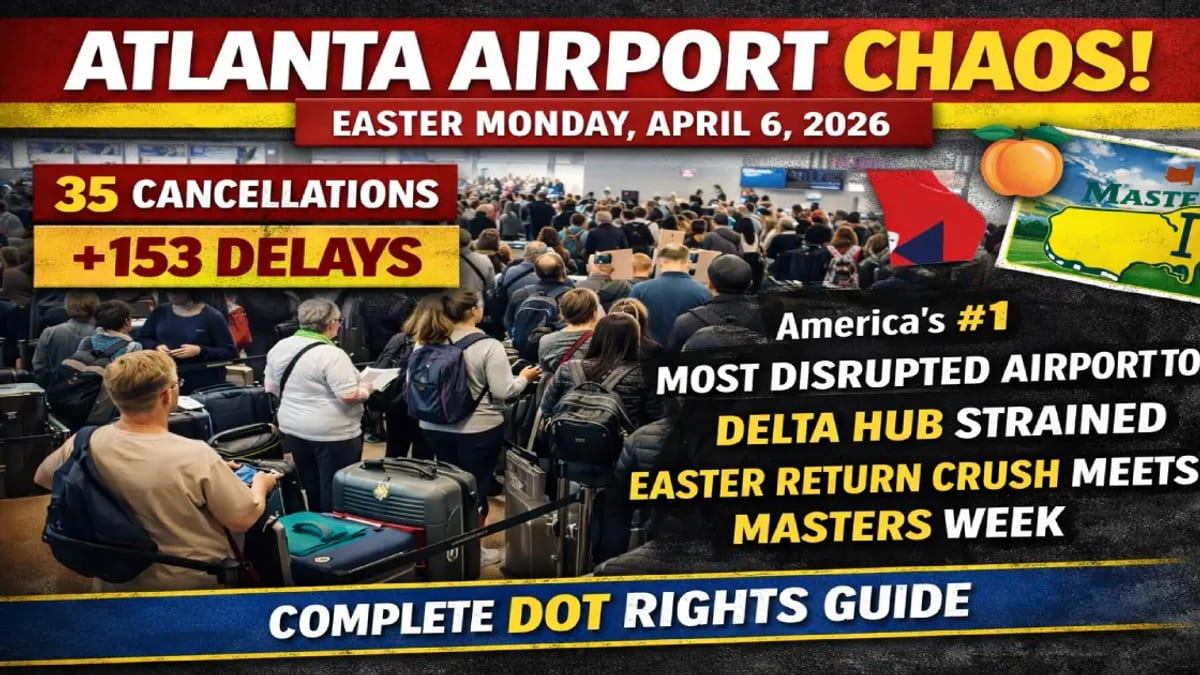
Hartsfield-Jackson Atlanta International Airport once again became the focal point of national aviation frustration on Easter Monday, April 6, 2026, as it ranked among the country’s most severely disrupted hubs for delays and cancellations at the close of a busy holiday travel period.
Get the latest news straight to your inbox!
Atlanta Tops U.S. Disruption Tables After Holiday Rush
Preliminary same-day data from flight-tracking and aviation analytics platforms show Atlanta handling one of the highest numbers of delayed and cancelled flights in the United States on April 6, with hundreds of operations affected as travelers tried to return home after the Easter weekend. Measured both by raw counts of disrupted departures and by the knock-on effect across connecting itineraries, Atlanta emerged as the most heavily impacted U.S. airport over much of the day.
Reports from widely used tracking tools indicate that by late afternoon, Atlanta was leading all U.S. airports in total disrupted flights, with ripple effects spreading across the domestic network as aircraft and crews failed to reach subsequent legs on time. The volume of connecting traffic that typically flows through the airport meant that individual schedule problems quickly cascaded into broader system delays.
Industry observers note that Atlanta’s role as the nation’s busiest airport by passenger volume, combined with tight banked-departure schedules, tends to magnify even moderate operational strains. When a peak travel day coincides with challenging conditions in the wider airspace system, Hartsfield-Jackson can rapidly shift from routine congestion to system-leading disruption statistics.
Holiday travel patterns added to the pressure. Passenger volumes remained elevated through Easter Monday, traditionally a heavy return-travel day, leaving airlines with limited slack to re-accommodate disrupted customers or reposition aircraft and crews once irregular operations set in.
Weather and Airspace Constraints Compound Delays
While clear skies may have greeted travelers at various points in the day around Atlanta, publicly available meteorological information and airline operations updates point to a complex regional weather picture that affected flights across large portions of the eastern United States. Thunderstorms and unstable conditions in key arrival and departure corridors periodically constrained traffic flows into and out of Atlanta, forcing reroutes, spacing restrictions and ground delays.
According to published aviation weather coverage, the spring of 2026 has already been marked by several high-impact systems that strained air traffic operations across the Southeast and Midwest. Although the most intense events earlier in March centered outside the Atlanta metro area, residual schedule tightness and aircraft positioning issues continued to affect carriers as they entered the Easter period.
Operational advisories issued through federal air traffic coordination channels indicated periods in which arrival rates into major hubs in the eastern half of the country were reduced due to convective weather, airspace saturation and flow control measures. When those constraints intersected with Atlanta’s peak connecting banks on April 6, departures to the airport from outstations faced holds, reroutes or cancellations, while outbound flights from Atlanta suffered from late-arriving aircraft.
In the absence of a single headline-grabbing shutdown, the day’s disruption profile reflected what analysts describe as a “system strain” scenario: no single catastrophic failure, but layered constraints that together pushed Atlanta’s tightly scheduled operation beyond its normal recovery capacity.
Mixed Passenger Experience Inside the Terminal
Despite the high number of flight disruptions, on-the-ground reports from travelers painted a more varied picture of conditions inside the terminal complex. Social media posts and community message boards dedicated to Atlanta travel on the morning of April 6 described relatively manageable security wait times, often in the range of 10 to 20 minutes at the main and North checkpoints, with some passengers reporting breezy experiences through PreCheck lanes.
Those comparatively smooth security flows contrasted sharply with the frustrations at the gate and on the tarmac, where rolling delays, aircraft swaps and last-minute cancellations left many passengers facing extended waits and missed connections. Travelers on certain regional routes, including flights connecting smaller Midwest cities to Atlanta, reported clusters of cancellations with limited rebooking options remaining by midday.
Publicly available wait-time tracking data and anecdotal accounts suggest that, unlike some past disruption events at the airport, security screening did not appear to be the primary bottleneck on Easter Monday. Instead, the strain was concentrated in the flight operations side of the experience, manifesting as gate crowding, rebooking lines and race-to-the-connection dashes through the concourses.
Airport infrastructure designed to handle immense volumes of passengers, such as the Plane Train people mover and extensive concourse systems, appeared to be functioning normally. The challenge for travelers was less about navigating the building and more about navigating rapidly shifting airline schedules.
Airlines Grapple With Tight Schedules and Crew Constraints
Publicly available airline operations dashboards and consumer reports over the past year have repeatedly highlighted how major U.S. carriers are running closer to their capacity limits, particularly at mega-hubs like Atlanta. On April 6, those constraints were on display as carriers worked to recover from multiple recent weather and operational shocks that had already stretched aircraft and crew availability.
When holiday demand overlaps with residual schedule fragility, even modest disruptions can wipe out the cushion that airlines use to absorb irregular operations. Aviation analysts reviewing same-day data noted that carriers were forced to prioritize certain trunk routes and high-demand markets, leaving some secondary city pairs to bear a disproportionate share of cancellations, including flights feeding into Atlanta.
Crew-rest rules and tight aircraft rotations further limited flexibility. Delays on early-morning segments quickly pushed pilots and flight attendants toward duty-time limits, which in turn led to additional cancellations or extended delays later in the day. For travelers, that translated into flights that initially showed as minorly delayed sliding into much longer waits or outright cancellation as crew availability windows closed.
The result was a pattern familiar to frequent flyers at large hubs: departure boards dotted with delays that shifted in 15- or 30-minute increments, punctuated by clusters of cancellations that stranded connecting passengers and filled remaining flights to capacity.
Broader Questions About Resilience at the Nation’s Busiest Hub
Atlanta’s difficult Easter Monday has renewed attention on the resilience of the U.S. air travel system and, in particular, on the role that mega-hubs play in amplifying or containing disruption. Academic research into airspace reliability has identified a small share of days each year that qualify as highly disrupted across the national system, with those days often centered on one or two major hubs.
Consumer-focused disruption reports published in recent months have repeatedly identified Hartsfield-Jackson as both the nation’s busiest airport and one of its most consequential for network reliability. When Atlanta struggles, there is a measurable effect on on-time performance metrics for airlines nationwide, since so many itineraries are routed through its concourses.
April 6 appears poised to join that list of high-impact days, particularly for passengers whose trips depended on tight connections through Atlanta in the afternoon and evening banks. Travel advocates are likely to scrutinize how airlines prioritized routes, deployed spare aircraft and communicated with passengers as the day’s irregular operations unfolded.
For now, publicly available information points to a convergence of factors rather than a single failure: lingering schedule fragility after a disruptive winter, Easter holiday demand, regional weather constraints and the structural vulnerabilities that come with running the world’s busiest passenger airport near its limits. For travelers passing through Atlanta on Easter Monday, those dynamics translated into one of the most disrupted U.S. airport experiences of the year so far.