

More news on this day
Fresh operational turmoil at Atlanta’s Hartsfield-Jackson International Airport is rippling across the United States air travel network, triggering rolling delays, cancellations and missed connections just as the busy spring travel period builds.
Get the latest news straight to your inbox!
Atlanta Hub Turbulence Intensifies
Publicly available flight-tracking data from recent days shows that Hartsfield-Jackson Atlanta International Airport has again emerged as one of the country’s most disrupted hubs, with dozens of cancellations and several hundred delays recorded on April 7 alone. One industry tally indicated roughly 70 to 75 canceled departures and arrivals at Atlanta, alongside more than 300 delayed flights, placing the airport among the nation’s top trouble spots.
Separate disruption tallies published on April 7 reported that Atlanta led all U.S. airports for combined schedule problems in one survey period, with around 20 to 60 cancellations and well over 150 delays attributed to the Georgia hub in a single day. Those figures came within a broader national picture of thousands of delayed flights and more than 200 cancellations affecting major nodes such as New York, Chicago, Orlando, Houston, Boston, Los Angeles and Seattle.
Although recent storms and air traffic control flow restrictions have been central triggers, the recurring pattern is familiar for Atlanta. The airport handled more passengers than any other U.S. facility last year and is projecting more than 8.3 million travelers in April alone, according to recent local business coverage. That scale means even a short-lived ground stop or runway slowdown can rapidly overflow into gate shortages, long taxi queues and significant knock-on delays.
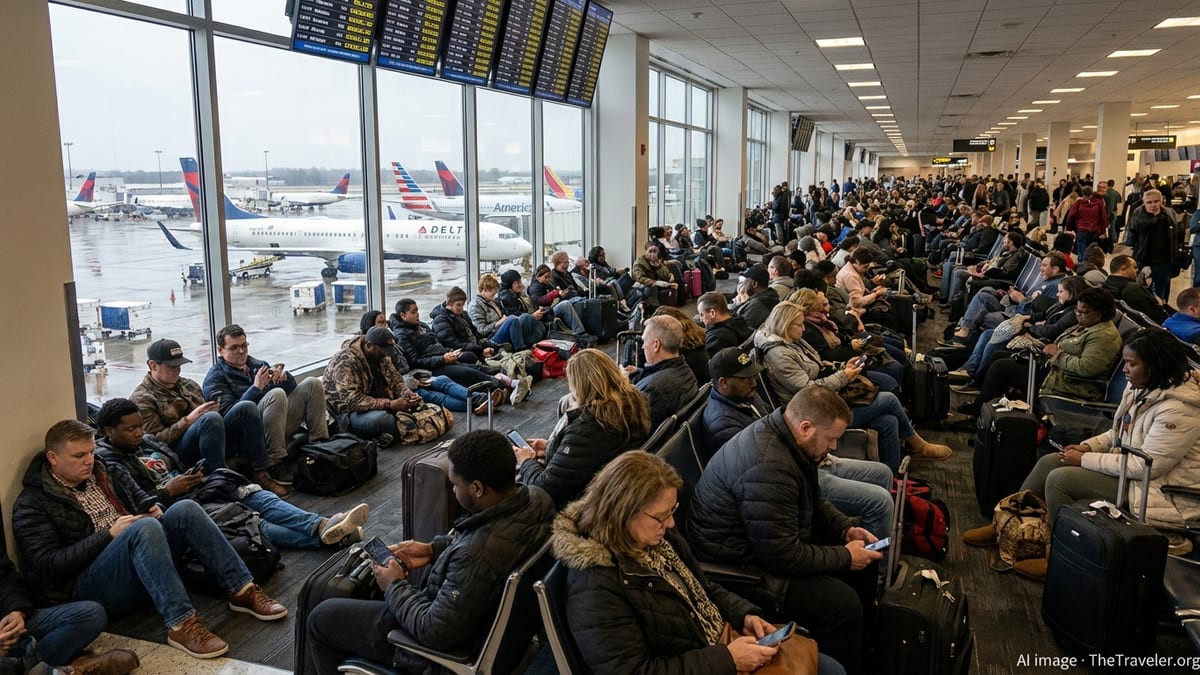
Reports from travel outlets and passenger accounts in March and early April describe hourslong waits on the tarmac, missed connections and crowded concourses as airlines tried to work through weather backlogs. Some travelers described being rebooked multiple times in a single day as rolling disruptions made it difficult for carriers to reset schedules.
Weather, Staffing and Network Complexity Combine
The latest wave of Atlanta disruption follows a turbulent first quarter for U.S. aviation, marked by severe winter weather and spring storms that have repeatedly forced ground stops and route suspensions. A powerful March blizzard in the Midwest, followed by strong storms sweeping through the Southeast, produced widespread cancellations and delays at hubs from Chicago O’Hare to Minneapolis-Saint Paul and into Atlanta, according to national travel and weather reports.
At Hartsfield-Jackson, several recent events show how multiple stress points can converge. Local outlets have documented thunderstorms prompting temporary ground stops, while separate coverage has highlighted long security queues linked to staffing constraints at security checkpoints. In response, airport advisories in late March urged travelers to arrive up to three hours before departure for some flights, signaling how routine processes have become more fragile under heavy demand.
Industry and aviation analyses cited in recent coverage point to a complex interplay of factors behind the current instability. Tight airline staffing after years of aggressive cost-cutting, high aircraft utilization, ongoing air traffic control personnel shortages and the lingering effects of earlier technology outages all contribute to a thinner margin for error. When a major hub like Atlanta is hit by severe weather or a flow restriction, there is less slack in the system to absorb the shock.
The result is a chain reaction that extends well beyond Georgia. Flights inbound to Atlanta arrive late or are canceled outright, aircraft and crews miss their scheduled turns, and subsequent departures from secondary cities across the United States push back or never leave the gate. Even travelers whose itineraries do not touch Atlanta can feel the effect when aircraft scheduled to serve their route are tied up in the Southeast.
National Impact Felt From New York to Los Angeles
Recent disruption summaries published by travel industry outlets describe a nationwide patchwork of delays and cancellations with Atlanta as a central node. One April 7 analysis counted more than 4,000 delayed flights and over 200 cancellations across U.S. airports, with Atlanta, Orlando, Chicago, New York LaGuardia and John F. Kennedy, Boston, Los Angeles and Houston among the hardest hit. Atlanta and Orlando together accounted for several hundred affected flights in that snapshot alone.
Another daily overview focused on a separate time window but reached a similar conclusion, noting that Atlanta again recorded some of the country’s highest combined totals of delays and cancellations. Major carriers including Delta Air Lines, American Airlines, United Airlines, Southwest Airlines, Spirit Airlines, Alaska Airlines and Frontier Airlines all showed elevated disruption, reflecting the broad reach of the current turbulence.
For Delta, which operates its largest hub at Hartsfield-Jackson, the stakes are particularly high. Travel-news coverage of the April 7 disruption described triple-digit flight cancellations for the airline, with images of crowded concourses, overnight stays on terminal floors and long rebooking lines as the carrier worked to recover its operation. Analysts noted that similar episodes during the 2024 technology outage and major winter storms since then have left some passengers wary of tight connections through Atlanta during peak seasons.
Other airlines are also feeling the strain. Low-cost and network carriers that depend on Atlanta for east-west or north-south connectivity have seen their operations constrained when crews or aircraft become trapped in weather systems affecting the Southeast. That has translated into rolling delays across routes that link smaller U.S. cities to major coastal markets, even on days when local weather at the origin or destination appears calm.
Travelers Confront Longer Lines and Narrower Options
For passengers, the recent disruptions at Atlanta and across the network are translating into practical challenges that go beyond late arrivals. Traveler accounts gathered in local and national coverage describe missed cruises, lost prepaid hotel nights and difficulties securing last-minute alternatives as flights depart full during the busy spring period. With carriers operating near capacity, a single cancellation can leave dozens or hundreds of customers competing for only a handful of remaining seats.
Long security lines at Hartsfield-Jackson have added a further layer of uncertainty. Local Atlanta coverage in March and early April documented wait times exceeding two hours at peak periods, prompting airlines to issue travel waivers and encourage customers to rebook to less congested times where possible. Social media posts and online forums have been filled with advice on arrival times, checkpoint choices and the best ways to navigate the airport’s crowded concourses.
Publicly available airline guidance suggests that rebooking options, meal vouchers and hotel accommodations vary widely depending on the cause of disruption and the specific carrier. In general, weather-related cancellations and air traffic control holds have been treated differently from crew or equipment issues, leaving some passengers responsible for their own overnight costs when storms are cited as the primary trigger.
Travel analysts writing about the current disruptions warn that structural issues may keep pressure on the system even as the latest storm cycles pass. Strong demand heading into the summer travel season, constrained fleet growth and continued staffing challenges in critical roles mean that major hubs such as Atlanta are likely to remain sensitive to any operational shock. For flyers, that reality may require building in longer connection windows, monitoring flights more closely and preparing backup plans when traveling through tightly wound parts of the U.S. aviation network.