

More news on this day
Severe storms sweeping across the Southeast are once again throwing Hartsfield-Jackson Atlanta International Airport into turmoil, with rolling delays and cancellations in Atlanta triggering knock-on disruption for travelers across the United States and on key transatlantic routes.
Get the latest news straight to your inbox!
Storm Systems Converge Over the Nation’s Busiest Hub
Publicly available flight-tracking data for early April indicate that repeated rounds of thunderstorms, heavy rain and low clouds over Georgia have sharply constrained movements at Hartsfield-Jackson Atlanta International Airport. On April 7, tallies compiled by aviation data services and summarized by industry outlets showed roughly 73 cancellations and more than 300 delays at Atlanta alone, a level of disruption that placed the airport among the hardest hit in the country for the day.
The pattern continued into April 8, as fresh operational reports pointed to around 186 delayed flights and two dozen cancellations tied to weather and associated congestion. While those figures marked a modest improvement from the previous day’s peak, they underscored how sensitive Atlanta’s schedule is to even brief periods of stormy conditions that slow arrivals and departures.
Meteorological analyses describe a series of storm systems tracking across the Southeast and lower Midwest, producing bands of thunderstorms and gusty winds at intervals. These outbreaks prompted air-traffic managers to impose ground delay programs and, at times, short-lived ground stops into Atlanta in recent weeks, reducing the rate at which jets can be safely launched and landed.
The early April turbulence follows an already bruising winter for the hub. A significant ice and snow event in late January led to nearly 1,200 cancellations at Hartsfield-Jackson in a single day, and additional severe weather episodes in March also produced ground stops and long security lines. The cumulative effect has been an extended period of strain for travelers using the hub as well as for the airlines that rely on it.
How Atlanta Disruption Ripples Across U.S. Routes
Operational data and airline network maps highlight why weather trouble at Hartsfield-Jackson so quickly radiates outward. The airport functions as the primary connecting node for one of the country’s largest carriers and an essential interchange for several partners, linking dozens of small and midsize U.S. cities with major coastal gateways and international destinations.
When a cluster of arrivals is delayed by storms or route restrictions, outbound departures that rely on the same aircraft and crews are pushed back in turn. On days like April 7, when more than 300 flights in and out of Atlanta ran late, the result was a wave of missed connections and rolling disruptions on routes linking the hub with cities such as New York, Chicago, Miami, Orlando, Dallas and Los Angeles.
Industry coverage notes that even services between other airports can be affected, because aircraft and crew schedules are typically built around fast turnarounds through a few central hubs. A delayed morning feeder flight into Atlanta can leave a jet out of position for an afternoon departure from another city, while crew duty-time limits may force last-minute cancellations if storms keep planes on the ground too long.
These knock-on effects are particularly pronounced on days when storm systems affect multiple hubs at once. Recent federal and commercial data show that during the busy Easter travel period, major airports including Atlanta, Dallas-Fort Worth, Chicago O’Hare and Houston George Bush recorded thousands of combined delays and hundreds of cancellations over several days, illustrating how a disturbance in one part of the network compounds pressures elsewhere.
Travelers Face Long Lines, Tight Connections and Lingering Backlogs
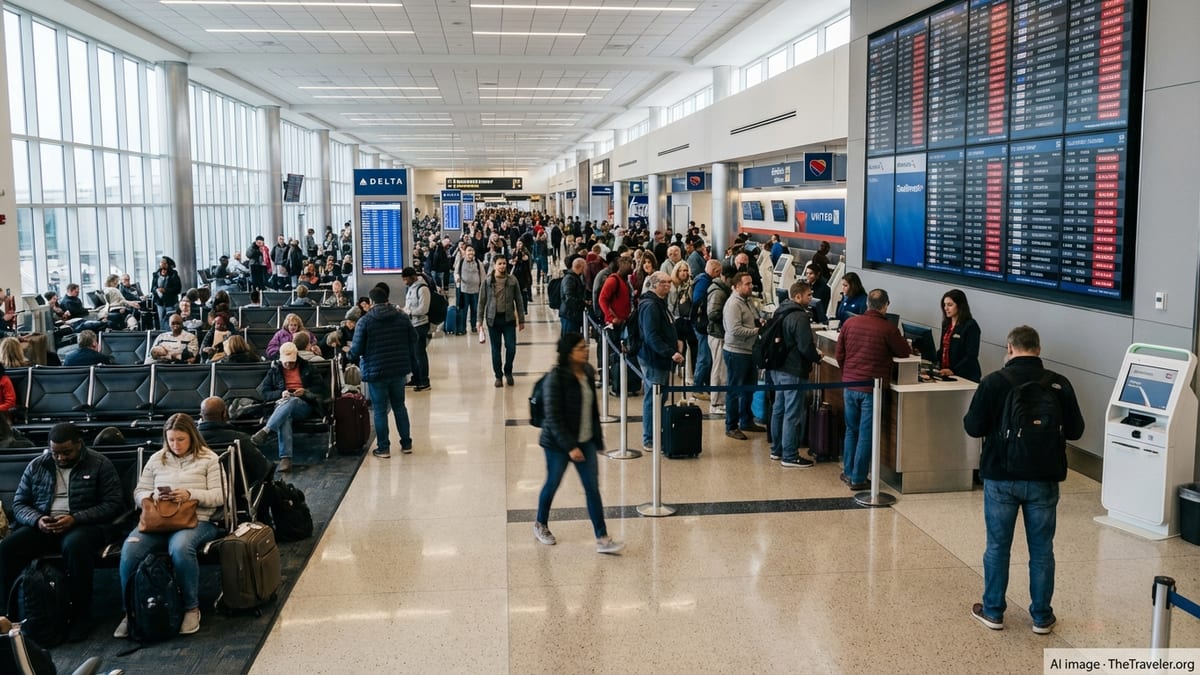
For passengers, the storm-driven turbulence in Atlanta has translated into long security queues, crowded gate areas and uncertain connection times. Local and national news coverage of recent weather episodes described early-morning ground stops that left aircraft waiting at the gate, followed by surges of departures once restrictions eased, compressing demand into narrow time windows at security checkpoints and boarding areas.
As departures stack up, connection times shrink, especially for travelers linking regional flights through Atlanta to reach coastal or international destinations. Reports from travel advisories and passenger-rights organizations emphasize that complex itineraries involving regional feeders into the hub are especially vulnerable, since a single missed leg can unravel several onward segments and leave travelers in need of overnight accommodation or extensive rebooking.
Even after the most intense storms pass, recovery can be slow. Aviation analysts point out that airlines must reposition aircraft and crews to where they are needed next, a process that can take several rotations. This means that an evening schedule can still reflect delays from a morning thunderstorm, and early-morning flights the next day may depart late as airlines work through residual congestion.
Data from recent disruption days suggest that passengers on short-haul domestic sectors, including routes within the Southeast, have been among the most affected. These flights are often scheduled tightly, with multiple daily frequencies and brief turnaround times, leaving little margin when traffic-management initiatives or lightning alerts temporarily halt ramp operations in Atlanta.
Airlines Adjust Schedules as Weather Volatility Persists
Published statements and operational updates from airlines serving Atlanta indicate that carriers are continuing to trim schedules and introduce waivers when forecast models point to significant storms. In several recent cases, including severe weather events in January and early March, airlines rolled out flexible rebooking policies that allowed travelers headed through Atlanta to shift trips to off-peak hours or different days without standard change penalties.
Carriers have also been leaning more heavily on tools such as ground delay programs, which meter departures into constrained airspace to prevent airborne holding patterns from becoming excessive. While these measures can reduce the risk of diversions and improve safety margins, they often translate into longer gate holds and pushback delays for passengers departing from outstations bound for Atlanta.
Operational planners face the additional challenge of crew availability. Industry analyses note that when storms force aircraft to sit on the tarmac or divert, pilots and flight attendants can quickly hit duty-time limits. This dynamic has been visible in several recent Atlanta disruption days, when the number of delays significantly exceeded cancellations, reflecting airlines’ efforts to keep flights operating but at slower-than-normal intervals.
In response to the sustained volatility, some experts are urging travelers connecting through Atlanta over the coming weeks to allow more buffer time between flights and to monitor airline and airport channels closely on days with active storm forecasts. With the spring severe weather season still ramping up, forecasters and aviation specialists suggest that intermittent disruptions at the hub are likely to continue.
What Travelers Can Expect in the Days Ahead
As of April 8, publicly available information shows that conditions at Hartsfield-Jackson remain fluid, with additional showers and thunderstorms possible as frontal systems move across the Southeast. While the scale of delays and cancellations has eased from the highest levels seen earlier in the week, airlines and data providers still report an elevated rate of late arrivals and departures compared with typical April norms.
Travel industry reporting suggests that passengers passing through Atlanta should anticipate crowded peak periods, especially during early-morning and late-afternoon banks when connecting traffic is heaviest. On days when national disruption levels are already high, any new storm cell forming near the hub can be enough to tip schedules back into wider disarray.
Consumer advocates emphasize that travelers have varying levels of protection depending on the airline, ticket type and cause of disruption. While weather-related delays are often excluded from compensation in many carriers’ contracts, passengers are encouraged by public guidance to review airline customer-service commitments and to make use of mobile rebooking tools, airport kiosks and staffed desks when schedules unravel.
With Atlanta’s role as a central junction in the U.S. air network, the latest storms serve as another reminder that conditions over a single metro area can reshape travel plans across an entire continent. For now, aviation data and meteorological outlooks point to more unsettled days ahead, leaving carriers and travelers alike bracing for further weather-related turbulence as spring unfolds.