

More news on this day
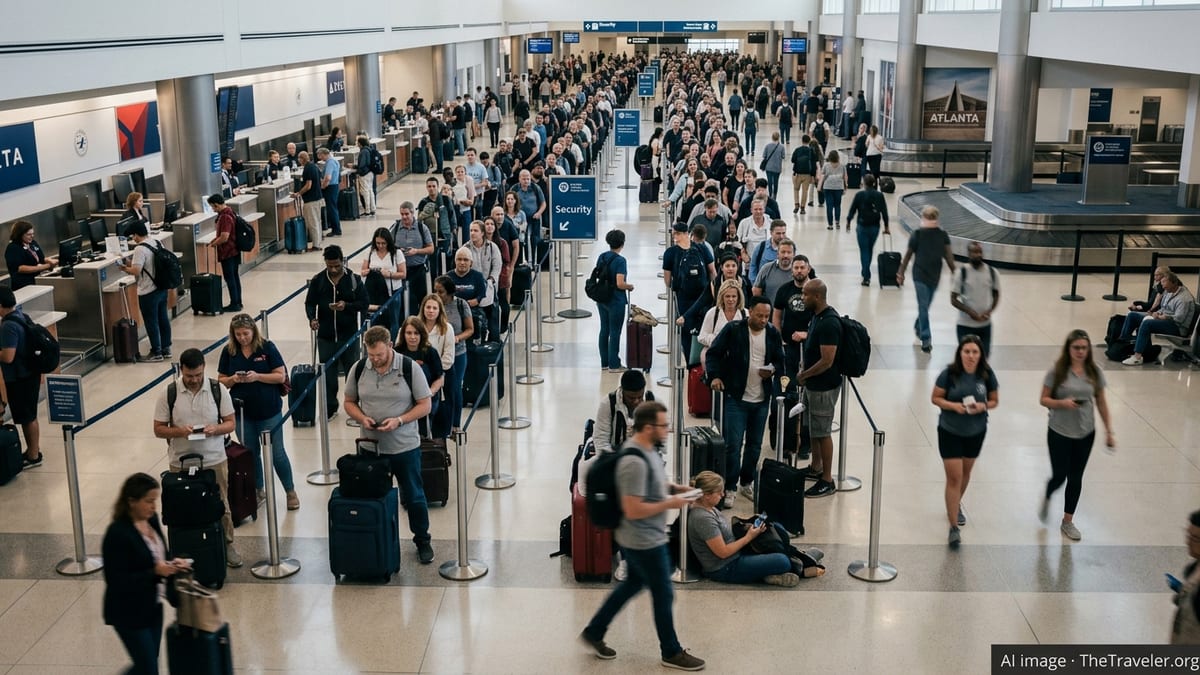
Hours-long security lines at Hartsfield-Jackson Atlanta International Airport are stranding travelers in queues that snake around baggage claim, as a federal funding lapse collides with peak spring break traffic and deepening staffing problems at security checkpoints.
Get the latest news straight to your inbox!
A Perfect Storm at the World’s Busiest Airport
Hartsfield-Jackson Atlanta International Airport, one of the world’s busiest hubs, has emerged as a flashpoint in a nationwide surge in Transportation Security Administration wait times. In recent days, reports from passengers and travel trackers have described lines stretching to two and even three hours at peak morning and evening periods, with crowds spilling from the main checkpoint areas back toward ticketing and baggage claim.
Publicly available information shows that the current crunch is tied to an ongoing partial shutdown of the Department of Homeland Security, which has required tens of thousands of TSA officers to continue working without pay. As the shutdown drags on, more officers are calling out or leaving their jobs, shrinking the ranks at a time when traffic through major hubs such as Atlanta is climbing.
Recent national coverage indicates that hundreds of officers have resigned since the latest shutdown began in mid-February, compounding what has already been a high-attrition workforce. At Atlanta, combined with routine sick days and reassignments, the reductions have translated into fewer open lanes, intermittent checkpoint closures and abrupt shifts between relatively smooth and severely congested conditions throughout the day.
Spring Break Traffic Turns Strain into Gridlock
The staffing crunch is landing just as spring break travel peaks. Forecasts from aviation and tourism analysts for March 2026 point to one of the busiest spring travel seasons in years, with lower airfares and pent-up demand driving more passengers through major hubs. Atlanta, a central connecting point for domestic and international routes, is absorbing a significant share of that volume.
Coverage from national travel outlets indicates that security wait times at multiple U.S. airports have topped three hours during the busiest windows, with Atlanta regularly listed among the hardest hit. Travelers passing through ATL over the past week have described early-morning lines that start forming well before dawn and grow rapidly as banked departures converge between roughly 5:30 a.m. and 9:00 a.m.
User reports on social platforms paint a picture of volatility rather than consistent overcrowding. Some passengers say they cleared TSA in 20 to 30 minutes during mid-morning or late evening, while others describe being stuck for two hours or more at similar checkpoints less than a day apart. For many, the unpredictability is proving as stressful as the waits themselves, prompting calls to arrive three hours or more before departure even for domestic flights.
Checkpoint Closures, Weather and Technology Gaps
Beyond the funding standoff and seasonal crowds, local operational issues are amplifying the disruption at Atlanta. Regional coverage in recent days has pointed to temporary closures of specific checkpoints, including periods when segments of the main terminal and international security areas have either reduced lanes or consolidated traffic into fewer screening positions.
Weather has added another layer of complexity. A powerful storm system that swept across parts of the United States in mid-March triggered waves of delays and cancellations, including hundreds of affected flights in and out of Atlanta. When flight schedules compress around recovery periods, passengers whose trips were rebooked or rolled into later departures often arrive at similar times, swelling already long lines at security and baggage recheck.
Technology and information gaps are also complicating matters for travelers attempting to plan around the congestion. Some passengers have reported that live wait-time estimates on the airport’s website or in third-party apps lag behind conditions on the ground or understate the length of the queues. In several recent cases, crowd-sourced posts have warned that official estimates were off by an hour or more, making it harder for passengers to judge how early to arrive.
National Labor Pressures Hit Atlanta Hard
The turmoil at Atlanta is part of a broader national pattern. Reports from wire services and regional outlets describe longer-than-normal lines at airports including Houston, New Orleans, Charlotte and Dallas, all underscoring the strain on TSA staffing as officers work through another extended period without pay.
Publicly available data from federal testimony and recent coverage indicate that TSA has faced elevated attrition since a series of shutdowns in late 2025. The current funding lapse, which began on February 14, has again forced officers to manage critical passenger volumes while dealing with missed paychecks, late bills and mounting personal financial pressure. Some have taken on second jobs or additional shifts elsewhere, making it harder to cover all scheduled screening lanes.
At large hubs like Atlanta, which rely on tightly calibrated staffing to move enormous numbers of passengers each day, even seemingly modest absence rates can cascade into systemwide slowdowns. When one checkpoint operates at partial capacity, travelers are diverted to other screening areas, lengthening queues there and setting off rolling backups that ripple through the terminal complex.
What Travelers Can Do Before Heading to ATL
In the absence of quick policy fixes, passenger behavior is becoming a key variable in how painful the experience feels on any given day. Travel advisories from airlines and consumer outlets are increasingly urging passengers through Atlanta to treat it like an international long-haul hub, recommending arrival three hours before domestic flights and four hours before international departures when traveling during peak periods.
Advisers suggest that travelers check multiple sources for real-time information before leaving for the airport, including the MyTSA app, airline notifications and airport communication channels, while recognizing that digital wait-time boards may not fully capture sudden spikes. Some coverage notes that premium screening options, such as TSA PreCheck and programs that provide access to dedicated lanes, can help but are not immune when the system is severely constrained.
Experts in aviation operations quoted across recent news reports emphasize that simple steps, such as packing light, avoiding prohibited items, and having identification and boarding passes ready, can still improve throughput at the margins. At an airport processing more than 100 million passengers annually, marginal gains can translate into minutes shaved off thousands of individual waits, even during a wider staffing and funding crisis.
For now, though, travelers connecting through Atlanta should prepare for a degree of uncertainty that may last as long as the funding standoff and staffing shortages continue. The combination of record seasonal demand, unsettled labor conditions and the sheer scale of the airport means that what begins as a delay at a single checkpoint can quickly grow into the kind of airport nightmare currently playing out across the concourses of ATL.