

More news on this day
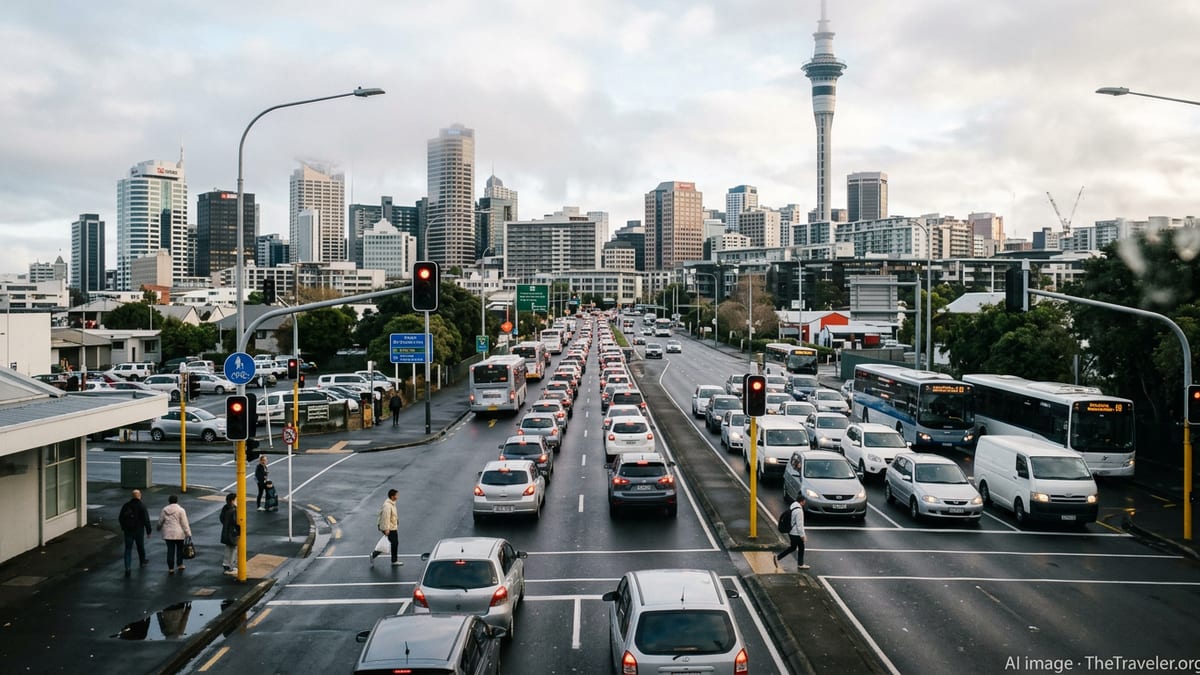
New data showing Auckland’s key corridors crawling at single-digit speeds has prompted fresh warnings to visitors and residents, as gridlocked roads, weather disruptions and construction collide to push New Zealand’s largest city toward a breaking point.
Get the latest news straight to your inbox!
Peak-Hour Crawl Puts Auckland on Travel Alert
Auckland’s already notorious congestion has intensified in recent weeks, with new figures revealing peak-hour traffic on some central routes slowing to an average of around 9 kilometres per hour during the morning rush. Commuter choke points including Ponsonby Road, Newton Road and Manukau Road have been singled out by transport officials as among the worst affected, leaving locals and visitors facing unpredictable journey times and mounting frustration.
The timing could hardly be worse for travellers. March is traditionally Auckland’s “March madness” period, when university semesters resume, schools are fully back and many workers end their summer leave, all returning to the roads at once. This year, that seasonal spike has collided with a packed calendar of roadworks, higher-than-usual storm activity on the upper North Island and ongoing disruption linked to major infrastructure projects.
Tourism operators say the mood in the city is shifting as delays spread beyond weekday commuter peaks and into weekends and evenings. Airport transfer companies report longer buffers being built into schedules, while hotel concierges are warning guests to double their usual travel time assumptions, particularly for cross-town trips and journeys to or from Auckland Airport.
Local officials have stopped short of urging travellers to avoid Auckland, but there is a growing emphasis on planning ahead and considering alternatives to private cars. Visitors unfamiliar with the city’s geography and congestion hotspots are being advised to pay closer attention to peak times, weather forecasts and live traffic information before setting out.
Weather Shocks and Harbour Bridge Closures Expose a Fragile Network
Recent severe weather has highlighted how quickly Auckland’s road network can seize when even a single critical link is compromised. In late January, high winds repeatedly forced partial closures of the Auckland Harbour Bridge, the main route between the central city and the North Shore. Motorists faced long queues and rolling delays as traffic was funnelled onto already stressed alternative routes skirting the Waitematā Harbour.
Those disruptions followed a series of heavy rain events in February that triggered surface flooding and slips across parts of the upper North Island. Authorities warned that intense downpours can rapidly overwhelm drainage on key arterial roads, turning routine trips into hours-long ordeals. Transport agencies are now reminding drivers that storm forecasts should be treated as a serious travel-planning factor, not an afterthought.
The Harbour Bridge, which carries both local and long-distance State Highway 1 traffic, remains a particular vulnerability. Planning work on a long-discussed second harbour crossing is advancing, but any new structure is years away. In the meantime, officials acknowledge that closures or lane restrictions on the bridge can quickly ripple through the entire Auckland region, with limited redundancy available when conditions deteriorate.
For tourists, the message is clear: itineraries that rely on quick hops across the harbour or tight connections between city attractions can be derailed when wind or rain forces rapid changes. Travel planners and tour operators are increasingly building in backup options to avoid stranding visitors on the wrong side of the harbour.
Construction, Roadworks and a Network Close to Capacity
On top of seasonal demand and weather shocks, Auckland is in the midst of an extended period of road and rail construction. Night-time motorway closures across several key corridors have been flagged by the national transport agency, while daytime lane reductions, temporary traffic management and diversions are increasingly common on city arterials.
Inside the central city, work to support rail upgrades and streetscape changes has narrowed streets and altered traffic patterns, particularly around core commuter and hospital routes. Auckland Transport has proposed changes near Auckland Hospital to relieve gridlock on Park Road, where queues can extend back through neighbouring suburbs at busy times. While the changes aim to improve flow in the long run, the transition period is contributing to delays and confusion for drivers unfamiliar with the updated layouts.
Longer term, projects such as the City Rail Link and planning for a second harbour crossing promise to reshape the way people move through Auckland, shifting more trips onto high-capacity public transport and providing alternative routes for vehicles. But until those projects are completed, officials concede that much of the city’s network is operating close to its practical capacity, with even minor incidents or lane closures tipping major routes into gridlock.
Business groups and infrastructure advocates have warned that without interim measures to manage demand, congestion will continue to sap productivity and damage the city’s reputation with visitors. A 2025 analysis for central government estimated that Auckland road congestion could cost the economy in the order of billions of dollars annually by the mid-2020s, with lost hours on the road and indirect disruption spreading across the country.
Tourists Rethink Routes, Modes and Timetables
For international visitors and domestic holidaymakers, Auckland’s congestion is no longer just an abstract local complaint. Rental car firms report more customers asking whether it is realistic to drive between airport, city hotels and attractions such as the North Shore beaches or West Auckland vineyards within traditional timeframes. Some travellers are opting to skip certain cross-city excursions altogether rather than risk spending precious holiday hours in stationary traffic.
Travel agents and tourism businesses are responding by reshaping itineraries. Central city stays are being paired with recommendations to explore on foot, by e-scooter or via bus and train, rather than relying on hire cars for short hops. Where road travel is unavoidable, such as outbound journeys to the Coromandel or Northland, visitors are being encouraged to depart outside peak times and to allow for unforeseen holdups caused by weather or roadworks.
The congestion is also changing the way locals host out-of-town guests. Aucklanders are increasingly steering visitors toward neighbourhood-based experiences that minimise multiple cross-town journeys in a single day. The trend is boosting interest in suburban dining and cultural districts, as residents look for ways to showcase the city without committing to multi-hour round trips across congested corridors.
Industry insiders say the shift is subtle but significant: where Auckland was once marketed primarily as a hub to transit through on the way to other regions, there is a growing incentive to persuade visitors to slow down and explore smaller slices of the city in depth, offsetting the frustration of traffic with more time on foot and less behind the wheel.
Authorities Urge Smarter Travel Choices Over Simple Warnings
While headlines about “gridlock” and “traffic nightmares” are proliferating, officials are wary of blanket warnings that might deter visitors altogether. Instead, Auckland Transport, Waka Kotahi NZ Transport Agency and tourism bodies are pushing a more nuanced message: the city remains open and attractive, but moving around requires more planning, flexibility and mode-shifting than in the past.
Authorities are urging both locals and visitors to build extra time into any trip that crosses the city at peak periods, to use journey-planning apps and live traffic feeds, and to consider park-and-ride options or switching at least some trips to buses, trains and ferries. For short distances, active modes such as walking and cycling are being promoted as often faster and more reliable than inching along in car queues.
Policy debates over congestion pricing, higher parking charges and accelerated public transport investment are intensifying as the scale of Auckland’s gridlock becomes harder to ignore. Advocates argue that measures to discourage unnecessary car trips, particularly into the city centre, could quickly free up road space for essential travel, including freight, emergency services and time-pressed tourists.
For now, the practical advice to travellers is pragmatic rather than alarmist: do not abandon plans to visit Auckland, but treat the city’s transport network as a constraint to navigate. That means checking conditions before leaving, avoiding tight back-to-back bookings on opposite sides of the harbour, and being ready to pivot to ferries, trains or a pair of walking shoes when the roads grind to a halt.