

More news on this day
Thousands of passengers at Austin-Bergstrom International Airport are facing cascading delays, abrupt cancellations and packed terminals, as severe weather and a strained national aviation system collide with one of the busiest spring travel periods of the year.
Get the latest news straight to your inbox!
How the Disruptions Escalated at Austin-Bergstrom
Publicly available flight-tracking data for the United States in mid-March 2026 shows hundreds of cancellations and thousands of delays nationwide, following days of powerful storms sweeping across large parts of the country and complicating airline operations. Those network-wide issues have rippled into Austin-Bergstrom International Airport, where a heavy spring break travel surge was already pushing the facility toward capacity.
Reports indicate that national cancellations climbed into the high hundreds on March 17, with delays surpassing 1,700 flights across the system. As aircraft and crews fell out of position, even airports with relatively mild local weather, including Austin, saw mounting disruption as airlines struggled to rethread tight schedules.
Austin-Bergstrom has experienced similar strain before, including recent episodes tied to federal staffing challenges and temporary ground stops affecting flights from key Texas hubs. Data compiled over the past several years suggests that, while the airport is often ranked as less stressful than some major counterparts, it remains highly sensitive to shocks elsewhere in the network due to its role as a fast-growing mid-sized hub.
These factors have combined over the last 24 to 48 hours to create a local bottleneck: full flights, limited spare seats and rolling operational changes are leaving many travelers in Austin with few immediate rebooking options and, in some cases, unexpected overnight stays.
Conditions Inside the Terminal
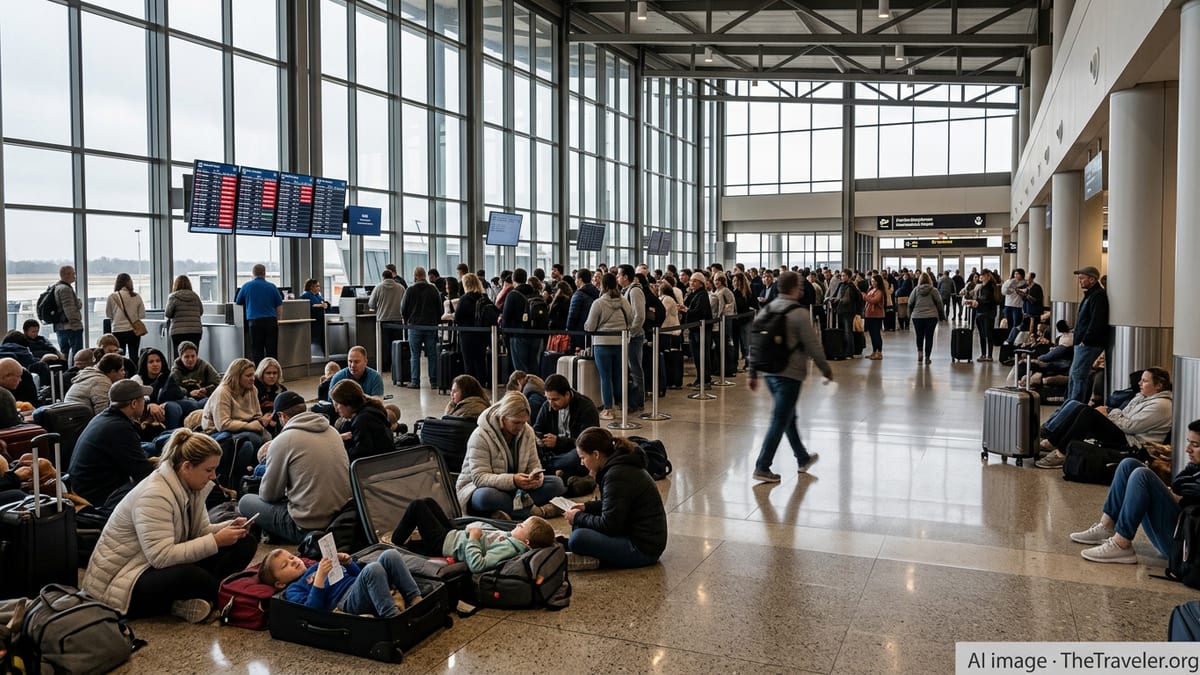
Traveler accounts shared on social platforms describe long check-in lines stretching through the ticketing hall, crowded gate areas and departure boards cycling rapidly between new departure times and cancellation notices. With many flights departing full at this time of year, even a single canceled departure can strand an entire plane’s worth of passengers if no additional capacity is available later in the day.
Images posted publicly from the terminal show passengers clustered around customer service desks, with some lines forming well before dawn as travelers attempt to move to earlier flights. Others report spending hours in the concourses waiting to see whether delayed flights will eventually depart or be scrubbed from the schedule.
Airport operations have also been dealing with a crush at security screening. In recent days, travelers in Austin have reported significantly extended waits at Transportation Security Administration checkpoints, citing the combination of spring break demand and continued pressure on federal staffing related to the ongoing partial government shutdown. Those compounding factors are slowing the flow of passengers even before they reach the gate.
Within the baggage claim area, the effects of delays and cancellations are also visible. Misaligned flight schedules can leave bags arriving without their owners, or travelers reaching Austin only to find their checked luggage still at a connection point. Piles of tagged suitcases are a familiar sight during major national disruptions, and Austin is now facing its share of that logistical tangle.
Why So Many Flights Are Being Canceled
According to recent aviation coverage and airline advisories, the immediate trigger for the latest wave of cancellations is severe weather across multiple regions, including heavy snow, thunderstorms and high winds that reduce capacity at key hubs. When large hubs slow or pause operations, knock-on effects quickly ripple through the network, affecting cities like Austin even when local skies are relatively clear.
Airlines are also contending with tight staffing and aircraft availability after years of robust travel demand. Industry analyses published over the past year highlight persistent pilot and crew shortages, as well as high utilization of aircraft, leaving limited slack to recover when major storms hit. A plane stuck in one city due to weather may be scheduled to operate several more flights that day, and if it cannot move, those flights are often canceled outright.
Federal staffing challenges have added a further complication. Public documents and recent reporting on the partial government shutdown describe the Federal Aviation Administration reducing traffic rates at certain facilities to maintain safety when controller staffing falls below ideal levels. Any such constraints at busy hubs or regional control centers can force airlines to trim schedules and may contribute to last-minute flight cancellations into and out of Austin.
The result is a fragile system where relatively small disruptions can escalate quickly. With March already ranking among the busiest months for Austin-Bergstrom, thanks to spring break, major events and convention traffic, the airport has little room to absorb sudden schedule changes without visible chaos for travelers.
What Stranded Travelers in Austin Can Do Right Now
Consumer advocates and travel experts consistently urge passengers caught in widespread disruptions to act quickly and use multiple channels to reach their airline. For travelers in Austin, that generally means using mobile apps or websites to request rebooking at the first sign of trouble, rather than waiting in a long physical line at the airport counter. In many mass disruption events, remaining seats on later flights are claimed within minutes.
Public guidance from airlines explains that passengers holding tickets on canceled flights are typically entitled to rebooking at no additional fare cost on the next available service operated by that carrier. In some cases, especially during severe weather, options may include rerouting through alternate hubs or departing from nearby airports if travelers can arrange ground transportation.
When disruptions extend overnight and are not strictly weather-related, some carriers may provide hotel or meal vouchers, but policies vary widely and often depend on the exact reason coded for the delay or cancellation. Travelers are encouraged to check the specific contract of carriage and any real-time travel alerts issued by their airline to understand what support, if any, is available.
For those already stranded in the terminal, basic steps such as securing access to power outlets, keeping essential medications and valuables in carry-on bags, and maintaining digital copies of travel documents can make long waits more manageable. Airport concessions and customer service points in Austin have historically extended hours during major disruptions, but options can still become limited late at night when multiple flights cancel at once.
Planning Ahead for Upcoming Austin Departures
For travelers who have flights scheduled from Austin-Bergstrom in the coming days, aviation data and recent patterns suggest that disturbances may take time to fully clear, even after the worst weather passes. Airlines often need several days to reposition aircraft and crews, meaning that residual delays and sporadic cancellations can linger beyond the peak of a storm system.
Passengers departing Austin are being advised in public travel alerts and local coverage to arrive earlier than usual, with recommendations commonly ranging from two and a half hours ahead of domestic departures to three hours for international flights during peak periods. Checking in online, traveling with carry-on baggage when possible and monitoring flight status frequently can all reduce the risk of missed departures.
It is also prudent for travelers to build flexibility into their plans. That can include avoiding tight connections, especially through weather-prone hubs, and considering travel insurance products that explicitly cover delays and cancellations. While no policy can prevent disruption, documentation from insurers and airlines can simplify reimbursement for unexpected expenses like hotels and meals.
In the near term, the situation at Austin-Bergstrom is likely to remain fluid. As airlines and federal agencies work to stabilize operations across the country, travelers using the airport should be prepared for rapidly changing conditions and make use of all available tools to stay informed and adjust itineraries as needed.