

More news on this day
Travelers at Austin-Bergstrom International Airport faced mounting delays and cancellations after three major Delta Air Lines and United Airlines services were grounded, disrupting more than 40 domestic and international connections across the United States and abroad.
Get the latest news straight to your inbox!
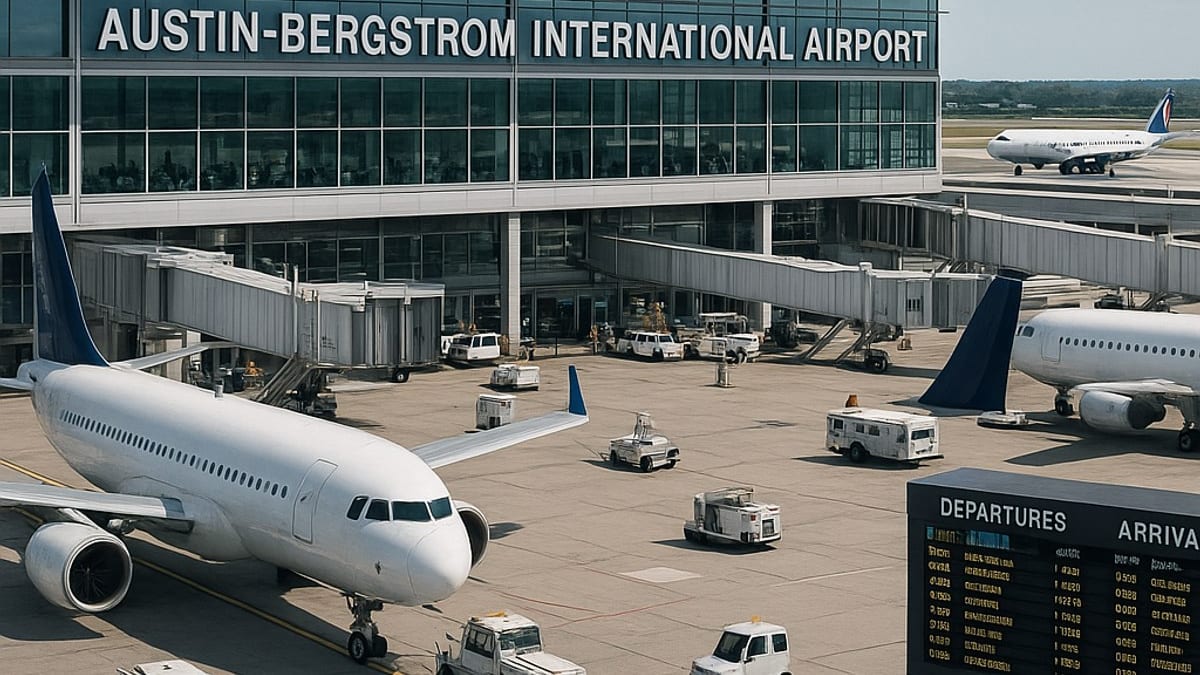
Image by Nomad Lawyer
Grounded Flights Ripple Across a Growing Texas Gateway
Published coverage and real-time flight tracking data indicate that three core Delta and United routes into and out of Austin-Bergstrom International Airport were taken out of operation, either through cancellations or prolonged ground delays. These flights function as vital spokes in both carriers’ networks, meaning their removal from schedules has had an outsized effect on onward connections for passengers using Austin as a transfer or origin point.
The grounded services include high-demand domestic routes that typically funnel travelers to coastal hubs as well as at least one service that links Austin to an international gateway. When those flights do not depart on time, missed connections cascade across networks, reducing access to more than 40 onward destinations, from secondary U.S. cities to long-haul international routes operated by alliance partners.
Publicly available airport-board snapshots and airline status pages show rows of delays and cancellations clustered around the affected Delta and United departures, with departure times repeatedly pushed back before flights were ultimately removed from schedules. For travelers already in the terminal, this meant extended waits, rebookings through alternative hubs, and in some cases overnight stays when same-day options disappeared.
The disruption has unfolded at a time when Austin-Bergstrom’s profile as a regional gateway is rising. Delta and United have both been growing their presence in the Texas capital, adding frequencies and new city pairs that rely heavily on smooth, banked connections. The temporary grounding of even a small number of key services has therefore had a much wider impact than the raw flight count might suggest.
Operational Strains and a Tight Airport Footprint
Austin-Bergstrom is widely recognized in industry reporting as an airport operating near the limits of its current infrastructure. The terminal runs a dense schedule of departures in peak periods, and airline forums and local coverage frequently highlight congestion at gates, taxiways, and security checkpoints. When irregular operations occur, there is limited slack in the system to absorb the shock.
In previous incidents, Austin has been subject to ground delay measures tied to broader air traffic control constraints and staffing challenges, which can quickly translate into local gridlock. Reports on recent events suggest a familiar pattern: inbound aircraft held on the ground at origin stations, outbound departures stacking up as crews and aircraft fall out of position, and gates occupied longer than scheduled as operators try to reset their lineups.
For Delta and United in particular, the constrained airport footprint complicates rapid recovery. Both use dedicated gates and contract ground handling teams at Austin-Bergstrom, which limits their flexibility to swap aircraft or share staff during peaks. When a disruption forces one or two key flights to pause, that delay can ripple through several subsequent rotations that rely on the same aircraft or crews.
Industry analysts note that this kind of event underscores how exposed fast-growing mid-sized airports can be to relatively small operational shocks. While major hubs often have spare gates and large staffing pools that can be reallocated in a crisis, airports with tight infrastructure and aggressive schedules have less capacity to recover quickly once delays start to stack up.
Impact on Travelers and Key Domestic and International Links
The immediate effect for passengers has been a patchwork of missed connections, last-minute rerouting, and longer journey times. Those booked on the grounded Delta and United flights often depend on them to access a web of onward connections throughout the United States, including Midwest and East Coast cities that do not have nonstop links from Austin.
For international travelers, the disruption has been particularly acute. Austin’s connections to overseas destinations typically rely on carefully timed links through coastal hubs and alliance partners. When a feeder flight from Austin is grounded, passengers may miss long-haul departures that operate only once a day, or on limited weekly schedules, narrowing rebooking options and forcing extended stopovers.
Travelers attempting to reach smaller regional airports have also been affected. Many of the onward routes impacted by the grounding are served by narrowbody or regional jets, which do not operate at high frequencies. When a single bank of inbound connections from Austin fails to arrive, the day’s only remaining departure to a secondary city may already be full, leaving passengers competing for scarce seats on alternative itineraries.
Social media posts and traveler accounts describe long queues at customer service desks and busy phone lines as passengers sought rebooking options across multiple carriers. Some were able to secure seats on competing airlines out of Austin, while others diverted to nearby airports in Dallas, Houston, or San Antonio in search of viable alternatives.
Wider Network Effects for Delta and United
Although the focal point of the disruption is Austin-Bergstrom, the grounding of the three flights has sent ripples through the broader networks of both Delta and United. Publicly available flight data show knock-on delays on routes that rely on aircraft and crews cycling through Austin, with schedule adjustments appearing at other airports as carriers reposition assets.
For Delta, Austin has been a key growth market, featuring expanded service to major hubs and select coastal cities. Interruptions on those routes risk undermining the appeal of the carrier’s investment in the region if reliability suffers. Industry commentary has repeatedly emphasized that on-time performance is a critical factor in attracting high-value business travelers, a segment Austin’s tech and creative economy generates in significant numbers.
United’s network is similarly sensitive to disruptions in mid-continent spokes. Flights into major connecting hubs are often carefully timed to meet narrow connection windows, and a delayed or canceled inbound from Austin can force United to rebook large numbers of passengers onto later departures. This can in turn spill over into seat availability on subsequent flights, tightening capacity even for travelers whose journeys do not touch Austin directly.
While the current disruption is limited in scope compared with systemwide meltdowns linked to software failures or extreme weather, it highlights how localized issues at a single airport can create visible turbulence across national and international networks when the affected flights sit at critical junctions in carriers’ schedules.
Pressure Builds for Capacity Upgrades and Contingency Planning
The latest disruption adds to mounting pressure on Austin-Bergstrom and its airline partners to accelerate capacity improvements and refine contingency planning. Local planning documents and aviation briefings outline an ambitious program of gate expansions and terminal upgrades designed to accommodate the region’s rapid population growth and the surge in air travel demand.
Until those projects are completed, however, airlines and airport managers must navigate a tight operating environment where even minor disruptions can produce outsized delays. Analysts suggest that carriers may look to build more schedule resilience into peak periods at Austin by adding buffer time between turns, diversifying ground handling arrangements, or adjusting aircraft routing to reduce dependence on a small number of critical flights.
Travel advisory services are already encouraging passengers traveling through Austin to allow extra time for connections, particularly when linking to long-haul flights or infrequent regional services. Some guidance also recommends booking earlier departures in the day where possible, when schedules are less likely to have accumulated rolling delays from earlier disruptions.
For travelers, the episode serves as a reminder of how interconnected modern air travel has become. A small cluster of grounded flights in a single fast-growing Texas airport can reverberate through dozens of destinations, affecting not only those in the terminal, but thousands of passengers across the country and overseas who may never set foot in Austin, yet still feel the impact through missed connections, longer journeys, and tighter seat availability.