

More news on this day
A sudden wave of grounded Delta Air Lines and United Airlines services at Austin-Bergstrom International Airport has triggered widespread disruption across the carriers’ networks, affecting more than 40 domestic and international destinations and underscoring the strain on one of the nation’s fastest-growing airports.
Get the latest news straight to your inbox!
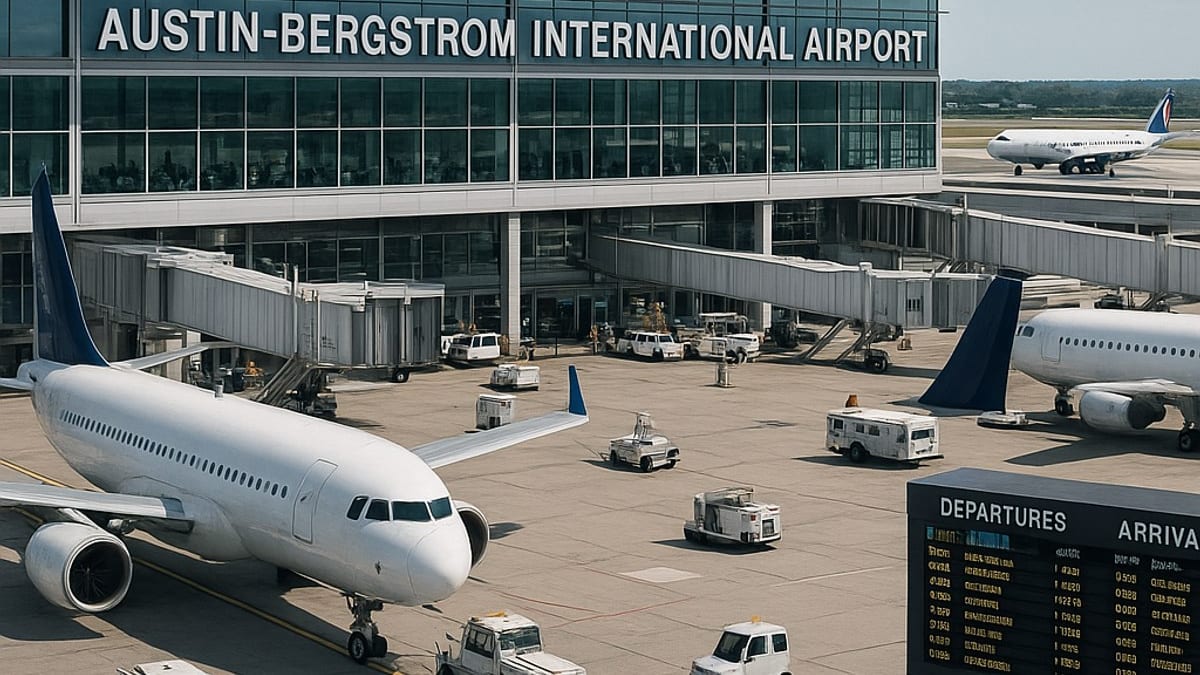
Image by Nomad Lawyer
Grounded Flights Expose Austin’s Growing Pains
Published reports and live flight-tracking data indicate that three key Delta and United departures from Austin were grounded for extended periods, either delayed to the point of cancellation or removed from schedules entirely. The impacted flights, originally scheduled to connect Austin with major hubs, created a knock-on effect across those carriers’ networks as aircraft and crews were left out of position.
While the specific causes vary by flight, the pattern highlights how vulnerable Austin-Bergstrom has become to localized disruptions. A relatively small number of grounded aircraft can reverberate through dozens of connected routes, particularly when those aircraft are tied to banked schedules at major hub airports.
Publicly available operational summaries for Austin show that Delta and United rely heavily on connecting traffic, feeding passengers from Texas into broader national and international networks. When outbound flights from Austin fail to depart on time, those onward journeys are disrupted, and aircraft expected to return to Austin later in the day may never arrive.
The episode comes as Austin’s airport continues to expand its route map and passenger numbers, intensifying questions about how the facility and its airline partners can maintain reliability during periods of stress on the system.
Impact Spreads Across More Than 40 Destinations
By late in the operational day, the grounding of the three Delta and United flights had affected itineraries touching more than 40 destinations in the United States and abroad. Passengers with connections through major hubs such as Atlanta, Denver, Houston, Los Angeles, and New York reported missed onward flights and involuntary overnight stays as schedules unraveled.
Travel patterns into and out of Austin mean that a single canceled or heavily delayed departure rarely affects just one origin and one destination. Aircraft scheduled to operate multiple legs over a 24-hour period can be removed from rotations entirely, forcing carriers to reshuffle fleets and crews. That ripple can quickly reach secondary cities and international gateways that may seem far removed from the original disruption point.
Published coverage of recent airline operations has shown how modern hub-and-spoke networks frequently magnify local issues into multi-city events. In this case, passengers on affected itineraries reported changes as far away as transborder destinations and major East and West Coast markets, even when local conditions there appeared normal.
For many travelers, the practical impact was uncertainty. Even when alternatives existed, limited remaining seat capacity on peak-day flights made it difficult to rebook quickly, especially for groups or passengers needing to coordinate with hotel and ground transport reservations.
AUS Infrastructure and Staffing Under Scrutiny
The latest disruptions are unfolding against a backdrop of infrastructure and staffing pressures at Austin-Bergstrom. In recent years, the airport has been operating near or above its designed capacity during peak periods, with tight gate availability and limited slack in the system. Publicly available planning documents and local reporting describe how rapid regional growth has outpaced terminal and airfield expansion.
Earlier operational reviews have pointed to the combination of busy departure banks, short turn times, and constrained ramp space as persistent risk factors. When even a minor slowdown occurs, ground operations can quickly become congested, making it harder to push aircraft back from gates, marshal arrivals, and turn planes in time for their next flights.
Staffing in critical roles, including air traffic control and ground handling, has also been highlighted as a challenge. National data show that staffing gaps can lead to ground delay programs or restrictions on arrivals and departures at individual airports. When those constraints intersect with high-demand schedules in a growing market such as Austin, the result is a higher probability that multiple flights will be forced to hold, divert, or cancel.
Local travelers and aviation observers have frequently noted that Austin’s long-term expansion plans, including new gates and terminal upgrades, are intended to alleviate some of these bottlenecks. However, those projects are still several years from full completion, leaving airlines and passengers to navigate an extended period of tight capacity.
Delta and United Networks Feel the Strain
Delta and United both treat Austin as a strategically important station, even if it is not a traditional fortress hub. Publicly available route maps show a web of nonstop services from Austin feeding into each airline’s core connecting centers, including Atlanta and Minneapolis for Delta, and Denver, Houston, and Newark for United. This strategy has increased options for Central Texas travelers but has also made the airport a critical node in each carrier’s broader network.
When a Delta or United aircraft is grounded at Austin, the disruption reaches far beyond Central Texas. The aircraft may have been scheduled to operate multiple segments that fan out across the country, and crews tied to that specific aircraft may run up against duty-time limitations if delays stretch for hours. That operational reality can lead to a mix of rolling delays and preemptive cancellations on later flights, even on routes that never touch Austin directly.
Recent industry coverage has emphasized how airlines are attempting to build more resilience into their networks by increasing spare aircraft capacity and adjusting schedules. However, demand growth in markets like Austin has often outpaced those efforts, leaving little room to maneuver when irregular operations occur. The latest flight groundings illustrate how quickly carefully balanced timetables can unravel when capacity is tight.
For frequent flyers, the pattern is familiar. A localized issue in one city leads to cascading problems at distant airports that share aircraft or crew rotations, turning what appears to be a limited disruption into a wide-ranging operational challenge across a carrier’s entire system.
What Travelers Can Expect in the Coming Days
For passengers traveling through Austin in the aftermath of the latest grounded flights, residual delays and scattered cancellations are likely to persist as Delta and United work to restore normal patterns. Once aircraft and crews fall out of sync with published schedules, it can take several days of relatively smooth operations to fully recover.
Travel advice from consumer advocates and airline-watchers remains consistent: passengers are encouraged to monitor their bookings closely, use airline apps for real-time rebooking options, and consider alternative routings through less congested hubs when possible. Travelers with time-sensitive commitments may also look at nearby airports within driving distance as backup options if schedules from Austin remain constrained.
At the same time, the situation is likely to reinforce ongoing debates about Austin’s aviation future. As airlines continue to add routes and upgauge aircraft in response to strong demand, questions are growing about how quickly infrastructure can catch up and how carriers will adjust their operational strategies to cope with recurring strains.
For now, the latest round of grounded flights serves as another reminder that in a tightly interlinked air travel system, problems at a single fast-growing airport can have outsized consequences for passengers across the country and beyond.