

More news on this day
Australia’s long-discussed dream of true high-speed rail is edging toward reality, as the federal government unveils a one-hour Newcastle to Sydney link it says will transform how millions of people live, work and travel along the nation’s busiest corridor.
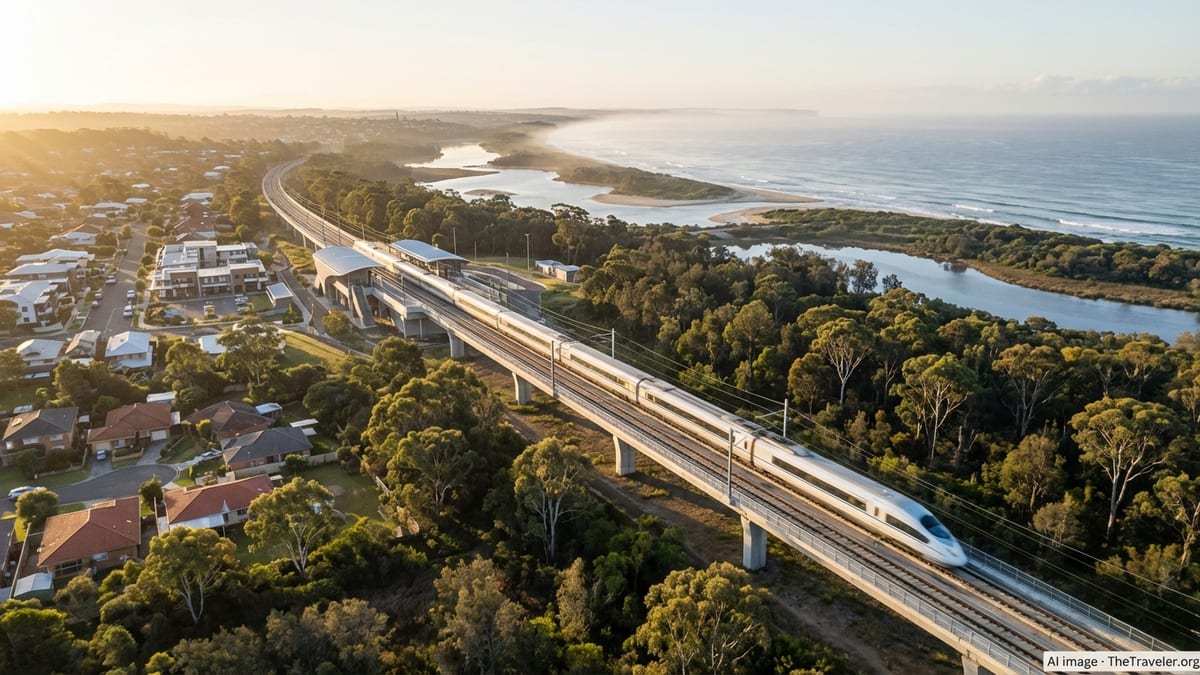
A Nation-Defining Rail Corridor Takes Shape
The Albanese government has confirmed a major new development phase for Australia’s first high-speed rail line, selecting the Newcastle to Sydney corridor as the starting point for a future east coast network. The project aims to slash current rail journey times of more than two and a half hours to around 60 minutes between Newcastle and Central Sydney, positioning the route as a test case for high-speed rail across the country.
Under the plan, trains are expected to reach speeds of up to 320 kilometres per hour on some stretches, with services designed to offer quick, frequent and comfortable connections between Newcastle, the Central Coast and Sydney. The High Speed Rail Authority has been tasked with turning a detailed business case into a construction-ready project that can move to major works later this decade.
Federal Infrastructure Minister Catherine King has framed the line as a nation-shaping investment, arguing that high-speed rail will bring people and places closer together while easing pressure on housing and roads. Officials say the Newcastle to Sydney section has been prioritised because of its potential to deliver strong economic returns, rapid travel-time savings and significant regional growth.
Two-Year Development Push and Multi-Billion-Dollar Price Tag
The latest announcement commits an additional 229.6 million Australian dollars to planning and design, bringing the total federal investment in the development phase to about 659.6 million dollars. Over the next two years, engineers and planners will work “metre by metre” along the proposed route to refine station locations, tunnel alignments and technical specifications before any major contracts are signed.
This intensive phase is intended to secure the rail corridor, complete at least 40 per cent of the design and lock in a realistic cost estimate for what is widely expected to be a multi-billion-dollar megaproject. Government documents and media briefings suggest the construction of the line alone could run into tens of billions of dollars, with the full program including trains, signalling and supporting infrastructure potentially far higher.
Officials argue that front-loading this detailed work will reduce the risk of cost blowouts and delays once construction begins. A final investment decision is currently targeted for 2028, with the government exploring a mix of public funding and private finance to underwrite what is likely to become one of the most expensive transport projects in Australian history.
From Congested Commute to One-Hour City Pair
At the heart of the project is a dramatic reimagining of everyday travel between Newcastle, the Central Coast and Sydney. The High Speed Rail Authority’s modelling indicates a journey of around one hour from Newcastle to Central Sydney, compared with current train trips that often exceed two hours and 30 minutes on a busy, winding coastal alignment.
Travel times between the Central Coast and either Sydney or Newcastle are forecast to fall to about 30 minutes, rapidly shrinking perceived distances across the region. Early plans envisage a new high-speed alignment of roughly 190 kilometres, with long tunnel sections under waterways and bushland, and new or upgraded stations in key growth areas such as Broadmeadow and the Central Coast.
Planners say the line is being designed from the outset as the first stage of a longer east coast network linking Brisbane, Sydney, Canberra and Melbourne. That means decisions on track geometry, tunnel diameters and rolling stock are being made with future long-distance express services in mind, even as the initial focus remains firmly on the Newcastle to Sydney commuter market.
Economic Windfall and Housing Shock Absorber
The business case backing the line projects that high-speed rail between Newcastle and Sydney could add around 250 billion dollars to the Australian economy over the next 50 years. Jobs in construction, advanced manufacturing, engineering and ongoing operations are expected to exceed 99,000 over the project’s life, according to government estimates released with the latest funding package.
Beyond direct employment, policymakers see the project as a powerful lever for reshaping population growth patterns. Faster connections to Sydney are forecast to unlock new housing supply in Newcastle, the Hunter and the Central Coast by making longer-distance commuting far more viable. Regional centres could attract residents priced out of the capital while still offering access to metropolitan jobs and services.
Tourism operators are also watching closely, with a one-hour link promising city-break visitors an easy hop between Sydney and the beaches, wineries and cultural attractions of the Hunter region. Business groups argue that the line will help build a single, integrated labour market across a corridor that already accounts for a large share of New South Wales’ economic activity.
Timelines, Skepticism and the Long Road Ahead
Despite the fanfare surrounding the one-hour promise, the government has been careful to stress that passengers will not be boarding high-speed trains any time soon. The two-year development phase will be followed by a final investment decision, with construction contracts expected later this decade and staged opening dates stretching into the 2030s and 2040s.
Early indicative timelines point to high-speed services potentially reaching between Newcastle and the Central Coast first, with the final approach into inner Sydney taking longer due to complex tunnelling and urban interfaces. Extensions toward Parramatta and the Western Sydney Airport are being considered as part of a broader long-term network plan.
The ambitious schedule and scale of the project have prompted renewed scepticism from some quarters, given Australia’s long history of unrealised high-speed rail proposals. Critics question whether cost estimates can be contained and whether political commitment will survive changes of government and economic cycles. Supporters counter that the creation of a dedicated High Speed Rail Authority, a robust business case and significant upfront funding signal a more serious intent than previous efforts.
For now, the government is betting that a one-hour Newcastle to Sydney journey can shift the debate from aspiration to delivery, recasting high-speed rail from electoral slogan to engineering reality and setting a template for how Australia might finally embrace fast intercity travel.