

More news on this day
Australian travellers bound for Europe are facing a fresh wave of disruption as escalating conflict in the Middle East shuts key air corridors, forcing airlines to cancel, divert or radically reroute long-haul services and leaving many passengers stranded in transit hubs or scrambling to rebook at short notice.
Get the latest news straight to your inbox!
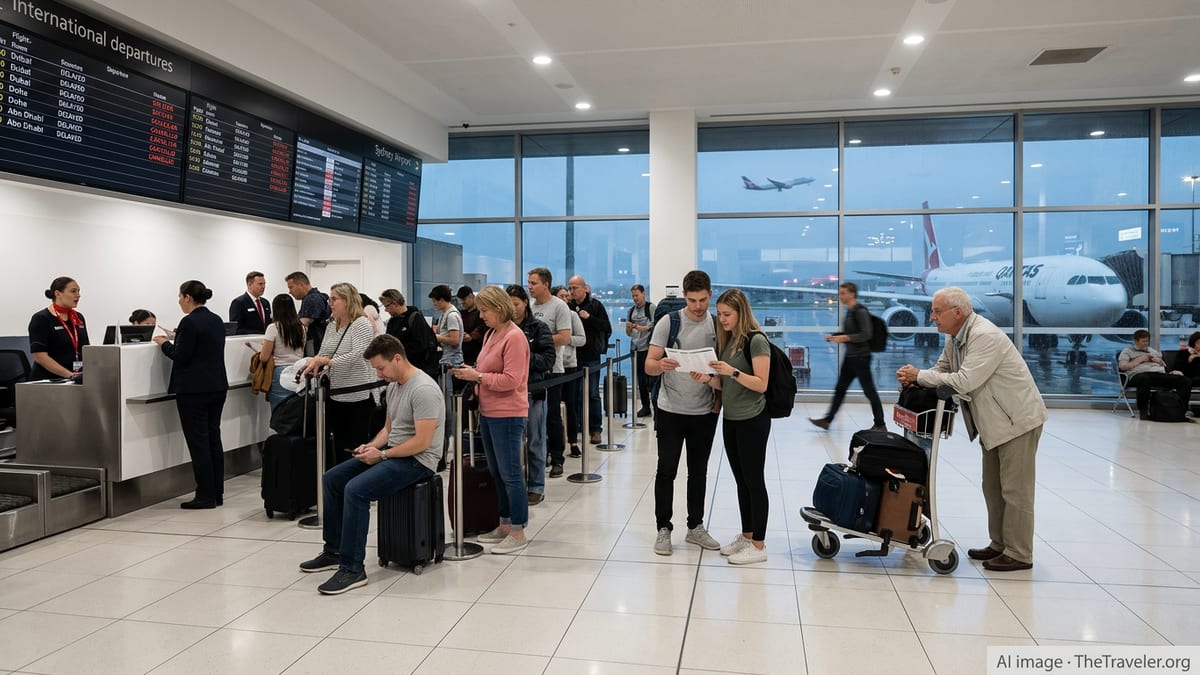
Middle East War Chokes Off a Critical Air Bridge
The long-established air bridge linking Australia to Europe via the Middle East has been severely curtailed in recent days, as the war involving Iran, Israel and the United States prompts widespread airspace closures and tight operational restrictions across the Gulf region. Routes that once relied on seamless connections through Doha, Dubai and Abu Dhabi are now either suspended or operating on sharply reduced schedules.
Major Middle Eastern carriers popular with Australians, including Emirates, Qatar Airways and Etihad Airways, have scaled back or temporarily halted many services as they navigate the complex patchwork of no-fly zones and military activity. Industry analyses point to airspace over Iran, Iraq and Israel largely closed to civilian traffic, while countries such as Jordan, Kuwait and Bahrain have imposed varying levels of restrictions, forcing wide detours to the north over the Caucasus or south over the Arabian Sea.
Global business travel groups and risk consultancies warn that thousands of flights between Europe and the Asia-Pacific have been cancelled or rerouted since the latest escalation, significantly reducing capacity on what is traditionally one of the world’s busiest long-haul corridors. With conflict-related uncertainty expected to persist for weeks or even months, airlines are being cautious about restoring normal schedules.
Australian officials have acknowledged that some citizens remain caught in the middle of the upheaval, particularly those who began journeys before the latest wave of closures and now find themselves stranded in third-country hubs. While emergency consular support is available, authorities continue to advise travellers to stay in close contact with their airline and monitor changing advisories before setting off.
Extended Journeys, Higher Costs and a Squeezed Kangaroo Route
The immediate impact for most passengers is time. Detours designed to avoid conflict zones are adding between 90 minutes and six hours to some long-haul legs, according to aviation data and route tracking services. Flights that would traditionally cross Iran and Iraq are now bending far to the south via Egypt and Saudi Arabia or to the north around the Caspian Sea, increasing fuel burn and complicating crew scheduling.
Those additional hours in the air translate directly into higher operating costs for airlines, at a time when jet fuel prices remain volatile. Carriers that continue to link Australia with Europe via Asia, including Singapore Airlines and some Qantas codeshare partners, are absorbing longer routings while warning that persistent disruption could feed through into higher fares during the upcoming northern summer peak.
The once-straightforward “Kangaroo Route” between Australia and the United Kingdom is already feeling the strain. Qantas, which does not currently operate its own flights into the Middle East, has kept its schedules largely intact but has again adjusted its flagship Perth to London service to avoid restricted skies. The non-stop flight is temporarily operating with a refuelling stop in Singapore, adding time on the ground but enabling the aircraft to carry extra fuel and, in the airline’s words, maintain a buffer against unplanned diversions.
Travel agents report that demand is quickly shifting toward perceived “safer” or more predictable routings via Singapore, Bangkok and other Asian hubs, even when that means longer journeys or multiple connections. For many travellers, the priority is simply reaching Europe at all, rather than securing the fastest possible trip.
Australians Stranded in Transit as Schedules Unravel
For a minority of unlucky passengers, the shake-up has been far more disruptive than a longer flight time. As airports across the Gulf temporarily closed overnight or restricted incoming services at short notice, aircraft were forced to divert mid-flight or return to their points of origin, leaving travellers in limbo across several continents.
Australian media have carried accounts of passengers whose flights from Perth to European destinations via the Middle East were turned back or diverted to alternative hubs such as Singapore or Rome, sometimes after many hours in the air. Others found themselves stuck at major transit airports when onward connections were cancelled en masse, with limited information and long queues at service desks as ground staff scrambled to rebook hundreds of people at once.
Travel risk briefings compiled in recent days describe “large numbers” of international travellers and airline crew stranded in the region due to airport closures and suspended commercial flights. While some carriers have begun operating limited repatriation services, hotel availability in key hubs is tight and options to reroute around the Middle East are constrained by the simultaneous closure of Ukrainian and much Russian airspace, which had already pushed many flights further south in recent years.
Australian consular authorities say the majority of citizens who were initially stranded in Gulf airports during the first wave of closures have now been able to depart, but they caution that further disruption remains likely as the security situation evolves. Passengers are being urged to keep receipts and records of any out-of-pocket expenses incurred while waiting for rebooking, in case compensation or insurance claims later become available.
Airlines Offer Flexibility, but Insurance Gaps Loom
In response to the turmoil, several major airlines have introduced temporary waivers that allow customers to change travel dates, alter routes or request refunds without the usual penalties. Emirates has publicly committed to offering full refunds for certain bookings through the end of March where flights are cancelled or passengers no longer wish to travel, while Etihad and other carriers have opened up free date changes into May for those affected by route suspensions.
Nevertheless, consumer advocates warn that flexibility policies differ significantly between airlines and that passengers should carefully check the conditions attached to any offer before accepting. In some cases, accepting a travel voucher rather than a cash refund could limit future options, especially if the disruption drags on longer than expected or if schedules are later cut back again.
Travel insurance has emerged as another critical pressure point. Many standard policies either exclude coverage for declared wars and civil unrest or restrict payouts for cancellations and delays linked directly to conflict events. Industry experts say that some Australians who booked multi-stop itineraries via the Middle East may discover that they are not covered for accommodation, missed tours or additional flights if their plans collapse due to closed airspace rather than a mechanical fault or ordinary weather disruption.
Advisers are urging travellers with upcoming European trips to review policy wording closely, paying particular attention to war and terrorism exclusions, and to consider purchasing higher-tier coverage that may offer broader protection in unstable regions. Those already abroad are encouraged to contact their insurer before making major changes, such as abandoning part of an itinerary, to avoid inadvertently voiding potential claims.
What Travellers Can Do Now
With the situation in the Middle East still fluid, experts say the most important step for Australians planning to travel to Europe is to avoid panic cancellations. Airlines generally move in stages, first tweaking flight paths, then suspending individual services and only later cutting entire routes if necessary. Passengers who cancel on their own initiative before an airline formally changes or cancels a flight may lose access to refunds and generous rebooking options.
Instead, travellers are being advised to keep a close eye on airline apps and email alerts, and to register contact details with both carriers and booking agents so that schedule changes are communicated as quickly as possible. For those with imminent departures routed through the Middle East, contacting the airline a few days before travel to confirm operating status and discuss alternative routings via Asia or Europe can provide clarity and, in some cases, a proactive rebooking.
Travel consultants also recommend building more flexibility into itineraries: adding long layovers between intercontinental legs to reduce the risk of missed connections, booking fully refundable accommodation where possible, and considering backup routes or dates if a preferred path becomes untenable. For travellers already overseas, keeping digital copies of passports, tickets and insurance documents, and monitoring official travel advisories, can streamline assistance if conditions deteriorate further.
Despite the turmoil, aviation safety experts emphasise that airlines are erring heavily on the side of caution, rerouting and cancelling flights precisely to keep passengers clear of conflict zones. For Australians determined to make it to Europe, the journey may be longer, more expensive and less predictable than in previous years, but alternative paths are still open as carriers, regulators and travellers adapt to a reshaped global sky.