

More news on this day
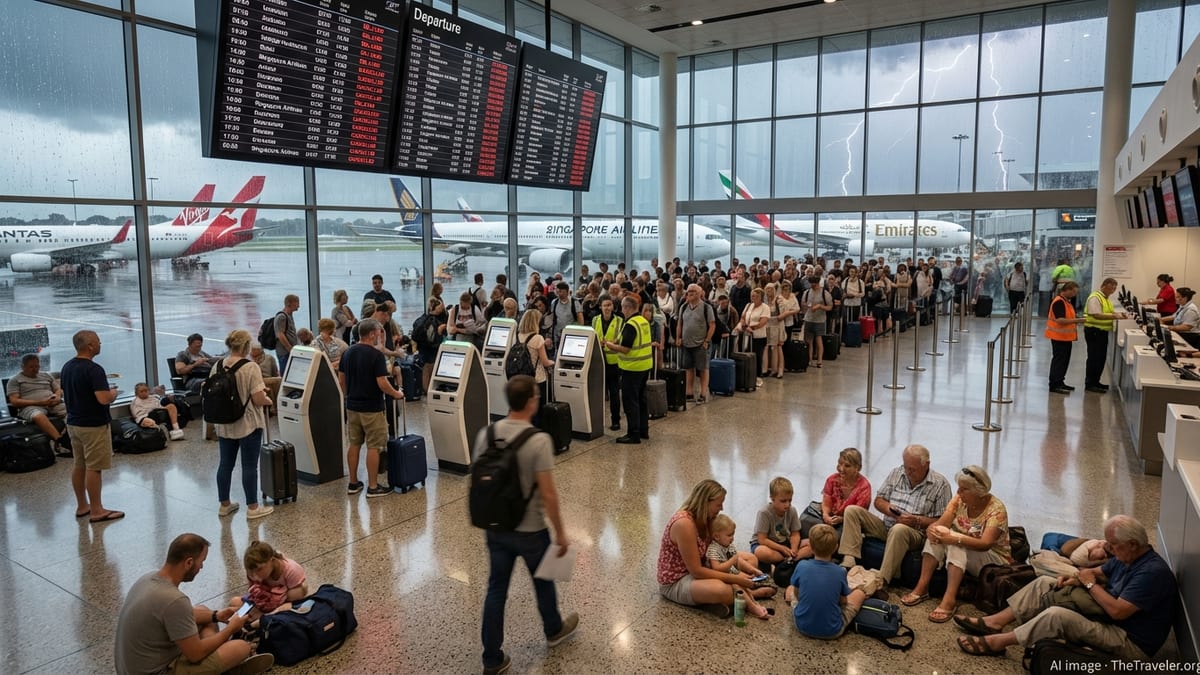
Hundreds of airline passengers across Australia faced significant disruption today as severe delays and cancellations at Sydney, Melbourne and Brisbane cascaded across the domestic and trans-Tasman network, affecting services to Canberra, Adelaide, Christchurch and other regional destinations.
Get the latest news straight to your inbox!
Weather and Operational Strains Collide at Major Gateways
Publicly available airport and aviation data for April 1 indicate that Sydney, Melbourne and Brisbane accounted for a combined 38 flight cancellations and 380 delays, creating knock-on disruption across some of the busiest corridors in Australia and New Zealand. The pattern mirrors a broader trend of operational fragility in the region, where storms, tight scheduling and aircraft availability can quickly translate into widespread timetable chaos.
Reports on the day’s operations point to adverse weather conditions, low cloud and patchy storms in parts of the east coast as key triggers for the schedule disruption. When coupled with already congested morning and evening peaks, relatively small delays have spiralled into lengthy queues at check in, security and boarding gates, leaving passengers stuck in terminals for hours.
Operational challenges, including crew rostering limits and aircraft rotations, have further amplified the ripple effect. Once flights at primary hubs such as Sydney and Melbourne fall significantly behind schedule, airlines often struggle to reposition aircraft and staff quickly enough to protect the remainder of the day’s timetable.
Industry and government performance reports over recent months have repeatedly highlighted the sensitivity of Australian aviation to single-day shocks, noting that a spike in cancellations or missed departure slots at one or two major airports can influence punctuality statistics nationwide.
Qantas, Air New Zealand, Singapore Airlines and Cathay Pacific Among Affected Carriers
The disruption has cut across both domestic and international operations, with flagship carriers Qantas and Air New Zealand among those experiencing notable delays and select cancellations. For Qantas, the issues have been most visible on east coast trunk routes linking Sydney, Melbourne and Brisbane, where dense schedules and high passenger loads provide limited slack when conditions deteriorate.
Trans-Tasman and long haul services have also felt the strain. Flights operated by Air New Zealand and Singapore Airlines between Australia, New Zealand and key Asian hubs have faced extended ground times and revised departure slots, complicating onward connections for travellers heading to North America, Europe and Southeast Asia.
Premium long haul operators such as Cathay Pacific, which connects Australian cities to Hong Kong and beyond, have had to adjust selected services as they navigate slot changes and air traffic control restrictions. While many of these flights have eventually departed, longer than usual delays have forced some passengers to seek rebooking options and overnight accommodation.
The pattern of disruption follows earlier episodes in the year in which a combination of airline staffing constraints and volatile weather exposed ongoing vulnerabilities in airline networks. Historical performance data has shown that carriers operating heavily utilised fleets are particularly exposed when several aircraft are delayed or temporarily removed from rotation on the same day.
Impact Spreads to Canberra, Adelaide, Christchurch and Regional Links
Although Sydney, Melbourne and Brisbane are bearing the brunt of today’s flight chaos, secondary cities and regional hubs have also been pulled into the turbulence. Publicly accessible tracking and schedule tools show knock-on effects in Canberra and Adelaide, where flights to and from the main east coast gateways have experienced late arrivals and departures.
Across the Tasman, services linking Australian capitals with Christchurch have also come under pressure as delayed aircraft and crews arrive hours behind schedule. When combined with limited daily frequencies, even a small number of disrupted flights can sharply reduce options for travellers needing to reach New Zealand’s South Island on specific dates.
Within Australia, regional communities dependent on connections via Sydney, Melbourne and Brisbane have reported disrupted same-day itineraries. Passengers travelling to and from destinations in Queensland, South Australia and New South Wales are facing missed onward flights, cut-short business trips and rebooked journeys that extend into overnight stays.
Transport economists have long warned that such days of intense disruption can have an outsized economic impact, particularly on small tourism operators and local businesses that rely on predictable visitor flows. Missed meetings, cancelled tours and abandoned hotel stays can quickly add up when several hundred passengers are stranded or significantly delayed across multiple cities.
Stranded Passengers Confront Long Queues and Limited Alternatives
For affected travellers, the most immediate consequence has been hours spent in terminals waiting for updates, new boarding times or alternative itineraries. Social media posts and traveller forums from throughout the day describe long lines at airline service desks, heavily booked later services and limited spare seats on competing carriers.
Where cancellations have occurred, many passengers have had to consider overnight stays or multi-stop routings to reach their destinations. With school holidays and business travel ramping up in parts of Australia and New Zealand, spare capacity on popular routes is often tight, reducing the pool of alternative options once an aircraft is removed from service.
In some cases, travellers with flexible plans have opted to shift to rail or long distance coach travel on short domestic hops, particularly between Sydney, Canberra and regional centres. However, for long haul and international itineraries, options remain largely confined to later flights or connection-heavy routings through alternate hubs.
Consumer advocates in Australia and New Zealand have previously argued that recurring disruption days highlight the need for clearer communication and more consistent support for delayed and stranded passengers, including food vouchers, accommodation and transparent information about rebooking rights where national regulations apply.
Ongoing Questions Over Resilience in Australasian Aviation
Today’s disruption adds to the growing body of evidence that aviation networks in Australia and New Zealand remain highly sensitive to short-term shocks, whether they arise from storms, air traffic control constraints or staffing issues. Industry observers note that even as airlines rebuild schedules and increase capacity after the pandemic, investments in resilience, spare aircraft and crew depth have often lagged.
Recent government and regulatory reports have pointed to elevated cancellation and delay rates on some key domestic routes over the past two years, particularly during peak holiday periods or major weather events. While performance has improved from the most challenging phases of the recovery, punctuality remains under pressure when several variables move against airlines on the same day.
For travellers, the events of April 1 serve as a reminder of the importance of contingency planning, including longer connection windows, travel insurance that covers delays and cancellations, and awareness of airline policies around rebooking and care. As aviation in the region continues to scale up, the balance between tight, efficient scheduling and built-in resilience is likely to remain a central topic in public and industry debate.
In the short term, attention is focused on how quickly airlines and airports can clear the backlog of disrupted flights at Sydney, Melbourne and Brisbane and restore normal operations to Canberra, Adelaide, Christchurch and other affected destinations over the coming 24 to 48 hours.