

More news on this day
Hundreds of airline passengers have been left stranded across Australia after a fresh wave of global flight disruptions delayed 314 services and cancelled 47 more, snarling operations at Sydney, Melbourne, Brisbane and Perth airports and triggering knock-on chaos for long-haul routes to Los Angeles, Abu Dhabi, Dubai, London and other major hubs.
Ripple Effects of Middle East Airspace Crisis Reach Australia
Australian aviation authorities and airport operators reported a sharp spike in delays and cancellations over the weekend as airlines continued to reroute around closed or heavily restricted airspace in the Middle East. The disruption has pushed already congested global networks to breaking point, with Australian gateways feeling the impact despite being thousands of kilometres from the conflict zone.
Data compiled from airline schedules and airport movement logs indicates that at least 314 flights touching Sydney, Melbourne, Brisbane and Perth were delayed, with a further 47 cancelled outright. The majority were international long-haul and connecting services that rely on tightly timed rotations through hubs in Dubai, Abu Dhabi, Doha, Singapore and major US and European cities.
Capacity constraints on alternative routes, extended flying times and tight crew-duty limits have combined to create rolling delays that now stretch well beyond the Middle East itself. Industry analysts warn that while cancellation rates have begun to ease at some Gulf airports, the backlog of displaced passengers and aircraft will continue to affect Australian timetables for days.
Domestic schedules have also come under pressure, as airlines reshuffle aircraft and crews to protect key international services. Travellers on busy east-coast routes reported a rising number of late departures, aircraft substitutions and last-minute gate changes as operations teams scrambled to keep aircraft circulating.
Major Carriers Scramble to Reroute Qantas, United, Emirates and Others
Flag carrier Qantas has been at the centre of the upheaval, with its flagship Perth to London service forced to route via Singapore instead of using traditional corridors over the Middle East. The extra refuelling stop has lengthened block times and tightened aircraft rotations, limiting the airline’s flexibility to recover from further delays elsewhere in the network.
United Airlines, which operates transpacific services linking Sydney and Melbourne to Los Angeles and San Francisco, has also seen its schedules strained by congestion at North American hubs handling diverted traffic from Europe and the Middle East. Longer holding patterns, slot constraints and crew rest requirements have contributed to late departures from Australia and missed onward connections for US-bound passengers.
Emirates and Singapore Airlines, two of the largest foreign carriers serving Australian cities, have faced some of the most complex operational challenges. Emirates continues to juggle a reduced schedule through Dubai, while Singapore Airlines has absorbed additional demand from travellers rebooked off disrupted Gulf services, placing intense pressure on already busy Australia to Europe and Australia to US corridors.
Other carriers including Etihad Airways, Qatar Airways and British Airways have been working with airport coordinators in Sydney and Melbourne to secure viable slots for retimed services. Industry sources say overnight banks of departures in particular have become increasingly compressed, raising the risk of further delays when even a single inbound aircraft arrives off schedule.
Passengers Sleep in Terminals as Rebooking Windows Shrink
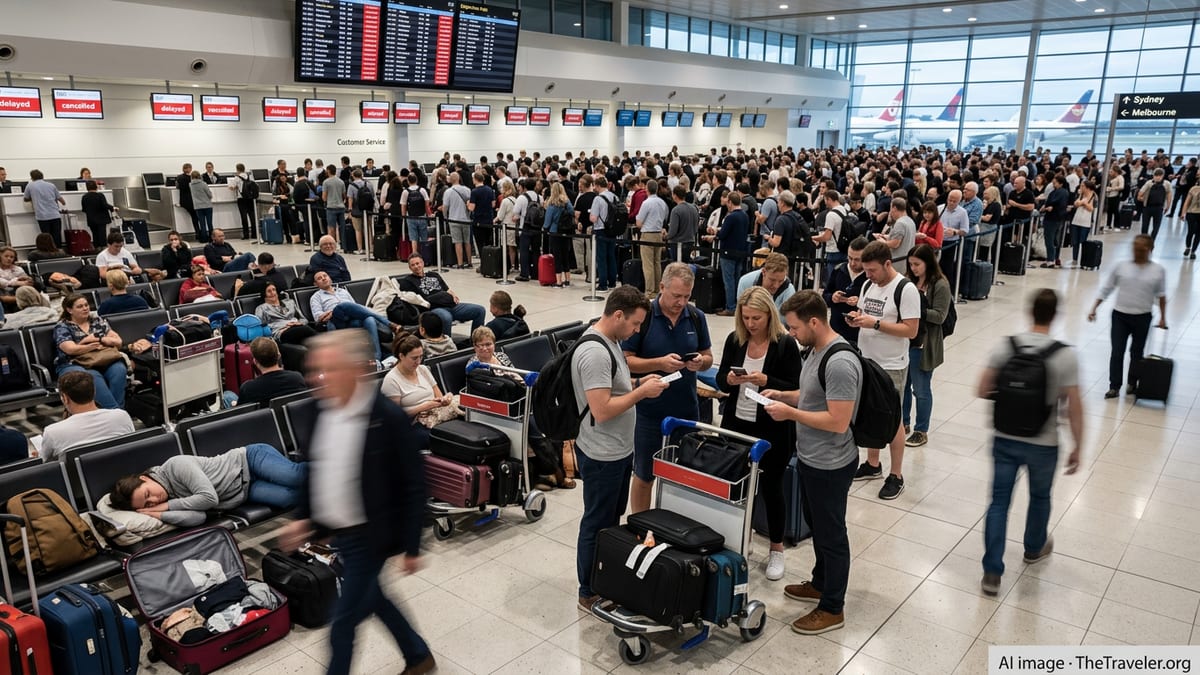
For passengers caught in the middle of the disruption, the operational challenges have translated into long queues, overnight waits on terminal floors and fraught attempts to secure scarce alternative seats. At Sydney Airport’s international terminal, families with young children were seen sprawled across the concourse on improvised bedding as they waited for rebooked flights to Dubai, London and US West Coast cities.
Check-in and customer service counters for Qantas, Emirates, Singapore Airlines and other major carriers reported surging volumes as travellers sought clarification on rapidly changing departure times. Many who had already completed part of their journey through affected hubs such as Abu Dhabi or Dubai arrived in Australia to find onward domestic connections cancelled or heavily delayed.
Consumer advocates warn that rebooking options are narrowing as disrupted passengers from Europe, the Middle East and Asia converge on the same limited pool of long-haul seats. Some travellers attempting to reach London or continental Europe from Brisbane and Perth have been told the first viable options may depart several days later, or require circuitous routings via multiple intermediate cities.
Hotel availability near major airports has also come under strain, with airlines struggling to secure enough rooms to accommodate involuntarily stranded passengers. Those who booked trips through online travel agencies or mixed-carrier itineraries have faced added complexity as responsibility for care, compensation and re-accommodation is passed between operators.
Operational Strain at Sydney, Melbourne, Brisbane and Perth
On the ground, airport operators have been forced to activate contingency plans originally designed for weather or technical outages, rather than a sustained, globally driven schedule shock. In Sydney and Melbourne, additional staff were rostered to manage crowd flow at security, immigration and transfer desks during peak disruption periods.
Brisbane and Perth, which handle a significant share of Australia’s long-haul services to Asia and Europe, have had to juggle irregular arrival waves that do not match traditional curfew and staffing patterns. Ground handlers reported challenges in positioning equipment and teams to meet late-running widebody aircraft that arrived outside normal banks.
The concentration of delayed departures into compressed time windows has led to congestion on taxiways and at departure gates. Air traffic controllers have had to carefully sequence pushbacks and takeoffs to maintain safe separation while accommodating airlines appealing for priority handling for severely delayed long-haul flights.
Despite the upheaval, all four major airports remained operational, with authorities emphasising that safety standards were not compromised. However, they acknowledged that service levels, from lounge access to baggage delivery times, had been impacted by the sheer volume of disrupted movements and stressed resources.
What Travellers Need to Know in the Days Ahead
Travel experts advise passengers flying to or from Australia over the coming week to prepare for continued uncertainty, particularly on itineraries involving London, the Gulf states or major European hubs. Even as cancellation rates at some Middle Eastern airports begin to decline, residual delays and aircraft repositioning are expected to echo through global networks.
Passengers are being urged to monitor their booking details closely, use airline apps for real-time updates and allow significantly more time at the airport, especially for early morning or late-night departures. Those with tight connections in Los Angeles, Dubai, Abu Dhabi or Singapore may want to explore options to build in longer layovers or request re-routing onto more resilient corridors.
Airlines including Qantas, United, Emirates and Singapore Airlines have broadened their rebooking and change-fee waivers on affected routes, but the exact terms vary between carriers and fare types. Travellers are encouraged to keep records of all disruption-related expenses and communications in case they are eligible for reimbursement or future travel credits.
With flight operations still finely balanced, airport and airline officials caution that conditions can change quickly as weather systems, further airspace restrictions or technical issues interact with already stretched schedules. For now, they say, patience and flexibility remain essential virtues for anyone attempting to move between Australia and the wider world.