

More news on this day
Austria has moved in step with Denmark, Sweden, Portugal, Romania, Germany, Poland and more than twenty other European countries as the European Union’s new biometric Entry/Exit System reshapes how non-EU travellers are processed at borders, replacing traditional passport stamps with tighter digital checks.
Get the latest news straight to your inbox!
A Europe-Wide Shift in How Borders Work
Publicly available information shows that Austria is now part of the broad European coalition deploying the Entry/Exit System, a shared database designed to record the movements of non-EU nationals at the external borders of the Schengen area. The move places Austria alongside Denmark, Sweden, Portugal, Romania, Germany, Poland and nearly all other Schengen and associated states that are progressively aligning passport control with biometric technology.
The new framework focuses on travellers from outside the EU, the European Economic Area and Switzerland who enter for short stays, typically up to 90 days within a 180-day period. Instead of relying on ink stamps to prove when a visitor arrived or departed, border guards now consult an electronic record that logs each crossing alongside biometric identifiers.
Reports indicate that this coordinated shift aims to make it harder for travellers to overstay, simplify checks for compliant visitors and give border officers a more complete picture of who is entering and leaving the bloc. For countries like Austria that are heavily connected to neighbouring states by rail and road, the changes are expected to be particularly visible at busy airport hubs and select land crossings where new hardware has been installed.
The reform reflects a broader European trend in which border management is increasingly handled by shared, interconnected systems. Austria’s participation underscores its role within the Schengen travel area and its commitment to the common standards being set across the continent.
What the New Biometric Checks Actually Do
The centrepiece of the reform is the Entry/Exit System, which records a traveller’s name, travel document details, nationality, the locations and times of border crossings, and biometric data such as fingerprints and facial images. According to published coverage and official technical descriptions, this data is gathered when a non-EU visitor first reaches an external Schengen border after the system’s activation.
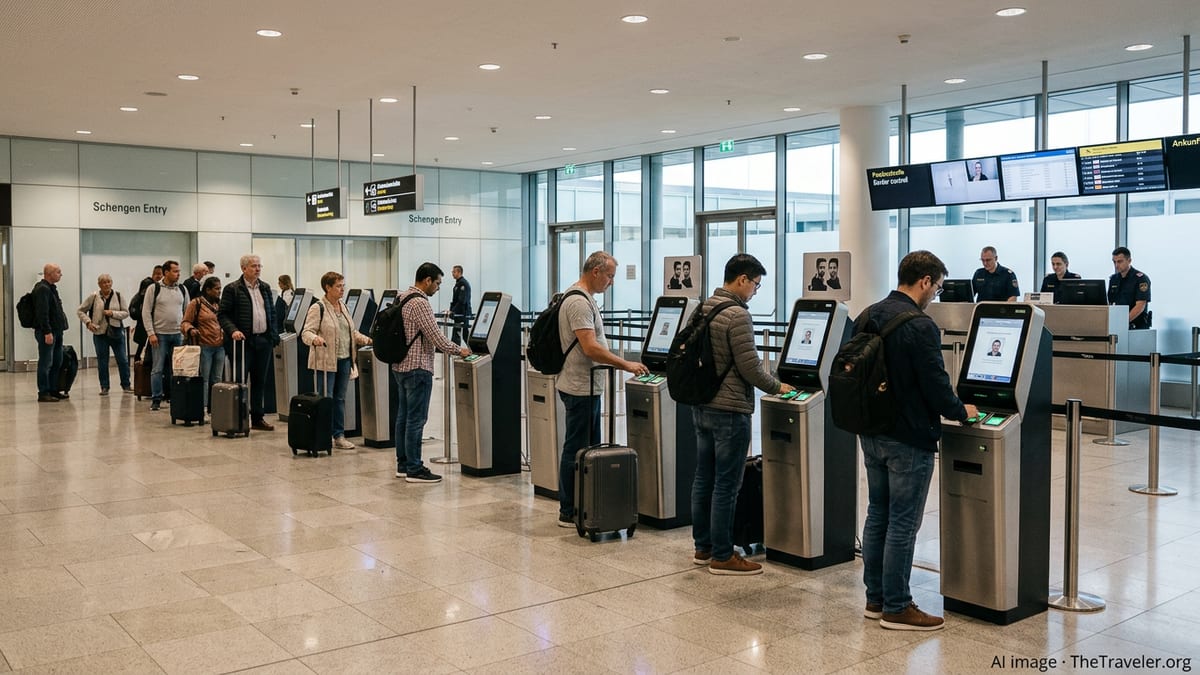
In practical terms, a traveller arriving in Vienna from a non-EU country may now be directed to automated kiosks or staffed counters equipped with cameras and fingerprint scanners. The traveller’s passport is scanned, their face is captured, and in many cases fingerprints are taken. The system then creates or updates a digital record that is visible to participating border authorities across the Schengen area.
Once enrolled, future crossings should become faster for the same traveller, as border officials can verify identity and remaining days of stay through the existing record. The Entry/Exit System is designed to calculate automatically whether someone has exceeded the 90 days within any 180-day rule, removing the need for guards to count stamps manually and reducing the risk of human error.
Austria’s adoption of the system mirrors rollouts already seen in countries such as Germany and Portugal, where new gates and kiosks have appeared at major airports. Coverage from technology providers and European agencies notes that similar deployments are under way or planned in Denmark, Sweden, Poland, Romania and many other participating states, contributing to a relatively uniform experience for travellers across the region.
Who Is Affected and Where the Changes Apply
The new checks primarily concern travellers who are not citizens of EU or Schengen countries and who do not hold long-term residence rights in the bloc. This includes visitors from the United States, United Kingdom, Canada and many Asian, African and Latin American nations who previously had their passports stamped on entry and exit but did not undergo systematic biometric registration every time.
Once a non-EU traveller enters Austria from outside the Schengen zone, their data is recorded at that first external border. Afterward, they can continue to move between Austria, Germany, Denmark, Sweden, Portugal, Poland, Romania and other Schengen participants without additional routine border stops, as internal Schengen travel remains free from standard checks. The biometric registration essentially replaces stamping only at the external perimeter, such as airports handling long-haul flights or land and sea crossings where people arrive from non-Schengen neighbours.
Travel industry guidance indicates that repeat visitors may notice the biggest impact on their first trip after the system’s activation, since initial registration can take longer than a traditional stamp-only inspection. Over time, as enrolment expands and more travellers have a profile in the system, authorities expect average processing times to decrease, particularly where automated lanes are in use.
The changes do not alter existing visa requirements. Instead, they modernise how border rules are enforced and monitored. Short-stay visas, where needed, continue to be issued through consulates and visa centres, but their use is now linked to digital records showing precisely when the traveller entered and left the territory.
Rollout Timelines, Technical Challenges and Growing Pains
Published information from European institutions and specialist migration consultancies indicates that the Entry/Exit System began operating in October 2025, with a progressive rollout over several months. Member states have been given a transition window to connect border posts, test equipment and move staff into new workflows before the system becomes fully entrenched at all external crossings.
Austria’s participation forms part of this staged approach. Large international airports and high-volume land borders are generally prioritised, while smaller checkpoints may follow later in the schedule. Throughout this period, some travellers may still encounter manual stamps or mixed procedures while authorities complete the shift to fully digital records.
Reports from across Europe describe a range of early challenges, from longer queues at peak hours to technical glitches as systems and databases are synchronised across multiple countries. Border posts in states such as Germany and Poland have had to balance the need for careful biometric capture with the realities of holiday rushes and busy commercial traffic.
Travel stakeholders are watching closely to see whether these issues persist once more people are enrolled in the system and frontline staff are fully accustomed to the new tools. For Austria, which handles a mix of tourism, business travel and regional transit, the coming months are expected to be a test of how efficiently the new checks can be integrated into everyday operations.
What Travellers to Austria Should Expect Next
For non-EU travellers planning trips to Austria through any of the participating countries, the key change is the likelihood of biometric registration at the first external Schengen border they cross. This could happen in Vienna, Munich, Copenhagen, Stockholm, Lisbon, Bucharest, Warsaw or another entry point, but once completed it will apply across the Schengen zone for the duration of their stay.
Travel experts and European travel coverage suggest that passengers should be prepared for possible extra time at passport control, especially during the early stages of the rollout or at airports introducing new kiosks. Removing hats, masks or other items that obstruct the face and having travel documents ready for scanning can help make the process smoother.
As the system matures and more countries, including Austria, expand self-service options, travellers may increasingly use automated gates that pair biometric checks with passport scans. These developments are intended to keep lines moving even as border controls become more data-driven and security-focused.
For now, the expansion of tougher biometric and passport checks across Austria, Denmark, Sweden, Portugal, Romania, Germany, Poland and two dozen other European destinations signals a lasting transformation in how the continent manages its borders. The familiar stamp in the passport is steadily giving way to a digital trail that follows every crossing, reshaping the practicalities of entering and leaving Europe’s passport-free travel area.