

More news on this day
Austria has issued red travel avalanche warnings for key Alpine regions, joining France and Switzerland in declaring the highest danger levels after a succession of powerful winter storms buried ski resorts, cut roads and rail lines, and triggered a surge of deadly avalanches across Europe’s mountain heartland.
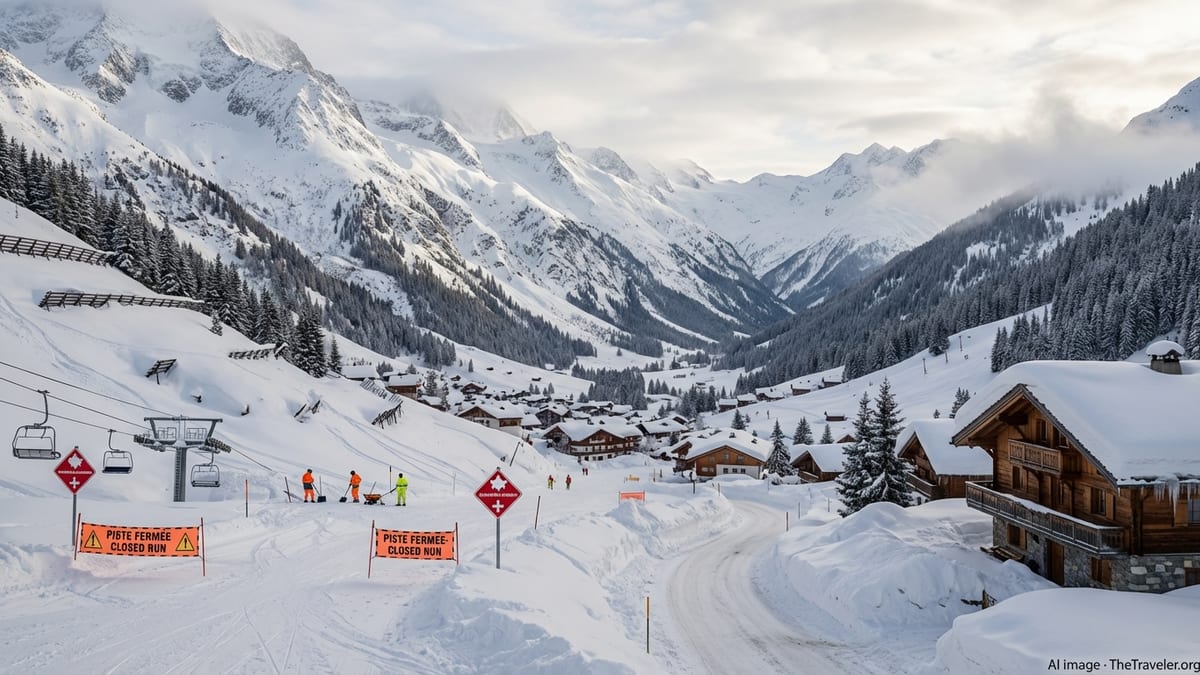
Alpine Nations Raise Top-Level Alerts After Deadly Storms
The coordinated escalation of warnings this week marks one of the most serious avalanche emergencies in the European Alps in recent decades. Meteorological and avalanche services in Austria, France and Switzerland report that the danger in many high-altitude zones has reached level 5 on the European avalanche scale, the maximum rating, with authorities urging residents and visitors to avoid all unsecured terrain.
In Switzerland, officials issued a rare very high alert for parts of Valais and the northern Alps after days of intense snowfall and storm-force winds triggered numerous spontaneous avalanches. Similar bulletins from French forecasters placed the Savoie department and sections of the broader Alpine arc under red avalanche alert, leading to the closure of entire ski areas and confinement orders in some resorts.
Austria’s avalanche services and civil protection authorities moved into alignment as fresh snow and violent gusts pounded the western federal states of Tyrol and Vorarlberg. As in neighboring countries, the red travel warning does not only target backcountry enthusiasts. It explicitly urges all travelers to reconsider nonessential journeys into high-risk valleys, warns of possible road and rail closures, and signals that some remote communities may face temporary isolation.
Officials emphasize that the alignment of national warning systems is intended to avoid mixed messages in an interconnected mountain region where visitors often cross borders in a single day. Tourists arriving for the crucial late February holiday period are being greeted by spectacular snow conditions, but also by some of the strictest safety advisories Europe’s Alpine countries have issued in years.
Austria’s High-Risk Zones: Tyrol, Vorarlberg and Salzburg Under Scrutiny
Within Austria, the focus of concern is firmly on the western and central Alps. Regional avalanche bulletins highlight particularly critical conditions in parts of Tyrol, including areas around St. Anton am Arlberg, the Ötztal and Zillertal valleys, and high basins above 1,800 meters. In neighboring Vorarlberg, steep north-facing slopes and narrow access corridors to ski villages are singled out as especially vulnerable to large, destructive slides.
Authorities there report that recent days have seen close to 200 recorded avalanches across the wider region, many of them spontaneous. A number of incidents have reached or crossed transport routes, burying mountain roads under several meters of snow and forcing temporary closures of avalanche galleries and tunnels. Local officials in some valleys have warned that further closures could be ordered with little notice if storm conditions persist.
Further east, sectors of Salzburg state are experiencing similar instability, particularly in the high Gastein and Lungau areas where strong winds have deposited thick slabs of snow above treeline. While not all of these districts are under continuous red alert, the national travel warning framework treats them as zones of heightened risk, urging visitors to follow local instructions and expect abrupt changes in operating schedules at ski lifts and on public transport.
The Austrian Foreign Ministry and tourism boards have updated guidance to emphasize that the red travel warning applies primarily to avalanche-prone mountain corridors and not to lowland cities or major transit hubs such as Innsbruck or Salzburg. Nonetheless, travelers connecting through these gateways en route to resort areas are advised to monitor updates closely and allow extra time for delays.
France and Switzerland Grapple With Exceptional Avalanche Danger
The crisis in Austria mirrors an unfolding emergency on the French and Swiss sides of the Alps, where the combination of heavy snow, wind and a fragile snowpack has produced what experts describe as an exceptional avalanche scenario. In France, forecaster Météo-France placed the Savoie department and several adjoining Alpine zones under red vigilance for avalanches following the passage of powerful winter storm systems.
French resorts in the Tarentaise and Maurienne valleys, including some of the country’s largest linked ski areas, have seen multiple days of full or partial lift closures. In several villages, including high-altitude stations popular with international visitors, local authorities have temporarily confined residents and guests to buildings overnight while mitigation teams carried out controlled releases and assessed the stability of surrounding slopes.
Across the border, Switzerland’s Institute for Snow and Avalanche Research has issued its own very high danger bulletins, singling out parts of Valais and the northern Alpine rim. Officials report that spontaneous avalanches of large to very large size are now possible, with some capable of reaching valley floors, impacting infrastructure, and blocking key corridors such as mountain passes and rail approaches to major resorts.
Swiss cantonal police in affected regions have responded by closing selected mountain roads, ordering evacuations in the most exposed hamlets, and restricting off-piste access even for experienced guides. Rail operators have warned of potential delays or suspensions on high-mountain lines if snow slides threaten tracks or overhead installations, a risk underscored by recent avalanche impacts on rolling stock in the wider Alpine region.
Layered Snowpack, Wind Slabs and a Volatile Weather Pattern
Behind the red travel and avalanche warnings lies a complex and highly unstable snowpack. Specialists across the three Alpine countries describe an underlying structure marked by weak layers formed during earlier cold, dry spells, now buried beneath dense new snow that arrived with successions of Atlantic and Mediterranean storm systems in January and February.
As storms swept in with milder air aloft and strong winds at ridge level, they deposited snow of varying density on top of these older fragile layers. The result is a classic setup for slab avalanches: thick, cohesive plates of wind-packed snow resting on top of faceted or crusted layers that can fail with minimal additional loading from fresh snowfall or the weight of a single skier.
In many sectors, the wind has further amplified the hazard by building deep drifts on leeward slopes and in gullies. Observers have documented widespread whumphing sounds and shooting cracks, early warning signs that the snowpack is under extreme tension. Avalanche control teams report that some of their test slopes are releasing larger slides than anticipated, indicating that the threshold for natural releases may already have been crossed in the most exposed terrain.
The broader meteorological pattern offers little immediate relief. Forecasts for the coming days point to continued unsettled weather, with further pulses of snow and intermittent rain at lower elevations. Fluctuating temperatures near the rain-snow line will add additional stress to the snowpack, as meltwater percolates through upper layers and increases the likelihood of wet-snow avalanches on sun-exposed aspects and at mid-mountain elevations.
Human Toll Mounts as Off-Piste Skiing Remains a Flashpoint
The severe conditions have already led to a growing number of accidents, with fatalities reported in several Alpine countries over recent days. In western Austria, multiple off-piste incidents involving skiers and snowboarders have resulted in deaths and serious injuries, including cases where groups were caught on steep terrain marked as high risk in local bulletins.
Rescuers in both France and Switzerland recount similar stories of skiers venturing beyond secured pistes despite public appeals to stay on groomed runs. In France, deadly avalanches in well-known resorts have underscored how little margin for error exists under a level 4 or 5 danger rating, even for experienced mountain users equipped with avalanche transceivers, shovels and probes.
Mountain rescue organizations emphasize that the current crisis is not limited to extreme freeride terrain. Snowshoers, ski tourers and even hikers on popular winter trails are vulnerable, particularly when routes traverse beneath steep slopes or cross avalanche runout zones. Several incidents in side valleys have involved individuals who were not seeking steep descents but were nonetheless exposed to overhead hazard from unstable slopes above.
Officials stress that while the red travel warnings are primarily aimed at protecting life, they also seek to reduce the strain on rescue services that are already stretched by the high volume of callouts. Helicopter teams and volunteer rescue groups are working in difficult flying and snow conditions, with some operations hampered by poor visibility and ongoing avalanche activity that threatens rescuers themselves.
Travel Disruption and Economic Jitters in Peak Holiday Season
The escalation to red warnings comes at a particularly sensitive time for Alpine tourism. Late February coincides with school holidays in several European countries, traditionally one of the busiest weeks of the winter season. Resorts across Austria, France and Switzerland have been expecting strong demand after a start to winter that was at times hampered by thin natural snow at lower elevations.
Instead, many operators now find themselves juggling safety closures, transport disruptions and guest concerns. Road authorities in Alpine regions report frequent convoy controls and temporary closures on access roads where avalanche risk is considered critical. In some valleys, heavy trucks have been banned from mountain passes, and cars are being turned back if not properly equipped with winter tires and chains.
Rail operators are deploying additional staff to monitor avalanche galleries and exposed sections of track. While most long-distance trains into Alpine hubs continue to run, connections to smaller high-mountain stations are under review on a day-by-day basis. Air travel has so far been less affected, but travelers are being warned that ground transfers from airports to resorts may take significantly longer than usual or be rerouted.
Local businesses face a delicate balancing act. Hotels and rental agencies stress that most major resorts remain open and that many slopes deemed safe by patrols are still operating. At the same time, tourism offices are pushing clear messaging that safety decisions will be prioritized over commercial considerations, and that guests should be prepared for last-minute changes to lift openings, ski school schedules and guided excursions.
How Authorities and Resorts Are Responding on the Ground
Across the Alps, authorities and resort operators are mobilizing a wide range of measures to manage the heightened risk. Avalanche control teams are conducting intensive blasting operations above critical roads, villages and lift corridors, using both on-the-ground charges and helicopter-borne explosives to preemptively release unstable slopes under controlled conditions where weather allows.
Ski patrols are reinforcing boundaries around closed terrain with additional rope lines, fencing and prominent multilingual signage. Patrol directors report that they are erring on the side of caution, extending closure zones well beyond traditional limits in areas where large, long-running avalanches are now deemed possible. Some resorts have also reconfigured their open piste networks to steer skiers away from the base of steep avalanche paths.
Municipalities are reviewing and, in some cases, activating pre-established emergency plans. These may include temporary evacuation of the most exposed neighborhoods, the opening of communal shelters, and coordination centers where police, fire services, medical teams and mountain rescue units share real-time information about evolving hazards.
Communication is a key pillar of the response. Local radio and television stations are broadcasting frequent updates, while resorts are pushing alerts via mobile apps, social media and digital signage at lift bases. National and regional authorities are urging visitors to rely on official avalanche bulletins and civil protection notices rather than informal advice or social media posts that may underestimate the risk.
Advice for Travelers Heading to the Alps in the Coming Days
For travelers with upcoming trips to Austria, France or Switzerland, officials are stopping short of calling for a blanket cancellation of holidays. Instead, they are emphasizing preparation, flexibility and strict adherence to safety guidance. Prospective visitors are advised to check national travel advisories, regional avalanche bulletins and resort-specific updates before departure and again shortly before entering mountain valleys.
Those who do travel are being encouraged to stay on open, patrolled pistes, to avoid any off-piste or backcountry excursions unless expressly authorized and guided by local professionals, and to respect closure signs and instructions from ski patrols and law enforcement. Drivers should ensure their vehicles are fully winter-ready, carry chains where required, and build extra time into itineraries to account for possible road checks or closures.
Travel insurers and tour operators are fielding increased inquiries about coverage in the event of weather-related disruption. Industry experts recommend that travelers review policy wording carefully, paying attention to provisions related to natural hazards, lift closures and alternative accommodation or transport arrangements if a resort or access road becomes temporarily inaccessible.
Above all, mountain safety agencies stress that this winter’s avalanche crisis highlights the need to treat level 4 and 5 warnings with the utmost seriousness. While the allure of deep fresh snow and dramatic Alpine scenery is understandably strong, the combination of a fragile snowpack, repeated storms and exceptional danger levels means that minimizing exposure to risk is the only responsible choice for the time being.