

More news on this day
Austrian Airlines is quietly reshaping its Asia network this month, adding short-notice capacity between Vienna and Bangkok to keep corporate and premium leisure travelers moving as Middle East tensions close key air corridors just weeks before Thailand’s Songkran holiday peak.
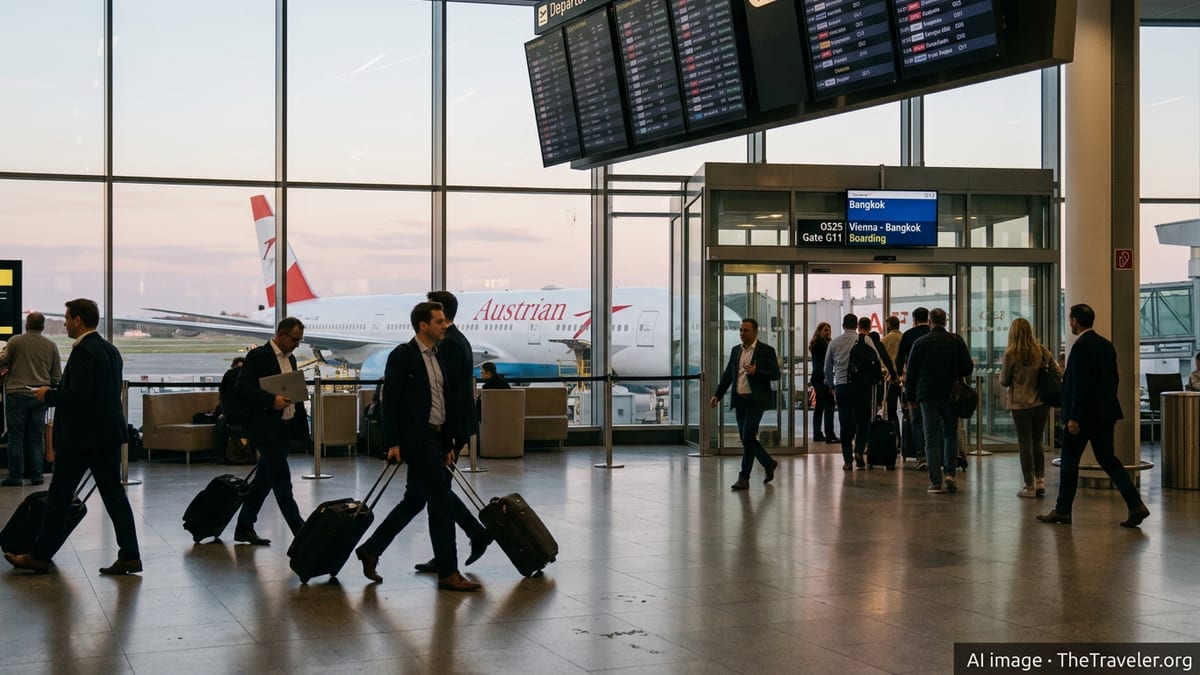
Extra Vienna–Bangkok Rotations Added for Late March
Austrian Airlines has increased frequencies on its Vienna–Bangkok route in the second half of March 2026, inserting additional rotations on top of its previously published schedule. According to the Lufthansa Group’s latest capacity update, the move is intended to absorb demand from passengers who would normally travel via Gulf hubs that are now constrained by airspace closures and suspended services.
The extra flights will operate in the run-up to Thailand’s Songkran festival, officially observed from 13 to 15 April, when both corporate and leisure traffic between Europe and Bangkok traditionally surges. With booking patterns already strong before the latest security crisis, Austrian has opted to bring more widebody capacity into the market rather than risk losing customers to rail or competing hubs.
While exact flight numbers and days of operation are being managed dynamically, corporate travel managers report that new inventory is appearing in global distribution systems at short notice. Travel buyers say this flexibility is critical as they try to reroute employees who can no longer safely or reliably transit via the Middle East.
The carrier continues to operate Bangkok as a nonstop service from Vienna, avoiding the need for a technical stop in the Gulf region. Schedules have been adjusted to reflect longer routings around restricted airspace, but Austrian is prioritizing overnight timings and convenient connections for onward travel across Europe and North America.
Middle East Closures Force Reroutes Across Europe–Asia Corridor
The decision comes as a cascade of airspace restrictions across the Middle East has upended the usual flows of long-haul traffic between Europe and Asia. Conflict-related closures in Iranian, Iraqi and several Gulf-country airspaces in late February forced thousands of flights to be cancelled, diverted or rerouted, with hub carriers in Dubai, Doha and Abu Dhabi particularly affected.
Vienna International Airport has been among the European hubs hardest hit, as Austrian Airlines temporarily halted its own Middle East network, including Tel Aviv, Amman, Erbil and key Gulf destinations, in response to government travel warnings and heightened security assessments. Risk advisers note that Austria’s Level 4 “Do Not Travel” advisories for multiple countries in the region have also complicated corporate duty-of-care and insurance coverage.
With many passengers reluctant or unable to fly through the region, pressure has increased on European point-to-point routes into major Asian gateways. Airlines able to offer nonstop or northernly routed services to Bangkok, Singapore and East Asia are seeing strong demand from both rerouted travelers and those booking new trips away from the Middle East.
Thai authorities have confirmed that Thailand itself remains open and operational. Airports of Thailand reports that Bangkok’s Suvarnabhumi Airport has absorbed hundreds of disrupted flights since 28 February, but has kept terminals and runways fully functional by adding staff, opening overflow waiting areas and expediting immigration.
Corporate Travel Priorities: Safety, Continuity and Policy Compliance
The timing of Austrian’s Bangkok capacity increase is particularly significant for corporate customers. Many multinational companies use Thailand as a regional base in Southeast Asia, with executives and technical teams flying in from Europe for meetings, project work and factory visits before and after the Songkran holiday period.
With multiple Middle Eastern countries now subject to high-level travel advisories, corporate travel managers are under pressure to keep employees away from affected hubs while still honoring contractual obligations and project timelines. Direct or northernly routed services like Austrian’s Vienna–Bangkok flights are emerging as preferred options, even when journey times are slightly longer due to detours around closed airspace.
Travel management companies in Austria and Germany report that clients are revising their approved-carrier lists and preferred routings in real time. Some firms have temporarily restricted the use of Gulf-based airlines for duty travel, while others are asking staff already in Asia to consolidate trips through stable hubs such as Bangkok, Singapore or Kuala Lumpur.
In this environment, Austrian’s decision to shore up capacity on a single, high-demand Asia route is viewed as both a commercial and a risk-management play. By offering more seats on its own metal, the airline can keep premium customers within the Lufthansa Group ecosystem while reassuring corporate clients that journeys will remain compliant with internal security policies.
Songkran Demand Underpins Thailand’s Recovery Hopes
Thailand’s travel industry is looking to Songkran 2026 as a key milestone in the country’s post-pandemic and post-crisis recovery. Tourism officials and hotel operators expect a sharp rise in arrivals from Europe in late March and early April, despite the turbulence in regional airspace, and are closely watching airline schedules for signs of confidence.
Recent disruptions have certainly been felt. Local media and aviation data providers estimate that more than 300 flights to and from Thailand were affected between 28 February and 4 March as carriers adjusted to Middle East closures, with Bangkok handling the majority of impacted operations. Yet industry leaders stress that demand remains solid and that travelers are proving willing to accept longer routings as long as safety assurances are robust.
The additional Austrian Airlines flights to Bangkok are therefore being interpreted in Thailand as a positive signal that European demand will hold into April. Hoteliers in Bangkok and popular beach destinations such as Phuket and Pattaya say forward bookings from German-speaking markets remain healthy, supported by strong pent-up demand for long-haul holidays timed around the Songkran water festivities.
For business travelers, Songkran’s fixed dates are equally important. Many companies schedule regional conferences, supplier visits and plant maintenance either side of the April holiday, creating a short but intense window of corporate travel. Extra nonstop capacity from Europe into Bangkok should help stabilize fares on key dates and reduce the risk of last-minute seat shortages.
What Travelers Should Expect in the Weeks Ahead
Despite the extra flights, passengers heading to Bangkok from Europe should prepare for a more complex travel environment than usual. Rerouted paths around restricted airspace can add flight time, and congestion at alternative waypoints may lead to tighter turnarounds and a greater risk of knock-on delays.
Travel experts advise booking as early as possible for late March and early April, particularly for premium cabins, which are heavily used by corporate travelers seeking to maximize rest on overnight sectors. Flexible tickets and clear communication with travel managers are also being strongly recommended, given that schedules remain subject to short-notice adjustments as the security situation evolves.
Airports and airlines across the region are emphasizing that safety remains the overriding priority. Both Austrian Airlines and Thai authorities state that route planning is being coordinated with national aviation regulators and international safety agencies, with constant monitoring of conflict-zone advisories and navigation risks such as GPS interference.
For now, the additional Vienna–Bangkok services provide a rare piece of good news in a fraught season for global aviation. If the Middle East crisis persists into April, Austrian’s tactical capacity shift could become a template for other European carriers seeking to protect Asia-bound corporate traffic and sustain traveler confidence during one of Thailand’s most important holiday periods.