

More news on this day
Austrian Airlines has rushed to evacuate a stranded crew out of Dubai via Muscat as missile and drone strikes, airport damage and sweeping airspace closures plunge the Middle East into one of the most serious aviation crises in recent decades, severing a critical bridge between Europe, Asia and Africa.
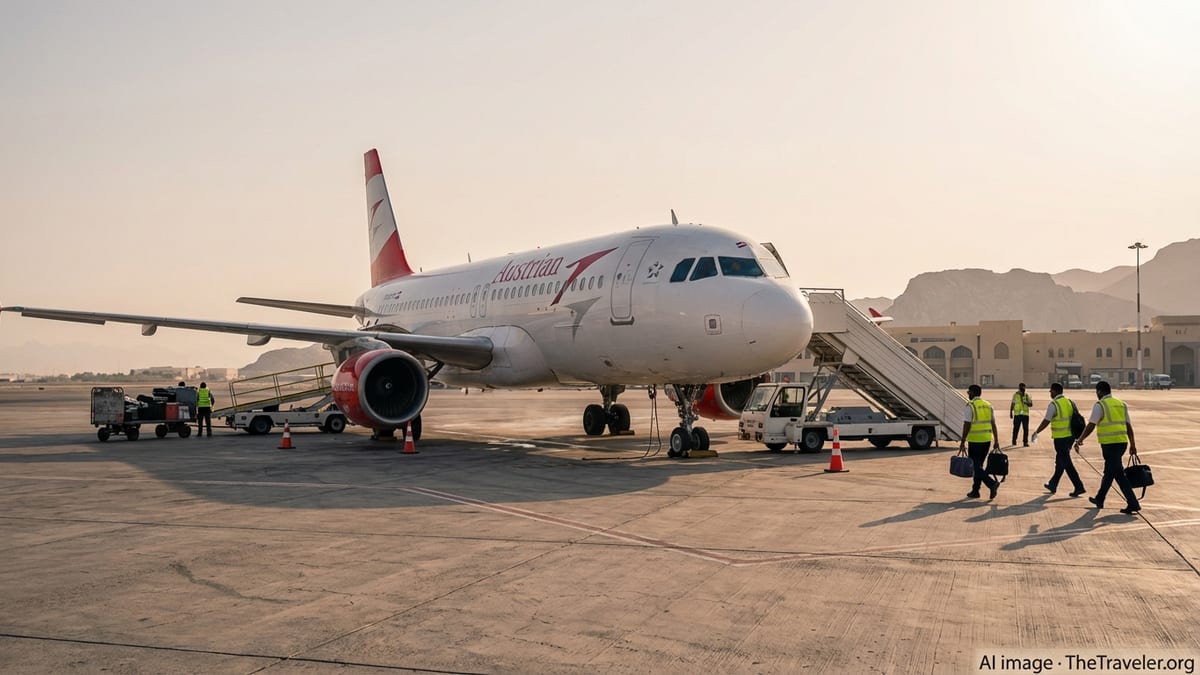
Emergency Extraction via Muscat as Dubai Shuts Down
With Dubai International Airport closed after being hit in Iranian retaliatory strikes and the wider United Arab Emirates airspace effectively off limits, Austrian Airlines moved quickly over the weekend to reposition and rescue a flight crew that had been trapped in the emirate. According to operational briefings shared with industry partners, the carrier dispatched a special rotation to Muscat in neighboring Oman, arranging for the crew to be ferried overland and by short charter from Dubai to meet the aircraft.
The tactical move allowed Austrian to get personnel back to Europe without entering Emirati or other newly restricted airspace across the Gulf and Levant. It unfolded as hundreds of other airline crews and tens of thousands of passengers remained stranded at shuttered hubs in Dubai, Abu Dhabi and Doha, where terminals were damaged and commercial flying largely halted following a joint United States and Israeli strike on Iran and subsequent missile barrages.
For Austrian, the priority was not only the welfare of its employees but also the preservation of future operational flexibility. By extracting the crew to Muscat, the airline avoided having key personnel tied down indefinitely in a city under both physical attack and strict movement curbs, at a time when the company is recalibrating its entire Middle East network.
Oman’s capital, which remains outside the immediate line of fire, has once again emerged as a vital safety valve for airlines seeking to park aircraft, swap crews and re-establish at least partial connectivity around a closed and increasingly militarized Gulf airspace.
Network Suspensions and a Rapidly Shifting Safety Map
The emergency crew evacuation comes as Austrian Airlines extends and deepens a wave of route suspensions across the region. The carrier has now halted services to Tel Aviv, Amman and Erbil until at least early March, and its Vienna–Dubai flights are canceled for several days as airspace closures over Israel, Lebanon, Jordan, Iraq, Iran, Kuwait and Bahrain are prolonged.
Those decisions track with broader moves by the Lufthansa Group and other European majors, which have effectively drawn a red line around critical portions of Middle Eastern airspace. Airlines are relying on a steady stream of safety notices and intelligence feeds to determine whether they can safely overfly or serve countries whose skies are suddenly subject to ballistic missile trajectories, drone activity and heightened military patrols.
In practical terms, that has turned what was once a dense web of overflight corridors into a patchwork of no-go zones, costly detours and last-minute cancellations. Routes that typically stitched together Europe with India, Southeast Asia and parts of Africa via the Gulf must now be replotted along longer arcs through the eastern Mediterranean, the Caucasus or the Red Sea, if they operate at all.
For Austrian, whose long-haul footprint is smaller than that of Gulf mega-carriers but still heavily reliant on smooth eastbound connections, any prolonged closure of Dubai and neighboring hubs magnifies schedule instability. Aircraft and crews are falling out of position, contingency fuel stops are adding hours and cost, and planners in Vienna face a daily puzzle in matching capacity to suddenly volatile demand.
Stranded Travelers and the Human Cost of Airspace Warfare
The crew airlift via Muscat underscores a wider, human-scale drama playing out across the region’s airports and hotels. As Dubai, Abu Dhabi and Doha closed, hundreds of thousands of passengers found themselves marooned in transit, their itineraries shattered by more than 3,000 combined cancellations and diversions recorded over just a couple of days.
Many travelers booked on Austrian and other European carriers bound for Middle Eastern cities awoke to messages notifying them that their flights were scrubbed, indefinitely delayed or rerouted far from original destinations. Those already en route were diverted to secondary airports across the Balkans, Cyprus and North Africa, where makeshift arrangements had to be made for overnight stays and onward passage.
The intense strain on call centers and digital channels left passengers struggling to reach airlines for rebooking, while hotel lobbies in regional capitals turned into impromptu holding areas for guests awaiting evacuation plans from consulates and corporate travel desks. In Dubai and Abu Dhabi, hotel basements doubled as shelters when drone alerts sounded, compounding the anxiety of people who had arrived only hours earlier expecting a routine layover.
For cabin crew and pilots, the stress is equally acute. Extended layovers in what has abruptly become an active conflict zone carry obvious safety concerns, but they also raise complex questions over duty times, rest requirements and insurance liability. Austrian’s decision to pull its stranded crew out via Muscat is an early example of how airlines are quietly prioritizing staff extraction alongside passenger welfare and fleet protection.
Global Repercussions for Hub-and-Spoke Travel
The turmoil engulfing Dubai and its Gulf peers reverberates far beyond the Middle East. For more than a decade, these hubs have functioned as the central hinge of global aviation, channelling millions of travelers each year between Europe and Asia under a hub-and-spoke model that relies on predictable airspace access and ultra-efficient aircraft utilization.
With that hinge suddenly seized up, airlines worldwide are scrambling to redesign networks on the fly. Long-haul services that once relied on one-stop links via Dubai or Doha are being replaced, where possible, by nonstop flights that leapfrog the region altogether. Others are being re-routed with additional stops in southern Europe, the Caucasus or Central Asia, increasing travel times and eroding the convenience that made Gulf hubs so attractive in the first place.
The immediate impact is visible in mounting delays, missed connections and higher operating costs. Longer routings typically require more fuel, which in turn can force payload restrictions on heavily booked services. Aircraft that would have operated two or three profitable sectors in a day may now complete only one extended rotation. For passengers, that translates into scarcer seats, higher fares and a renewed premium on flexibility when booking complex itineraries.
In strategic terms, the crisis may accelerate a nascent shift toward more point-to-point flying, especially by European and Asian carriers that have invested in ultra-long-range aircraft designed to bypass traditional hubs. Yet even those jets must eventually traverse contested airspace somewhere, underscoring how profoundly vulnerable international aviation remains to geopolitical shocks centered on key chokepoints.
What Comes Next for Austrian Airlines and Regional Connectivity
As of early March, Austrian Airlines is treating its crew evacuation via Muscat as both a one-off emergency measure and a template for further action if the conflict widens or drags on. Operations teams are examining alternative crew-basing strategies, potential wet-lease arrangements and more robust contingency plans that would allow the carrier to restart limited services quickly if specific corridors reopen, without committing staff to overnight stays in high-risk cities.
Industry analysts note that governments are simultaneously preparing large-scale evacuation frameworks for their citizens in the Gulf, including from the United Arab Emirates, and that airlines like Austrian will almost certainly be asked to participate in organized repatriation efforts if commercial flying remains curtailed. Such missions would resemble the ad hoc “air bridges” seen during previous crises, with carefully coordinated corridors, military escorts in some cases and strict limitations on who and what can be carried.
For Vienna as a European gateway, the next few weeks will be critical. Austrian’s home hub is contending with the ripple effects of grounded aircraft, disrupted crew rotations and anxious travelers rethinking trips that traverse contested skies. Travel advisories are shifting almost daily, leaving both leisure and corporate customers hesitant to commit to itineraries touching the broader Middle East.
What is already clear, however, is that the scramble to move a single crew out of Dubai is emblematic of a deeper structural shock to global aviation. As the conflict reshapes the map of where and how airlines can safely fly, carriers like Austrian face an uncomfortable reality: their ability to connect continents now depends less on fleet size or commercial strategy than on the fragility of political calculations far above the clouds.