

More news on this day
Austrian Airlines has suspended all flights to Dubai and Abu Dhabi until March 28, intensifying an already severe aviation disruption across the Gulf as airspace closures and missile threats ripple through the region’s key hubs and leave business travelers scrambling for alternatives.
Get the latest news straight to your inbox!
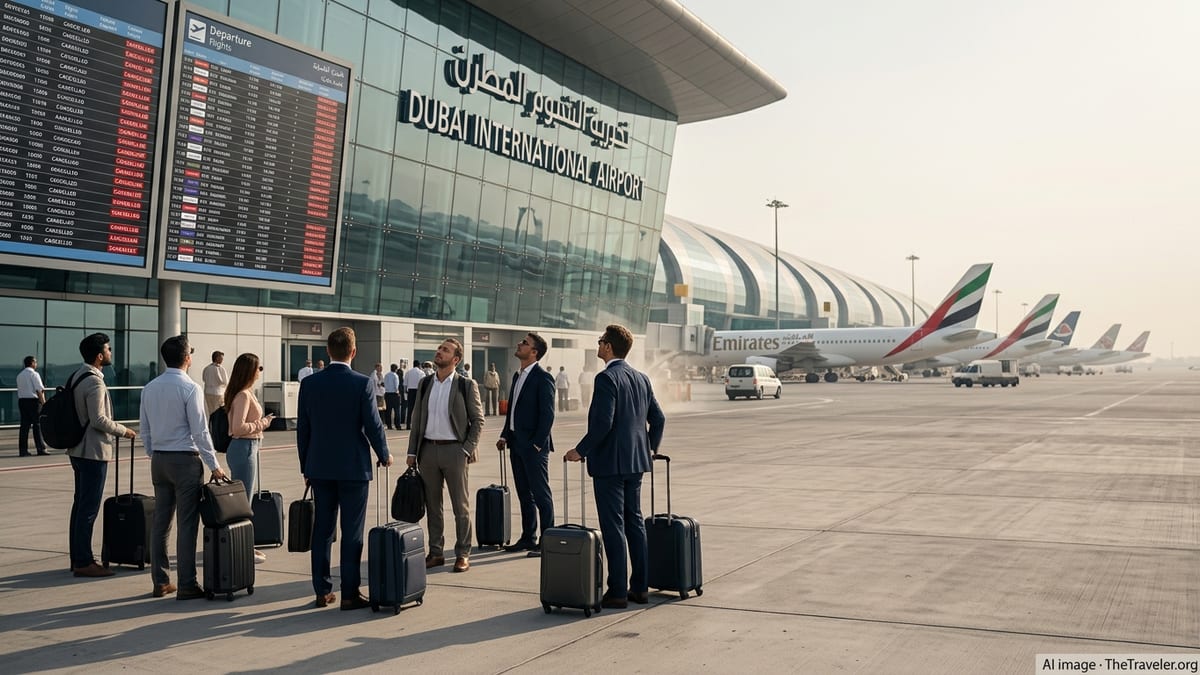
Europe–Gulf Links Severed Amid Expanding Airspace Disruptions
The temporary halt by Austrian Airlines affects its services from Vienna to both Dubai and Abu Dhabi, routes that are widely used by corporate travelers connecting between Europe, Asia, and Africa. According to recent European press reports, the carrier’s parent group has paused services to the United Arab Emirates through March 28, aligning with similar suspensions to Tehran as operators navigate evolving risk assessments.
This decision comes against the backdrop of a broader aviation crisis triggered by Iranian missile and drone attacks across the Gulf, which prompted the United Arab Emirates and several neighboring states to partially close their airspace. Publicly available information indicates that Dubai International and Abu Dhabi’s Zayed International have faced repeated operational interruptions since late February, with authorities periodically halting arrivals and departures after strikes or interception debris near airport facilities.
As a result, a growing list of international airlines have curtailed operations to the region’s largest transit hubs. Recent coverage from European and Gulf outlets shows that carriers across the Lufthansa Group, including Eurowings, Swiss, Brussels Airlines, and Austrian, have implemented suspensions or heavy schedule reductions to Dubai and Abu Dhabi, significantly thinning the usual dense web of east–west connections.
While the United Arab Emirates has begun to restore some air traffic following brief airspace reopenings, the uneven pattern of closures and limited “relief” flights has left commercial schedules volatile. Business travelers accustomed to same-day connections and high-frequency service between Europe and the Gulf now face uncertainty, rolling cancellations, and extended detours.
Regional Airspace Closures Reconfigure Middle East Transit Hubs
The suspension by Austrian Airlines underscores how the United Arab Emirates has effectively joined other key regional states in a cascading airspace crisis. Iran, Qatar, Turkey, and parts of the Gulf have all experienced significant restrictions or closures since late February, according to open-source aviation and security briefings that track flight paths and notices to airmen.
Qatar’s Hamad International Airport has seen major disruptions following Iranian strikes and a temporary closure of Qatari airspace, sharply reducing Doha’s capacity to function as a stable long-haul hub. In parallel, Iranian airspace has become heavily constrained by ongoing military activity, while airlines have grown more reluctant to route over parts of Iraq and neighboring areas because of heightened perceived risk.
Turkey, which normally offers a crucial bridge between Europe and Asia, has also been affected as carriers adjust routings around sensitive corridors and reassess overflight options. According to regional aviation summaries, rerouted traffic has put additional strain on already busy corridors and extended flight times, increasing fuel costs and scheduling complexity for airlines operating across the wider Middle East.
These overlapping restrictions have sharply curtailed the role of Gulf megahubs such as Dubai, Abu Dhabi, and Doha, which typically serve as pivotal waypoints between Europe, Asia Pacific, and Africa. For now, publicly available analysis suggests that some airlines are relying more heavily on alternative routings via Saudi Arabia and other states where airspace remains more consistently open, although even these corridors are experiencing congestion and frequent last-minute adjustments.
Business Travelers Face Cancellations, Detours, and Rising Costs
For corporate travelers, the grounding of Austrian Airlines flights to the United Arab Emirates until March 28 is more than a timetable inconvenience. Vienna–Dubai and Vienna–Abu Dhabi links are critical for multinational firms with regional headquarters, energy and logistics interests, and financial operations spread across the Gulf and South Asia.
Reports from passenger forums and regional newspapers describe travelers stranded at European and Gulf airports as cancellations cascade across multiple carriers. Some travelers have been rebooked via indirect routings that add many hours of flying and transit time, while others have struggled to secure alternative seats at short notice as demand concentrates on the few remaining services.
Travel management companies tracking the situation indicate that short-notice corporate itineraries have become particularly difficult to arrange, with premium cabins on remaining routes selling out quickly and economy fares climbing sharply. Meeting schedules, site visits, and deal-making trips in sectors such as energy, construction, and finance are all being rescheduled, shifted online, or postponed entirely when rerouting proves too complex or costly.
Travel insurers and corporate risk managers are also reassessing coverage, with some policies treating airspace closures and conflict-related disruptions differently from standard operational delays. Business travelers are being advised, through public advisories and company memos, to allow greater flexibility in their plans, maintain close contact with booking channels, and factor in the possibility of abrupt schedule changes even after check-in.
Airlines Balance Safety, Liability, and Network Strategy
The Austrian Airlines suspension highlights the delicate balance carriers must strike between safety obligations, commercial considerations, and regulatory requirements when operating in or near conflict-affected airspace. Published aviation security briefings note that many airlines have adopted a conservative posture, choosing to avoid certain corridors entirely rather than rely solely on national airspace reopenings or limited-time exemptions.
For network planners, the Gulf disruptions pose a significant challenge. Dubai and Abu Dhabi serve not only as destinations but as critical transfer points that underpin the economics of long-haul flying. Suspending flights can sever onward connectivity for passengers traveling between Europe and cities in Asia, Africa, and Oceania, undermining the profitability of multiple routes beyond the immediate Gulf destinations.
At the same time, operating into an airport that is subject to intermittent closures, missile alerts, or sudden shifts in airspace access carries operational and reputational risks. According to industry commentary, airlines are weighing the risk of crews and passengers being forced into extended ground holds or diversions against the revenue benefits of continuing service, often opting to retain only a minimal number of “relief” or repositioning flights until the situation stabilizes.
Analysts expect that if airspace conditions improve and closures are lifted in a sustained way, carriers like Austrian may gradually restore limited frequencies before fully rebuilding pre-crisis schedules. The pace of that recovery will depend not only on the regional security situation but also on traveler confidence and corporate demand, both of which can be slow to rebound after high-profile disruptions.
Longer-Term Implications for Gulf Aviation and Global Connectivity
Beyond the immediate wave of cancellations, the crisis is prompting a broader reassessment of how reliant global aviation has become on a handful of Gulf hubs. Industry observers note that the current disruptions expose vulnerabilities in a system where a large share of Europe–Asia and Europe–Africa traffic connects through a narrow geographic corridor highly exposed to geopolitical shocks.
In the short term, airlines are experimenting with alternative routings via southern or northern corridors, including more connections through cities in Saudi Arabia and, where feasible, through European or Central Asian hubs that can bypass the most volatile zones. However, these alternatives often entail longer flight times and higher operating costs, which could feed through to higher fares or reduced service frequency if the situation persists.
For the United Arab Emirates, the temporary loss of Austrian Airlines and other international services carries symbolic and economic weight. Dubai and Abu Dhabi’s growth as global aviation centers has been central to their broader development strategies, supporting tourism, trade, and high-value business travel. A prolonged perception of instability in regional skies could encourage some travelers and companies to diversify their routing preferences or base locations over the longer term.
For now, the suspension of Austrian’s UAE flights until March 28 stands as a visible marker of an unprecedented aviation disruption spanning the Gulf, Iran, and neighboring states. With airspace restrictions and security risks still in flux, business travelers and airlines alike are navigating an environment where flexibility, contingency planning, and rapid adaptation have become essential parts of any journey through the region.